Winzer Brooke M, Paratz Jennifer D, Whitehead Jonathan P, Whiteman David C, Reeves Marina M
Burns, Trauma and Critical Care Research Centre, School of Medicine, The University of Queensland, Brisbane, Australia.
Metabolic Medicine Group, Mater Research Institute University of Queensland, Brisbane, Australia.
PLoS One. 2015 Feb 23;10(2):e0117922. doi: 10.1371/journal.pone.0117922. eCollection 2015.
To investigate the feasibility and safety of a 24-week exercise intervention, compared to control, in males with Barrett's oesophagus, and to estimate the effect of the intervention, compared to control, on risk factors associated with oesophageal adenocarcinoma development.
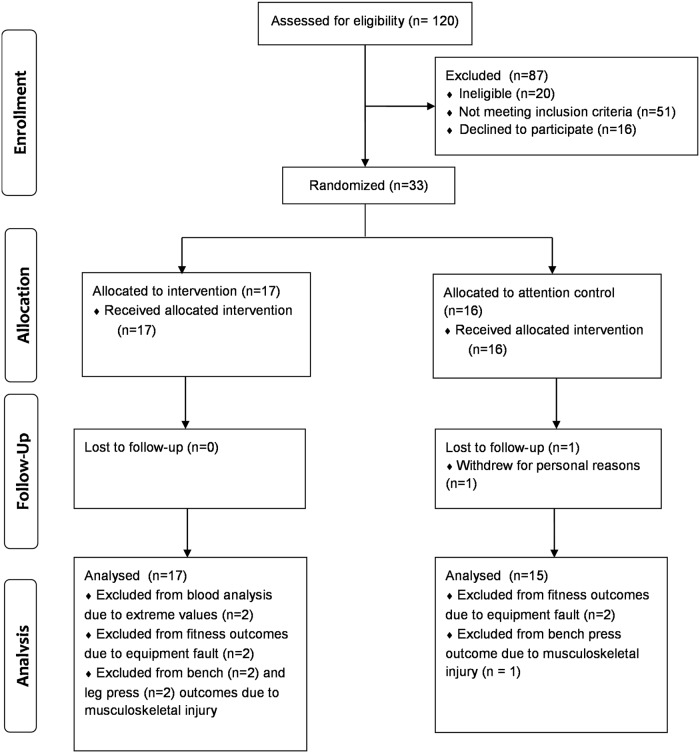
A randomized controlled trial of an exercise intervention (60 minutes moderate-intensity aerobic and resistance exercise five days/week over 24 weeks; one supervised and four unsupervised sessions) versus attention control (45 minutes stretching five days/week over 24 weeks; one supervised and four unsupervised sessions) in inactive, overweight/obese (25.0-34.9 kg/m2) males with Barrett's oesophagus, aged 18-70 years. Primary outcomes were obesity-associated hormones relevant to oesophageal adenocarcinoma risk (circulating concentrations of leptin, adiponectin, interleukin-6, tumour necrosis factor-alpha, C-reactive protein, and insulin resistance [HOMA]). Secondary outcomes included waist circumference, body composition, fitness, strength and gastro-oesophageal reflux symptoms. Outcomes were measured at baseline and 24-weeks. Intervention effects were analysed using generalised linear models, adjusting for baseline value.
Recruitment was difficult in this population with a total of 33 participants recruited (target sample size: n = 80); 97% retention at 24-weeks. Adherence to the exercise protocol was moderate. No serious adverse events were reported. A statistically significant intervention effect (exercise minus control) was observed for waist circumference (-4.5 [95% CI -7.5, -1.4] cm; p < 0.01). Effects on primary outcomes were not statistically significant.
This small, exploratory trial provides important information to inform future trial development including recruitment rates and estimates of effect sizes on outcomes related to oesophageal adenocarcinoma risk. Future trials should investigate a combined dietary and exercise intervention to achieve greater weight loss in this population and relax inclusion criteria to maximize recruitment.
Australian New Zealand Clinical Trials Registry (ANZCTR) ACTRN12609000401257.
与对照组相比,研究一项为期24周的运动干预对患有巴雷特食管的男性的可行性和安全性,并评估与对照组相比,该干预对与食管腺癌发生相关的危险因素的影响。
一项随机对照试验,将运动干预(每周五天,每次60分钟中等强度有氧运动和抗阻运动,持续24周;一次有监督和四次无监督课程)与注意力控制组(每周五天,每次45分钟伸展运动,持续24周;一次有监督和四次无监督课程)进行比较,纳入对象为年龄在18 - 70岁、不活跃、超重/肥胖(25.0 - 34.9 kg/m²)且患有巴雷特食管的男性。主要结局指标是与食管腺癌风险相关的肥胖相关激素(瘦素、脂联素、白细胞介素 - 6、肿瘤坏死因子 - α、C反应蛋白的循环浓度以及胰岛素抵抗[HOMA])。次要结局指标包括腰围、身体成分、体能、力量和胃食管反流症状。在基线和24周时测量结局指标。使用广义线性模型分析干预效果,并对基线值进行调整。
该人群招募困难,共招募了33名参与者(目标样本量:n = 80);24周时保留率为97%。对运动方案的依从性为中等。未报告严重不良事件。观察到腰围有统计学显著的干预效果(运动组减去对照组为 - 4.5 [95% CI - 7.5, - 1.4] cm;p < 0.01)。对主要结局指标的影响无统计学显著性。
这项小型探索性试验提供了重要信息,为未来试验的开展提供参考,包括招募率以及对与食管腺癌风险相关结局的效应大小估计。未来试验应研究饮食和运动联合干预,以在该人群中实现更大程度的体重减轻,并放宽纳入标准以最大限度地增加招募人数。
澳大利亚新西兰临床试验注册中心(ANZCTR)ACTRN12609000401257。