Mukherjee Manali, Sehmi Roma, Nair Parameswaran
St Joseph's Healthcare & Department of Medicine, Firestone Institute for Respiratory Health, McMaster University, 50 Charlton Avenue East, Hamilton, Ontario L8N 4A6 Canada.
World Allergy Organ J. 2014 Dec 4;7(1):32. doi: 10.1186/1939-4551-7-32. eCollection 2014.
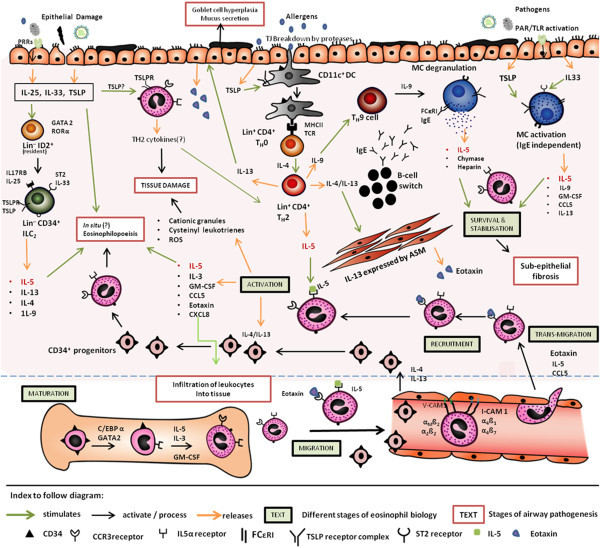
Airway inflammation is considered to be the primary component contributing to the heterogeneity and severity of airway disorders. Therapeutic efficacies of diverse novel biologics targeting the inflammatory pathways are under investigation. One such target is IL-5, a type-1 cytokine that is central to the initiation and sustenance of eosinophilic airway inflammation. Over the past decade, anti-IL5 molecules have been documented to have mixed therapeutic benefits in asthmatics. Post hoc analyses of the trials reiterate the importance of identifying the IL-5-responsive patient endotypes. In fact, the currently available anti-IL5 treatments are being considered beyond asthma management; especially in clinical complications with an underlying eosinophilic pathobiology such as hypereosinophilic syndrome (HES) and eosinophilic granulomatosis and polyangitis (EGPA). In addition, closer analyses of the available data indicate alternative mechanisms of tissue eosinophilia that remain uncurbed with the current dosage and delivery platform of the anti-IL5 molecules.
气道炎症被认为是导致气道疾病异质性和严重性的主要因素。针对炎症途径的多种新型生物制剂的治疗效果正在研究中。其中一个靶点是白细胞介素-5(IL-5),这是一种1型细胞因子,对嗜酸性粒细胞气道炎症的起始和维持至关重要。在过去十年中,抗IL-5分子已被证明对哮喘患者有不同的治疗效果。试验的事后分析重申了识别IL-5反应性患者内型的重要性。事实上,目前可用的抗IL-5治疗方法正被考虑用于哮喘管理之外;特别是在伴有潜在嗜酸性粒细胞病理生物学的临床并发症中,如高嗜酸性粒细胞综合征(HES)和嗜酸性肉芽肿性多血管炎(EGPA)。此外,对现有数据的进一步分析表明,组织嗜酸性粒细胞增多的替代机制在目前抗IL-5分子的剂量和给药平台下仍未得到控制。