Catalano Michael J, Liu Shuo, Andersen Nisana, Yang Zhiyu, Johnson Kevin M, Price Nathan E, Wang Yinsheng, Gates Kent S
‡Environmental Toxicology Graduate Program and Department of Chemistry, University of California-Riverside, Riverside, California 92521-0403, United States.
J Am Chem Soc. 2015 Mar 25;137(11):3933-45. doi: 10.1021/jacs.5b00669. Epub 2015 Mar 11.
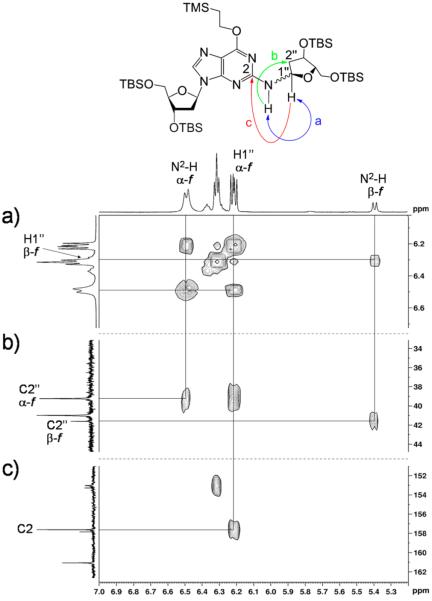
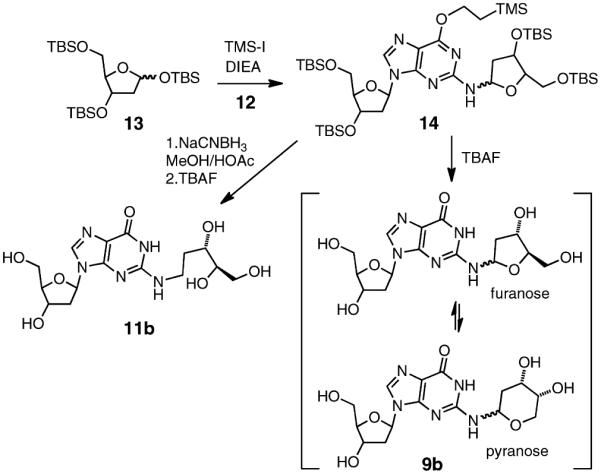
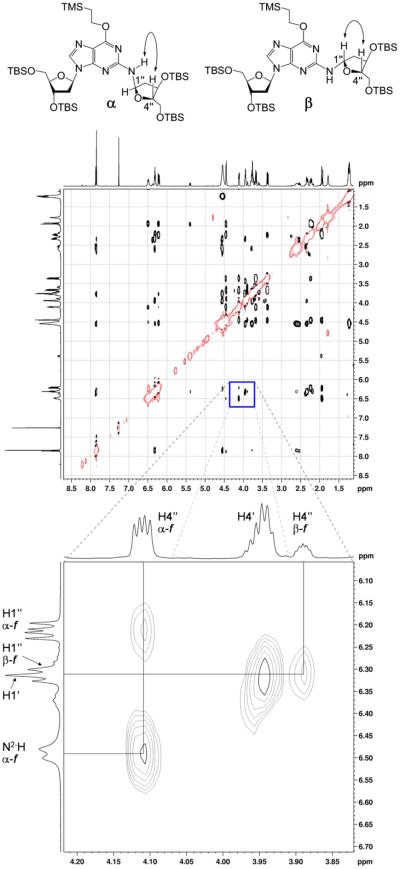
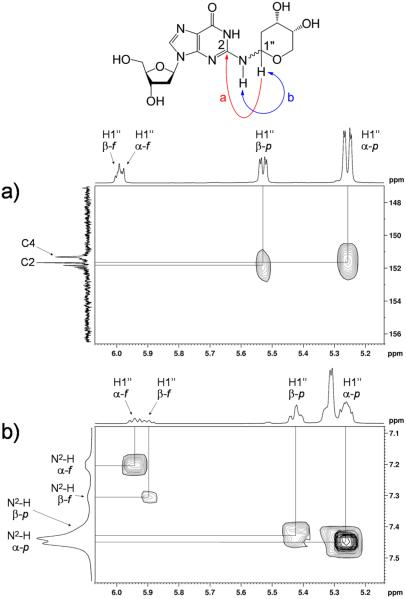
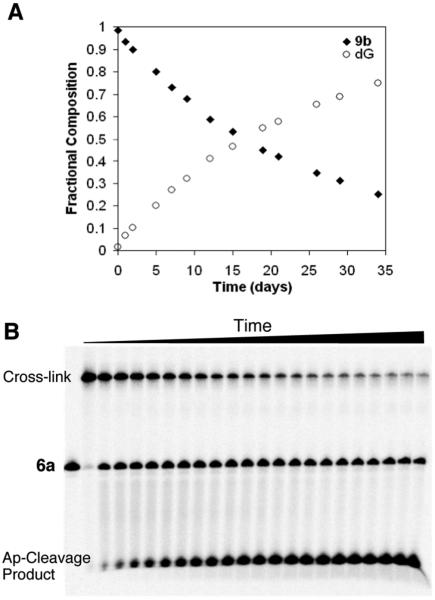
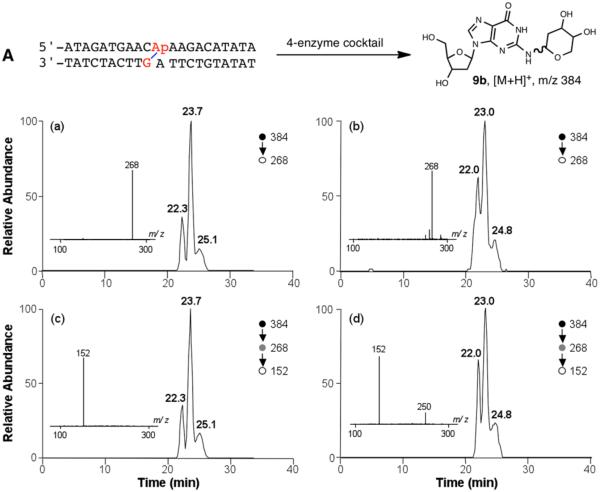
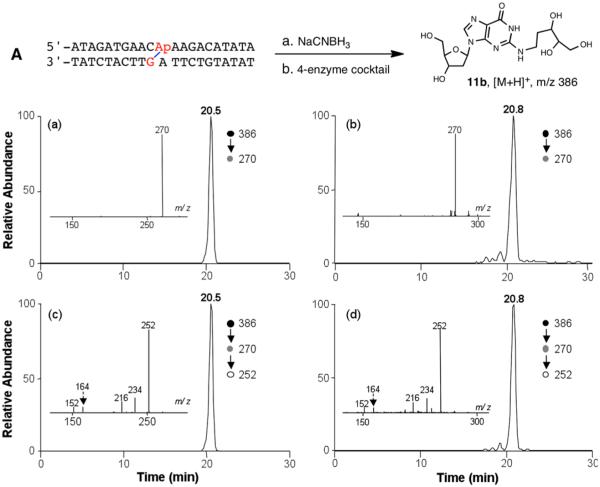
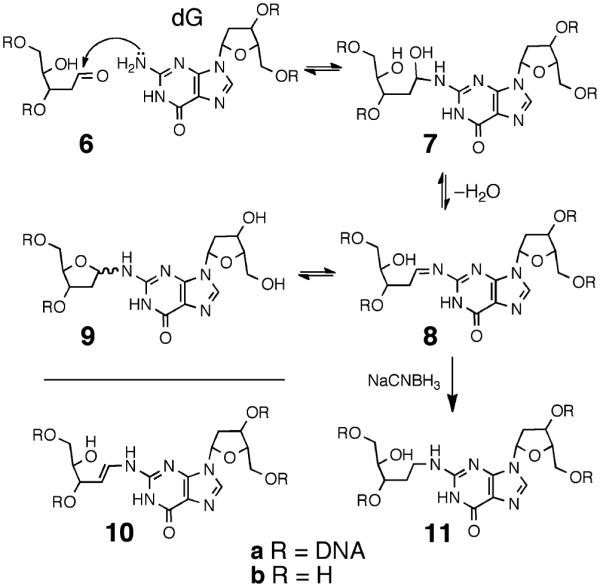
A new type of interstrand cross-link resulting from the reaction of a DNA abasic site with a guanine residue on the opposing strand of the double helix was recently identified, but the chemical connectivity of the cross-link was not rigorously established. The work described here was designed to characterize the chemical structure and properties of dG-AP cross-links generated in duplex DNA. The approach involved characterization of the nucleoside cross-link "remnant" released by enzymatic digestion of DNA duplexes containing the dG-AP cross-link. We first carried out a chemical synthesis and complete spectroscopic structure determination of the putative cross-link remnant 9b composed of a 2-deoxyribose adduct attached to the exocyclic N(2)-amino group of dG. A reduced analogue of the cross-link remnant was also prepared (11b). Liquid chromatography-tandem mass spectrometric (LC-MS/MS) analysis revealed that the retention times and mass spectral properties of synthetic standards 9b and 11b matched those of the authentic cross-link remnants released by enzymatic digestion of duplexes containing the native and reduced dG-AP cross-link, respectively. These results establish the chemical connectivity of the dG-AP cross-link released from duplex DNA and provide a foundation for detection of this lesion in biological samples. The dG-AP cross-link in duplex DNA was remarkably stable, decomposing with a half-life of 22 days at pH 7 and 23 °C. The intrinsic chemical stability of the dG-AP cross-link suggests that this lesion in duplex DNA may have the power to block DNA-processing enzymes involved in transcription and replication.
最近发现了一种新型的链间交联,它是由DNA无碱基位点与双螺旋互补链上的鸟嘌呤残基反应产生的,但这种交联的化学连接性尚未得到严格确定。本文所述的工作旨在表征双链DNA中产生的dG-AP交联的化学结构和性质。该方法包括对含有dG-AP交联的DNA双链体进行酶切释放的核苷交联“残基”进行表征。我们首先对由连接到dG的环外N(2)-氨基上的2-脱氧核糖加合物组成的假定交联残基9b进行了化学合成和完整的光谱结构测定。还制备了交联残基的还原类似物(11b)。液相色谱-串联质谱(LC-MS/MS)分析表明,合成标准品9b和11b的保留时间和质谱性质分别与含有天然和还原dG-AP交联的双链体酶切释放的真实交联残基的保留时间和质谱性质相匹配。这些结果确定了从双链DNA释放的dG-AP交联的化学连接性,并为在生物样品中检测这种损伤提供了基础。双链DNA中的dG-AP交联非常稳定,在pH 7和23°C下分解的半衰期为22天。dG-AP交联的固有化学稳定性表明,双链DNA中的这种损伤可能有能力阻断参与转录和复制的DNA加工酶。