Allem Jon-Patrick, Soto Daniel, Baezconde-Garbanati Lourdes, Unger Jennifer
a Doctoral Candidate, Keck School of Medicine of USC , Los Angeles , CA.
J Psychoactive Drugs. 2015 Jan-Mar;47(1):60-4. doi: 10.1080/02791072.2014.1001099.
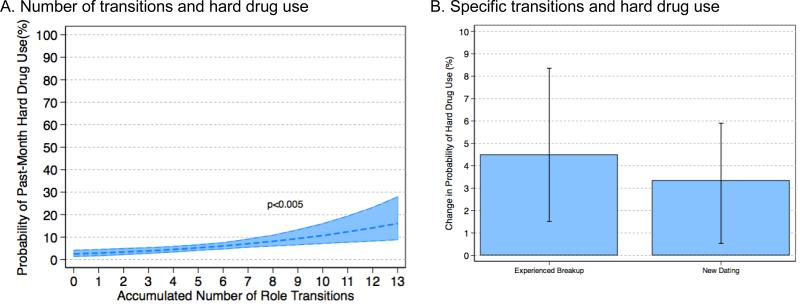
Emerging adults (ages 18 to 25) who experience multiple role transitions in a short period of time may engage in hard drug use as a maladaptive coping strategy to avoid negative emotions from stress. Given the collectivistic values Hispanics encounter growing up, they may experience additional role transitions due to their group-oriented cultural paradigm. This study examined whether those who experience many role transitions are at greater risk for hard drug use compared to those who experience few transitions among Hispanic emerging adults. Participants completed surveys indicating their hard drug use in emerging adulthood, role transitions in the past year of emerging adulthood, age, gender, and hard drug use in high school. Simulation analyses indicated that an increase in the number of role transitions, from 0 to 13, was associated with a 14% (95% CI, 4 to 29) higher probability of hard drug use. Specific role transitions were found to be associated with hard drug use, such as starting to date or experiencing a breakup. Intervention/prevention programs may benefit from acknowledging individual reactions to transitions in emerging adulthood, as these processes may be catalysts for personal growth where identities are consolidated and decisions regarding hard drug use are formed.
在短时间内经历多次角色转变的新兴成年人(18至25岁)可能会使用硬性毒品,作为一种适应不良的应对策略,以避免压力带来的负面情绪。鉴于西班牙裔在成长过程中所遇到的集体主义价值观,由于他们以群体为导向的文化范式,他们可能会经历更多的角色转变。本研究调查了在西班牙裔新兴成年人中,与经历较少角色转变的人相比,经历多次角色转变的人使用硬性毒品的风险是否更高。参与者完成了相关调查,表明他们在成年初期使用硬性毒品的情况、成年初期过去一年中的角色转变、年龄、性别以及高中时使用硬性毒品的情况。模拟分析表明,角色转变的数量从0增加到13,与使用硬性毒品的概率高出14%(95%置信区间,4%至29%)相关。发现特定的角色转变与使用硬性毒品有关,比如开始约会或经历分手。干预/预防项目可能会受益于认识到个人对成年初期角色转变的反应,因为这些过程可能是个人成长的催化剂,在此过程中身份得以巩固,关于使用硬性毒品的决定也得以形成。