Department of Clinical Laboratory, First Affiliated Hospital of Guangxi Medical University, Nanning, Guangxi China.
Department of Occupational Health and Environmental Health, School of Public Health at Guangxi Medical University, Nanning, Guangxi China.
Cancer Cell Int. 2014 Dec 12;14:134. doi: 10.1186/s12935-014-0134-4. eCollection 2014.
Epidermal growth factor (EGF) plays a pivotal role in cell proliferation, differentiation, and tumorigenesis of epithelial tissues. Variation of the EGF +61A/G (rs4444903) can lead to an alteration in EGF production and/or activity, which may result in individual susceptibility to gastric cancer. Studies investigating the association between EGF +61A/G polymorphism and gastric cancer risk produced inconsistent results. The aim of this study was to quantitatively summarize the evidence for such an association.
Eligible studies on the association between EGF +61A/G polymorphism and gastric cancer risk were identified by search of electronic databases including PubMed, EMBASE, Cochrane Library, and Chinese Biomedical Literature database (CBM). Data were extracted by two independent authors and pooled odds ratios (ORs) with 95% confidence intervals (CIs) were used to assess the strength of the association. Metaregression and subgroup analyses were performed to identify the source of heterogeneity.
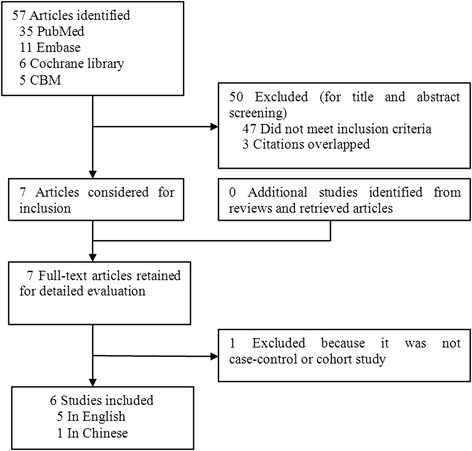
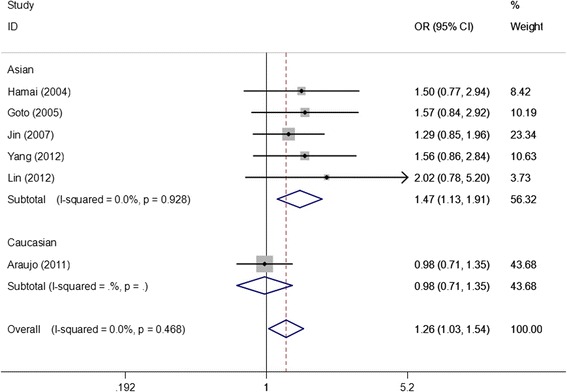
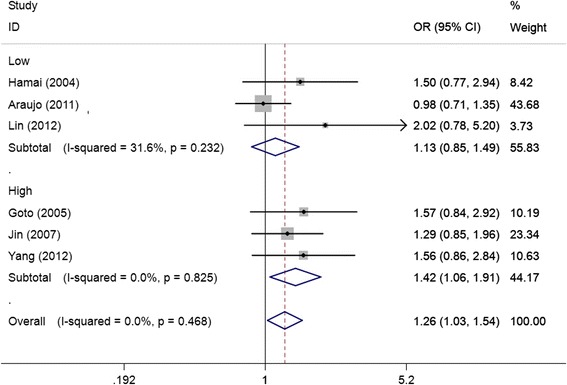
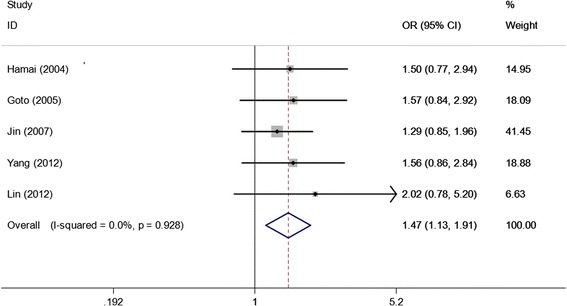
Finally, six case-control studies with 1547 gastric cancer cases and 2762 controls were eventually identified. Overall, significant increased gastric cancer risk was found when all studies were pooled in the meta-analysis (GG vs. AA: OR = 1.438, 95% CI 1.021-2.025, P = 0.038; GG + AG vs. AA: OR = 1.256, 95% CI 1.025-1.539, P = 0.028; GG vs. AG + AA: OR = 1.265, 95% CI 1.002-1.596, P = 0.048). In subgroup analysis by ethnicity, source of control, study quality, and HWE in controls, significant increased gastric cancer risk was observed in Asians, population-based studies, high quality studies, and studies consistent with HWE. In subgroup analysis according to tumor location, and histological type, significant association was observed in all subgroups.
This meta-analysis suggested that the EGF +61A/G polymorphism contributes to increased gastric cancer risk, especially in Asian populations. Further well-designed studies based on large sample size in diverse populations are needed to confirm this association.
表皮生长因子(EGF)在细胞增殖、上皮组织分化和肿瘤发生中起着关键作用。EGF+61A/G(rs4444903)的变异可导致 EGF 产生和/或活性的改变,从而导致个体对胃癌的易感性。研究表明 EGF+61A/G 多态性与胃癌风险之间存在关联,但结果并不一致。本研究旨在定量总结这种关联的证据。
通过检索 PubMed、EMBASE、Cochrane 图书馆和中国生物医学文献数据库(CBM)等电子数据库,筛选出 EGF+61A/G 多态性与胃癌风险相关的研究。由两位作者独立提取数据,并采用合并优势比(OR)及其 95%置信区间(CI)来评估关联强度。采用 Meta 回归和亚组分析来确定异质性的来源。
最终纳入 6 项病例对照研究,共包括 1547 例胃癌病例和 2762 例对照。Meta 分析结果显示,总体上,与 AA 基因型相比,GG 基因型增加胃癌风险(GG vs. AA:OR = 1.438,95%CI 1.021-2.025,P = 0.038;GG+AG vs. AA:OR = 1.256,95%CI 1.025-1.539,P = 0.028;GG vs. AG+AA:OR = 1.265,95%CI 1.002-1.596,P = 0.048)。按种族、对照来源、研究质量和 Hardy-Weinberg 平衡(HWE)进行亚组分析,结果显示,亚洲人群、基于人群的研究、高质量研究和与 HWE 一致的研究中,胃癌风险增加有统计学意义。按肿瘤位置和组织学类型进行亚组分析,结果均有统计学意义。
本 Meta 分析提示 EGF+61A/G 多态性与胃癌风险增加相关,尤其是在亚洲人群中。需要进一步开展基于大样本量和不同人群的设计良好的研究来验证这种关联。