Williams Rebecca S, Derrick Jason, Ribisl Kurt M
Lineberger Comprehensive Cancer Center, University of North Carolina, Chapel Hill2Center for Health Promotion and Disease Prevention, University of North Carolina, Chapel Hill.
Lineberger Comprehensive Cancer Center, University of North Carolina, Chapel Hill.
JAMA Pediatr. 2015 Mar;169(3):e1563. doi: 10.1001/jamapediatrics.2015.63. Epub 2015 Mar 2.
Electronic cigarettes (e-cigarettes) entered the US market in 2007 and, with little regulatory oversight, grew into a $2-billion-a-year industry by 2013. The Centers for Disease Control and Prevention has reported a trend of increasing e-cigarette use among teens, with use rates doubling from 2011 to 2012. While several studies have documented that teens can and do buy cigarettes online, to our knowledge, no studies have yet examined age verification among Internet tobacco vendors selling e-cigarettes.
To estimate the extent to which minors can successfully purchase e-cigarettes online and assess compliance with North Carolina's 2013 e-cigarette age-verification law.
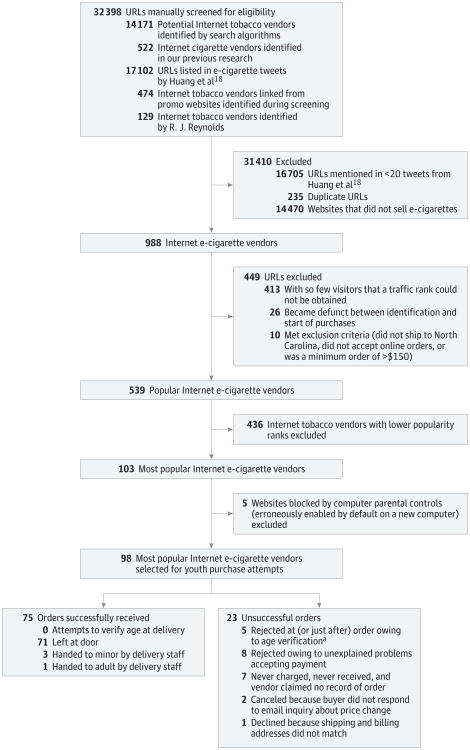
DESIGN, SETTING, AND PARTICIPANTS: In this cross-sectional study conducted from February 2014 to June 2014, 11 nonsmoking minors aged 14 to 17 years made supervised e-cigarette purchase attempts from 98 Internet e-cigarette vendors. Purchase attempts were made at the University of North Carolina Internet Tobacco Vendors Study project offices using credit cards.
Rate at which minors can successfully purchase e-cigarettes on the Internet.
Minors successfully received deliveries of e-cigarettes from 76.5% of purchase attempts, with no attempts by delivery companies to verify their ages at delivery and 95% of delivered orders simply left at the door. All delivered packages came from shipping companies that, according to company policy or federal regulation, do not ship cigarettes to consumers. Of the total orders, 18 failed for reasons unrelated to age verification. Only 5 of the remaining 80 youth purchase attempts were rejected owing to age verification, resulting in a youth buy rate of 93.7%. None of the vendors complied with North Carolina's e-cigarette age-verification law.
Minors are easily able to purchase e-cigarettes from the Internet because of an absence of age-verification measures used by Internet e-cigarette vendors. Federal law should require and enforce rigorous age verification for all e-cigarette sales as with the federal PACT (Prevent All Cigarette Trafficking) Act's requirements for age verification in Internet cigarette sales.
电子烟于2007年进入美国市场,由于监管极少,到2013年已发展成为一个年销售额达20亿美元的产业。疾病控制与预防中心报告称青少年使用电子烟呈上升趋势,使用率从2011年到2012年翻了一番。虽然有几项研究记录了青少年能够且确实在网上购买香烟,但据我们所知,尚无研究调查过销售电子烟的网络烟草供应商的年龄验证情况。
估计未成年人能够在网上成功购买电子烟的程度,并评估北卡罗来纳州2013年电子烟年龄验证法的合规情况。
设计、地点和参与者:在这项于2014年2月至2014年6月进行的横断面研究中,11名年龄在14至17岁的不吸烟未成年人在监督下从98家网络电子烟供应商处尝试购买电子烟。购买尝试在北卡罗来纳大学网络烟草供应商研究项目办公室使用信用卡进行。
未成年人在互联网上成功购买电子烟的比率。
未成年人在76.5%的购买尝试中成功收到了电子烟,快递公司在交货时未尝试核实他们的年龄,95%的已交付订单只是放在门口。所有已交付的包裹都来自运输公司,根据公司政策或联邦法规,这些公司不会向消费者运送香烟。在总订单中,18份因与年龄验证无关的原因未能成功。在其余80次青少年购买尝试中,只有5次因年龄验证被拒绝,导致青少年购买率为93.7%。没有一家供应商遵守北卡罗来纳州的电子烟年龄验证法。
由于网络电子烟供应商未采取年龄验证措施,未成年人很容易从互联网上购买电子烟。联邦法律应要求并强制对所有电子烟销售进行严格的年龄验证,如同联邦《防止所有香烟贩运》(PACT)法案对网络香烟销售年龄验证的要求一样。