Izquierdo-Condoy Juan S, Sosa Kenny Ruiz, Salazar-Santoliva Camila, Restrepo Natalia, Olaya-Villareal Guillermo, Castillo-Concha Juan S, Loaiza-Guevara Valentina, Ortiz-Prado Esteban
One Health Research Group, Faculty of Medicine, Universidad de las Américas, Quito, Ecuador.
Facultad de Medicina, Fundación Universitaria Autónoma de las Américas, Pereira, Colombia.
Prev Med Rep. 2024 Dec 19;49:102952. doi: 10.1016/j.pmedr.2024.102952. eCollection 2025 Jan.
Electronic cigarettes, introduced as a safer tobacco alternative, have unintentionally exposed millions of youths to nicotine and harmful chemicals. Adolescence, a key period for forming lifelong habits, has seen rising e-cigarette use, particularly in developing regions like Latin America, warranting thorough investigation.
To describe the prevalence and factors associated with e-cigarette use among adolescents in Latin America.
A systematic review was conducted according to PRISMA guidelines, covering studies published between 2003 and May 2024. Database searches included PubMed/Medline, Web of Science, Scopus, Google Scholar, Scielo, and LILACS. A total of 582 studies were identified, of which 14 met the inclusion criteria. Study data were synthesized and assessed using the Newcastle-Ottawa Scale and Joanna Briggs Institute checklist.
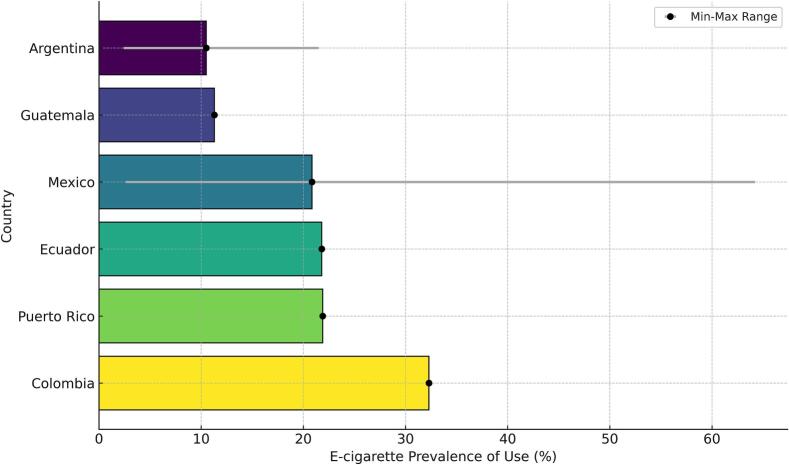
The prevalence of e-cigarette among adolescents in six Latin American countries ranged from 2.6 % to 64.2 %, with a pooled mean prevalence of 18.9 %, and lifetime use higher than current use. Key associated factors included male sex, concurrent use of tobacco and other substances, social influences, and exposure to online advertising. A widespread lack of knowledge regarding e-cigarette risks, coupled with limited regulatory oversight, may be contributing to higher usage rates.
This review underscores critical gaps in data on adolescent e-cigarette use in Latin America and highlights the need for expanded research and targeted public health interventions. Nearly one-fifth of adolescents reported using e-cigarettes. Comprehensive prevention programs addressing factors associated with adolescent e-cigarette use in Latin America, involving diverse stakeholders and integrating education, school-based policies, social media campaigns, and policy restrictions, are strongly recommended.
电子烟作为一种更安全的烟草替代品被引入,但却无意间使数百万年轻人接触到尼古丁和有害化学物质。青春期是形成终身习惯的关键时期,在此期间电子烟的使用呈上升趋势,尤其是在拉丁美洲等发展中地区,这值得进行深入调查。
描述拉丁美洲青少年电子烟使用的流行情况及相关因素。
根据PRISMA指南进行系统综述,涵盖2003年至2024年5月发表的研究。数据库检索包括PubMed/Medline、科学网、Scopus、谷歌学术、Scielo和LILACS。共识别出582项研究,其中14项符合纳入标准。使用纽卡斯尔-渥太华量表和乔安娜·布里格斯研究所清单对研究数据进行综合和评估。
六个拉丁美洲国家青少年电子烟的流行率在2.6%至64.2%之间,合并平均流行率为18.9%,终身使用率高于当前使用率。关键相关因素包括男性、同时使用烟草和其他物质、社会影响以及接触网络广告。对电子烟风险普遍缺乏了解,再加上监管监督有限,可能导致了较高的使用率。
本综述强调了拉丁美洲青少年电子烟使用数据方面的关键差距,并突出了扩大研究和针对性公共卫生干预措施的必要性。近五分之一的青少年报告使用过电子烟。强烈建议制定全面的预防计划,解决拉丁美洲青少年电子烟使用的相关因素,涉及不同利益相关者,并整合教育、校本政策、社交媒体宣传活动和政策限制。