Lucan Sean C, Maroko Andrew R, Sanon Omar, Frias Rafael, Schechter Clyde B
Department of Family and Social Medicine, Albert Einstein College of Medicine/Montefiore Medical Center, Bronx, NY 10461, USA.
Department of Health Sciences, Lehman College, City University of New York, Bronx, NY, USA.
Appetite. 2015 Jul;90:23-30. doi: 10.1016/j.appet.2015.02.034. Epub 2015 Feb 27.
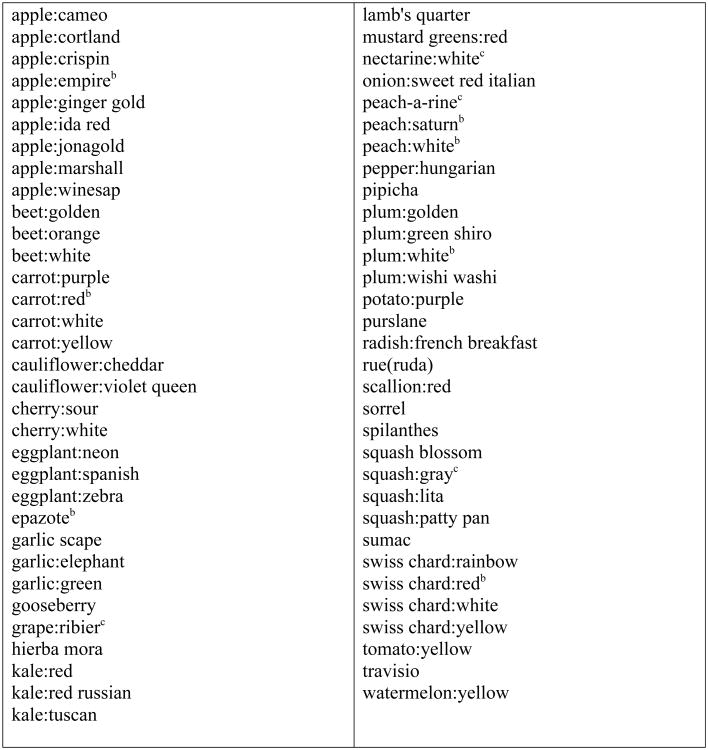
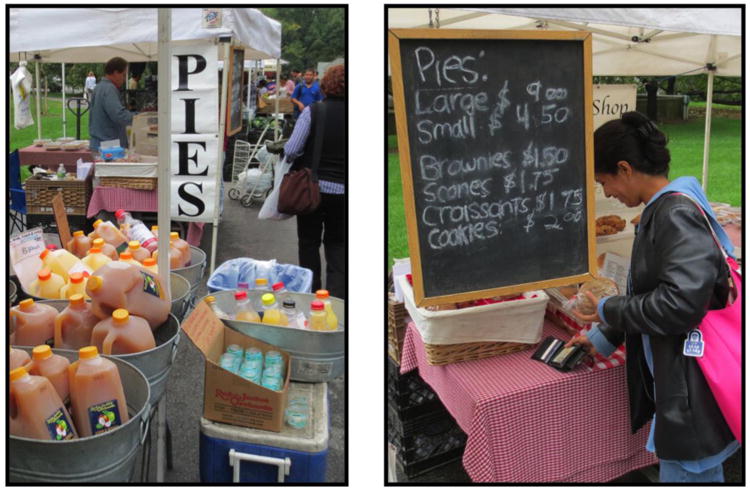
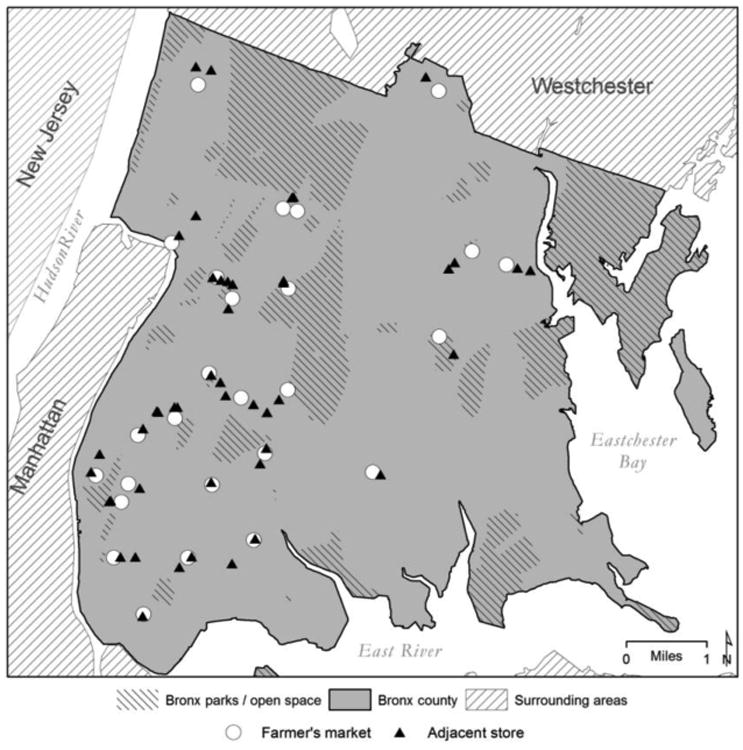
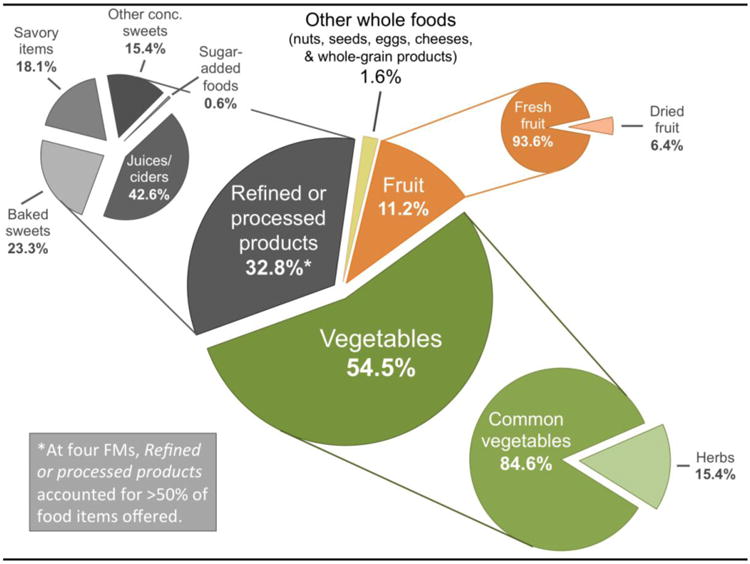
Most food-environment research has focused narrowly on select stores and restaurants. There has been comparatively less attention to non-storefront food sources like farmers' markets (FMs), particularly in urban communities. The objective of the present study was to assess FMs' potential contribution to an urban food environment in terms of specific foods offered, and compare FM accessibility as well as produce variety, quality, and price to that of nearby stores. Investigators conducted a detailed cross-sectional assessment of all FMs in Bronx County, NY, and of the nearest store(s) selling produce within a half-mile walking distance (up to two stores per FM). The study included 26 FMs and 44 stores. Investigators assessed accessibility (locations of FMs and stores relative to each other, and hours of operation for each), variety (the number and type of all food items offered at FMs and all fresh produce items offered at stores), quality (where produce items were grown and if they were organic), and price (including any sales prices or promotional discounts). Analyses included frequencies, proportions, and variable distributions, as well as mixed-effect regressions, paired t-tests, and signed rank tests to compare FMs to stores. Geographic information systems (GIS) allowed for mapping of FM and store locations and determining street-network distances between them. The mean distance between FMs and the nearest store selling fresh produce was 0.15 miles (range 0.02-0.36 miles). FMs were open substantially fewer months, days, and hours than stores. FMs offered 26.4 fewer fresh produce items on average than stores (p values <0.02). FM produce items were more frequently local and organic, but often tended toward less-common/more-exotic and heirloom varieties. FMs were more expensive on average (p values <0.001 for pairwise comparisons to stores) - even for more-commonplace and "conventional" produce - especially when discounts or sales prices were considered. Fully, 32.8% of what FMs offered was not fresh produce at all but refined or processed products (e.g., jams, pies, cakes, cookies, donuts, juice drinks). FMs may offer many items not optimal for good nutrition and health, and carry less-varied, less-common fresh produce in neighborhoods that already have access to stores with cheaper prices and overwhelmingly more hours of operation.
大多数食品环境研究都局限于特定的商店和餐馆。相对而言,像农贸市场(FMs)这样的非店面食品来源受到的关注较少,尤其是在城市社区。本研究的目的是根据所提供的特定食品评估农贸市场对城市食品环境的潜在贡献,并将农贸市场的可达性以及农产品的种类、质量和价格与附近商店进行比较。研究人员对纽约布朗克斯县的所有农贸市场以及步行半英里范围内最近的农产品销售商店(每个农贸市场最多两家商店)进行了详细的横断面评估。该研究包括26个农贸市场和44家商店。研究人员评估了可达性(农贸市场和商店的相对位置以及各自的营业时间)、种类(农贸市场提供的所有食品项目的数量和类型以及商店提供的所有新鲜农产品项目)、质量(农产品的种植地以及是否为有机产品)和价格(包括任何销售价格或促销折扣)。分析包括频率、比例和变量分布,以及用于比较农贸市场和商店的混合效应回归、配对t检验和符号秩检验。地理信息系统(GIS)可用于绘制农贸市场和商店的位置图,并确定它们之间的街道网络距离。农贸市场与最近的新鲜农产品销售商店之间的平均距离为0.15英里(范围为0.02 - 0.36英里)。农贸市场的营业月数、天数和小时数比商店少得多。农贸市场平均提供的新鲜农产品项目比商店少26.4种(p值<0.02)。农贸市场的农产品项目更常是本地的和有机的,但往往倾向于不太常见/更具异国情调的品种和传家宝品种。农贸市场的平均价格更高(与商店进行两两比较时p值<0.001)——即使是更常见的“传统”农产品——尤其是考虑到折扣或销售价格时。实际上,农贸市场提供的商品中有32.8%根本不是新鲜农产品,而是精制或加工产品(如果酱、馅饼、蛋糕、饼干、甜甜圈、果汁饮料)。在已经有价格更便宜且营业时间长得多的商店的社区,农贸市场可能提供许多对良好营养和健康并非最佳的商品,且所售新鲜农产品种类较少、不太常见。