Ellwardt Lea, van Tilburg Theo, Aartsen Marja, Wittek Rafael, Steverink Nardi
University of Cologne, Cologne Graduate School in Management, Economics and Social Sciences (CGS), Cologne, Germany.
Vrije Universiteit Amsterdam, Department of Sociology, Amsterdam, The Netherlands.
PLoS One. 2015 Mar 3;10(3):e0116731. doi: 10.1371/journal.pone.0116731. eCollection 2015.
Research on aging has consistently demonstrated an increased chance of survival for older adults who are integrated into rich networks of social relationships. Theoretical explanations state that personal networks offer indirect psychosocial and direct physiological pathways. We investigate whether effects on and pathways to mortality risk differ between functional and structural characteristics of the personal network. The objective is to inquire which personal network characteristics are the best predictors of mortality risk after adjustment for mental, cognitive and physical health.
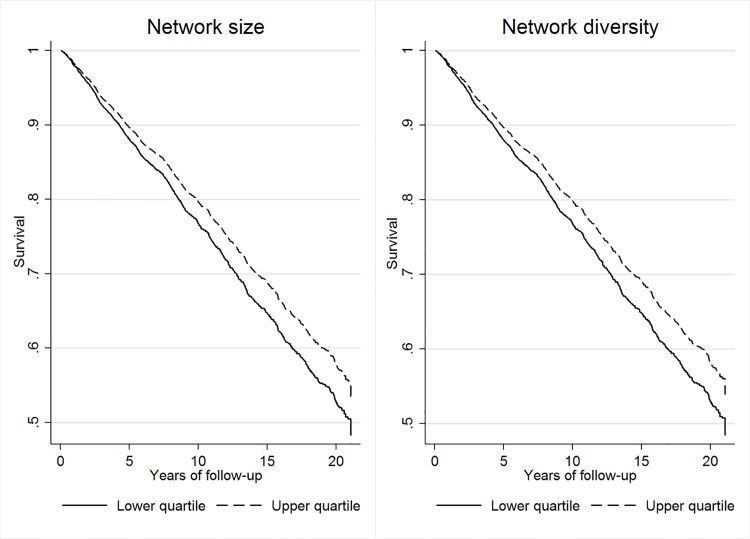
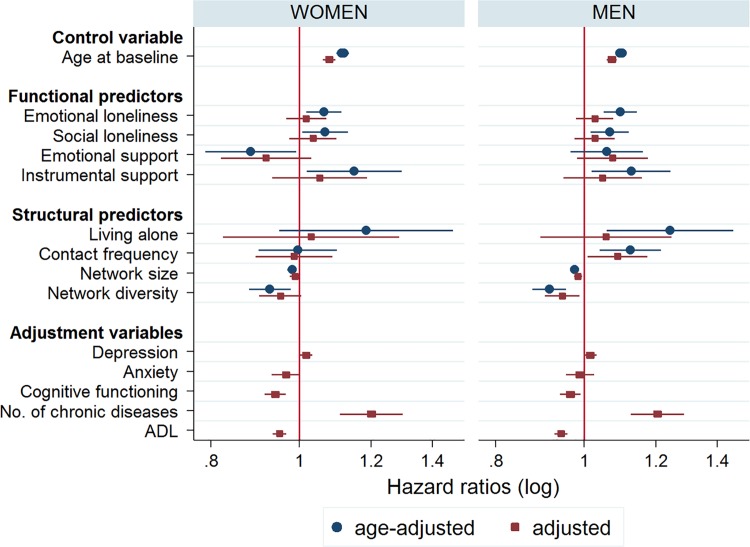
Empirical tests were carried out by combining official register information on mortality with data from the Longitudinal Aging Study Amsterdam (LASA). The sample included 2,911 Dutch respondents aged 54 to 85 at baseline in 1992 and six follow-ups covering a time span of twenty years. Four functional characteristics (emotional and social loneliness, emotional and instrumental support) and four structural characteristics (living arrangement, contact frequency, number of contacts, number of social roles) of the personal network as well as mental, cognitive and physical health were assessed at all LASA follow-ups. Statistical analyses comprised of Cox proportional hazard regression models. Findings suggest differential effects of personal network characteristics on survival, with only small gender differences. Mortality risk was initially reduced by functional characteristics, but disappeared after full adjustment for the various health variables. Mortality risk was lowest for older adults embedded in large (HR = 0.986, 95% CI 0.979-0.994) and diverse networks (HR = 0.948, 95% CI 0.917-0.981), and this effect continued to show in the fully adjusted models.
Functional characteristics (i.e. emotional and social loneliness) are indirectly associated with a reduction in mortality risk, while structural characteristics (i.e. number of contacts and number of social roles) have direct protective effects. More research is needed to understand the causal mechanisms underlying these relations.
对衰老的研究一直表明,融入丰富社会关系网络的老年人存活几率会增加。理论解释称,个人网络提供了间接的心理社会途径和直接的生理途径。我们调查个人网络的功能和结构特征对死亡风险的影响以及途径是否存在差异。目的是探究在对心理、认知和身体健康进行调整后,哪些个人网络特征是死亡风险的最佳预测因素。
通过将官方登记的死亡信息与来自阿姆斯特丹纵向衰老研究(LASA)的数据相结合进行实证检验。样本包括1992年基线时年龄在54至85岁的2911名荷兰受访者以及涵盖二十年时间跨度的六次随访。在所有LASA随访中评估了个人网络的四个功能特征(情感和社交孤独感、情感和工具性支持)、四个结构特征(居住安排、联系频率、联系人数量、社会角色数量)以及心理、认知和身体健康状况。统计分析包括Cox比例风险回归模型。结果表明个人网络特征对生存有不同影响,性别差异较小。功能特征最初会降低死亡风险,但在对各种健康变量进行全面调整后消失。嵌入大型(风险比=0.986,95%置信区间0.979 - 0.994)和多样化网络(风险比=0.948,95%置信区间0.917 - 0.981)的老年人死亡风险最低,并且这种效应在完全调整后的模型中仍然存在。
功能特征(即情感和社交孤独感)与死亡风险降低间接相关,而结构特征(即联系人数量和社会角色数量)具有直接的保护作用。需要更多研究来理解这些关系背后的因果机制。