Baams Laura, Grossman Arnold H, Russell Stephen T
Department of Developmental Psychology, Utrecht University.
Department of Applied Psychology, Steinhardt School of Culture, Education, and Human Development, New York University.
Dev Psychol. 2015 May;51(5):688-96. doi: 10.1037/a0038994. Epub 2015 Mar 9.
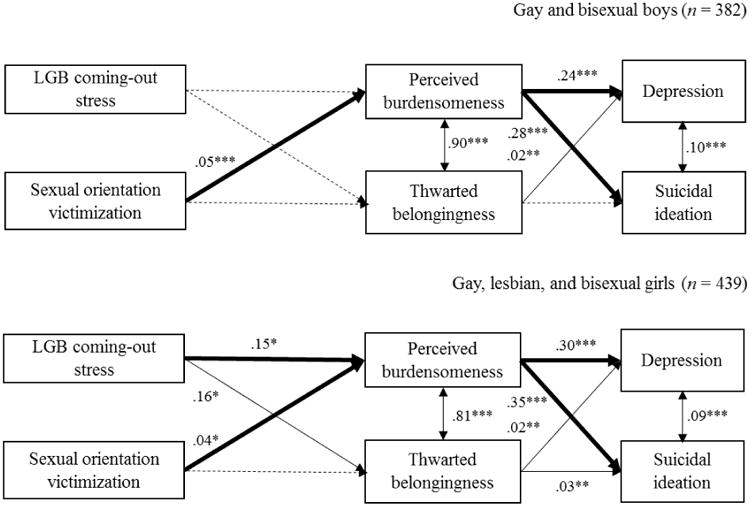
The experience of minority stress is often named as a cause for mental health disparities among lesbian, gay, and bisexual (LGB) youth, including higher levels of depression and suicidal ideation. The processes or mechanisms through which these disparities occur are understudied. The interpersonal-psychological theory of suicide posits 2 key mechanisms for suicidal ideation: perceived burdensomeness and thwarted belongingness (Joiner et al., 2009). The aim of the current study is to assess the mental health and adjustment among LGB youth emphasizing the minority stress model (Meyer, 2003) and the interpersonal-psychological theory of suicide (Joiner et al., 2009). With a survey of 876 LGB self-identified youth, levels of coming-out stress, sexual orientation victimization, perceived burdensomeness, thwarted belongingness, depression, and suicidal ideation were examined. The results of a multigroup mediation model show that for all gender and sexual identity groups, the association of sexual orientation victimization with depression and suicidal ideation was mediated by perceived burdensomeness. For gay, lesbian, and bisexual girls coming-out stress was also found to be related to depression and suicidal ideation, mediated by perceived burdensomeness. The results suggest that feeling like a burden to "people in their lives" is a critical mechanism in explaining higher levels of depression and suicidal ideation among LGB youth. These results have implications for community and social support groups, many of which base their interventions on decreasing social isolation rather than addressing youths' beliefs of burdensomeness. Implications for future research, clinical and community settings are discussed.
少数群体压力的经历常被认为是导致女同性恋、男同性恋和双性恋(LGB)青少年心理健康差异的一个原因,这些差异包括更高水平的抑郁和自杀意念。这些差异产生的过程或机制尚未得到充分研究。自杀的人际心理理论提出了自杀意念的两个关键机制:感知到成为他人负担和归属感受挫(乔伊纳等人,2009年)。本研究的目的是评估LGB青少年的心理健康和适应情况,重点关注少数群体压力模型(迈耶,2003年)和自杀的人际心理理论(乔伊纳等人,2009年)。通过对876名自我认定为LGB的青少年进行调查,考察了出柜压力、性取向受侵害情况、感知到成为他人负担、归属感受挫、抑郁和自杀意念的水平。多组中介模型的结果表明,对于所有性别和性身份群体,性取向受侵害与抑郁和自杀意念之间的关联是通过感知到成为他人负担来介导的。对于男同性恋、女同性恋和双性恋女孩,出柜压力也被发现与抑郁和自杀意念有关,由感知到成为他人负担介导。结果表明,感觉自己是“生活中他人的负担”是解释LGB青少年中更高水平的抑郁和自杀意念的一个关键机制。这些结果对社区和社会支持团体具有启示意义,其中许多团体的干预措施基于减少社会隔离,而不是解决青少年认为自己是负担的信念。还讨论了对未来研究、临床和社区环境的启示。