Sabia Séverine, Cogranne Pol, van Hees Vincent T, Bell Joshua A, Elbaz Alexis, Kivimaki Mika, Singh-Manoux Archana
Department of Epidemiology and Public Health, University College London, London, United Kingdom; University Versailles St-Quentin, Boulogne-Billancourt, France.
INSERM, U1018, Center for Research in Epidemiology and Population Health, Villejuif, France.
J Am Med Dir Assoc. 2015 May 1;16(5):438.e7-13. doi: 10.1016/j.jamda.2015.01.086. Epub 2015 Mar 6.
Physical activity is critically important for successful aging, but its effect on adiposity markers at older ages is unclear as much of the evidence comes from self-reported data on physical activity. We assessed the associations of questionnaire-assessed and accelerometer-assessed physical activity with adiposity markers in older adults.
DESIGN/SETTING/PARTICIPANTS: This was a cross-sectional study on 3940 participants (age range 60-83 years) of the Whitehall II study who completed a 20-item physical activity questionnaire and wore a wrist-mounted accelerometer for 9 days in 2012 and 2013.
Total physical activity was estimated using metabolic equivalent hours/week for the questionnaire and mean acceleration for the accelerometer. Time spent in moderate-and-vigorous physical activity (MVPA) was also assessed by questionnaire and accelerometer. Adiposity assessment included body mass index, waist circumference, and fat mass index. Fat mass index was calculated as fat mass/height² (kg/m²), with fat mass estimated using bioimpedance.
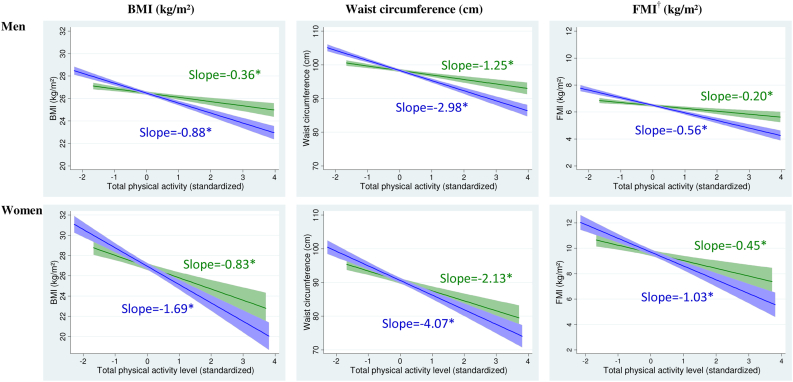
Greater total physical activity was associated with lower adiposity for all adiposity markers in a dose-response manner. In men, the strength of this association was 2.4 to 2.8 times stronger with the accelerometer than with questionnaire data. In women, it was 1.9 to 2.3 times stronger. For MVPA, questionnaire data in men suggested no further benefit for adiposity markers past 1 hour/week of activity. This was not the case for accelerometer-assessed MVPA where, for example, compared with men undertaking <1 hour/week of accelerometer-assessed MVPA, waist circumference was 3.06 (95% confidence interval 2.06-4.06) cm lower in those performing MVPA 1-2.5 hours/week, 4.69 (3.47-5.91) cm lower in those undertaking 2.5-4 hours/week, and 7.11 (5.93-8.29) cm lower in those performing ≥4 hours/week.
The association of physical activity with adiposity markers in older adults was stronger when physical activity was assessed by accelerometer compared with questionnaire, suggesting that physical activity might be more important for adiposity than previously estimated.
身体活动对成功老龄化至关重要,但由于大部分证据来自自我报告的身体活动数据,其对老年人肥胖指标的影响尚不清楚。我们评估了问卷调查评估和加速度计评估的身体活动与老年人肥胖指标之间的关联。
设计/地点/参与者:这是一项针对怀特霍尔二世研究中3940名参与者(年龄范围60 - 83岁)的横断面研究,这些参与者完成了一份包含20个条目的身体活动问卷,并在2012年和2013年佩戴腕式加速度计9天。
使用代谢当量小时/周来估计问卷的总身体活动量,使用加速度计的平均加速度来估计。还通过问卷和加速度计评估了中度至剧烈身体活动(MVPA)的时间。肥胖评估包括体重指数、腰围和脂肪量指数。脂肪量指数计算为脂肪量/身高²(kg/m²),脂肪量使用生物电阻抗法估计。
总身体活动量越大,所有肥胖指标的肥胖程度越低,呈剂量反应关系。在男性中,加速度计评估的这种关联强度比问卷数据强2.4至2.8倍。在女性中,强1.9至2.3倍。对于MVPA,男性的问卷数据表明,每周活动超过1小时后,肥胖指标没有进一步改善。加速度计评估的MVPA情况并非如此,例如,与每周加速度计评估的MVPA<1小时的男性相比,每周进行1 - 2.5小时MVPA的男性腰围低3.06(95%置信区间2.06 - 4.06)厘米,每周进行2.5 - 4小时的男性腰围低4.69(3.47 - 5.91)厘米,每周进行≥4小时的男性腰围低7.11(5.93 - 8.29)厘米。
与问卷调查相比,加速度计评估身体活动时,老年人身体活动与肥胖指标之间的关联更强,这表明身体活动对肥胖的重要性可能比之前估计的更高。