Kobayashi Sota, Tsutsui Toshiyuki, Yamamoto Takehisa, Hayama Yoko, Muroga Norihiko, Konishi Misako, Kameyama Ken-Ichiro, Murakami Kenji
Viral Diseases and Epidemiology Research Division, National Institute of Animal Health, 3-1-5 Kannondai, Tsukuba, Ibaraki 305-0856, Japan.
J Vet Med Sci. 2015 Jul;77(7):861-3. doi: 10.1292/jvms.15-0007. Epub 2015 Mar 5.
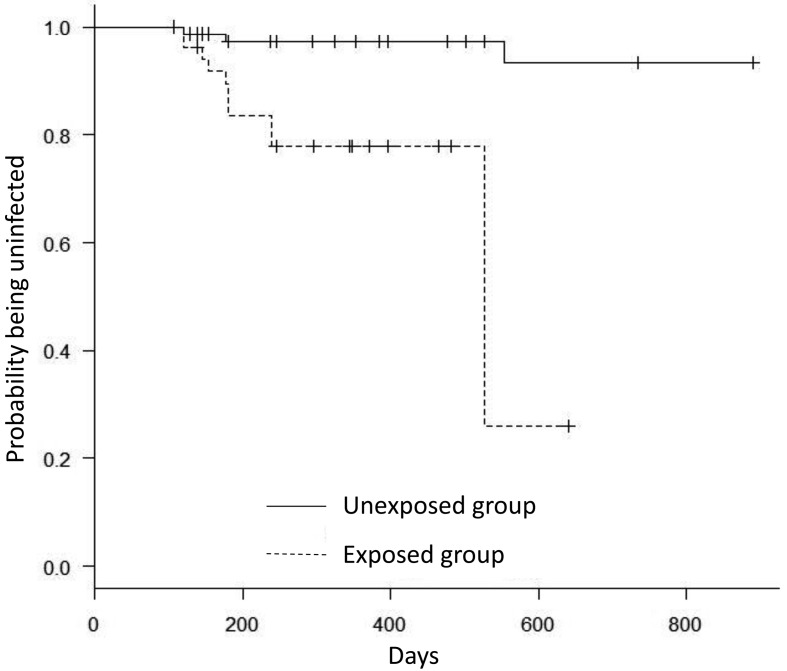
A cohort study was conducted to evaluate the risk of bovine leukemia virus (BLV) transmission to uninfected cattle by adjacent infected cattle in 6 dairy farms. Animals were initially tested in 2010-2011 using a commercial ELISA kit. Uninfected cattle were repeatedly tested every 4 to 6 months until fall of 2012. The Cox proportional hazard model with frailty showed that uninfected cattle neighboring to infected cattle (n=53) had a significant higher risk of seroconversion than those without any infected neighbors (n=81) (hazard ratio: 12.4, P=0.001), implying that neighboring infected cattle were a significant risk factor for BLV transmission. This finding provides scientific support for animal health authorities and farmers to segregate infected cattle on farms to prevent spread of BLV.
进行了一项队列研究,以评估6个奶牛场中相邻感染牛将牛白血病病毒(BLV)传播给未感染牛的风险。2010 - 2011年最初使用商用ELISA试剂盒对动物进行检测。未感染的牛每4至6个月重复检测一次,直至2012年秋季。带有脆弱性的Cox比例风险模型显示,与感染牛相邻的未感染牛(n = 53)血清转化风险显著高于没有任何感染邻居的未感染牛(n = 81)(风险比:12.4,P = 0.001),这意味着相邻的感染牛是BLV传播的一个重要风险因素。这一发现为动物卫生当局和养殖户在农场隔离感染牛以防止BLV传播提供了科学依据。