Comninos Alexander N, Anastasovska Jelena, Sahuri-Arisoylu Meliz, Li Xiaofeng, Li Shengyun, Hu Minghan, Jayasena Channa N, Ghatei Mohammad A, Bloom Stephen R, Matthews Paul M, O'Byrne Kevin T, Bell Jimmy D, Dhillo Waljit S
Department of Investigative Medicine, Imperial College London, 6th Floor Commonwealth Building, Hammersmith Hospital, Du Cane Road, London, W12 0NN, UK.
Metabolic and Molecular Imaging Group, MRC Clinical Science Centre, Imperial College London, Hammersmith Hospital, Du Cane Road, London, W12 0NN, UK.
Brain Struct Funct. 2016 May;221(4):2035-47. doi: 10.1007/s00429-015-1024-9. Epub 2015 Mar 11.
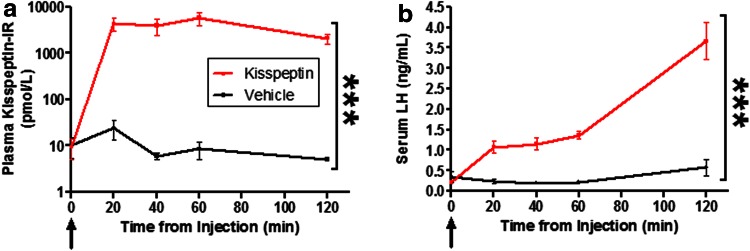
Kisspeptin (encoded by KISS1) is a crucial activator of reproductive function. The role of kisspeptin has been studied extensively within the hypothalamus but little is known about its significance in other areas of the brain. KISS1 and its cognate receptor are expressed in the amygdala, a key limbic brain structure with inhibitory projections to hypothalamic centers involved in gonadotropin secretion. We therefore hypothesized that kisspeptin has effects on neuronal activation and reproductive pathways beyond the hypothalamus and particularly within the amygdala. To test this, we mapped brain neuronal activity (using manganese-enhanced MRI) associated with peripheral kisspeptin administration in rodents. We also investigated functional relevance by measuring the gonadotropin response to direct intra-medial amygdala (MeA) administration of kisspeptin and kisspeptin antagonist. Peripheral kisspeptin administration resulted in a marked decrease in signal intensity in the amygdala compared to vehicle alone. This was associated with an increase in luteinizing hormone (LH) secretion. In addition, intra-MeA administration of kisspeptin resulted in increased LH secretion, while blocking endogenous kisspeptin signaling within the amygdala by administering intra-MeA kisspeptin antagonist decreased both LH secretion and LH pulse frequency. We provide evidence for the first time that neuronal activity within the amygdala is decreased by peripheral kisspeptin administration and that kisspeptin signaling within the amygdala contributes to the modulation of gonadotropin release and pulsatility. Our data suggest that kisspeptin is a 'master regulator' of reproductive physiology, integrating limbic circuits with the regulation of gonadotropin-releasing hormone neurons and reproductive hormone secretion.
亲吻素(由KISS1编码)是生殖功能的关键激活因子。亲吻素在下丘脑内的作用已得到广泛研究,但对其在大脑其他区域的重要性却知之甚少。KISS1及其同源受体在杏仁核中表达,杏仁核是边缘脑的关键结构,对参与促性腺激素分泌的下丘脑中心有抑制性投射。因此,我们推测亲吻素对下丘脑以外尤其是杏仁核内的神经元激活和生殖途径有影响。为了验证这一点,我们绘制了与啮齿动物外周注射亲吻素相关的脑神经元活动图谱(使用锰增强磁共振成像)。我们还通过测量对直接向内侧杏仁核(MeA)注射亲吻素和亲吻素拮抗剂后的促性腺激素反应,研究了其功能相关性。与单独注射载体相比,外周注射亲吻素导致杏仁核信号强度显著降低。这与促黄体生成素(LH)分泌增加有关。此外,向MeA内注射亲吻素导致LH分泌增加,而通过向MeA内注射亲吻素拮抗剂阻断杏仁核内的内源性亲吻素信号传导,则会降低LH分泌和LH脉冲频率。我们首次提供证据表明,外周注射亲吻素会降低杏仁核内的神经元活动,并且杏仁核内的亲吻素信号传导有助于调节促性腺激素的释放和脉冲性。我们的数据表明,亲吻素是生殖生理学的“主调节器”,将边缘回路与促性腺激素释放激素神经元的调节和生殖激素分泌整合在一起。