Department of Brain and Behavioral Science, University of Pavia Pavia, Italy.
Brain Connectivity Center, Istituto Neurologico IRCCS C. Mondino Pavia, Italy.
Front Cell Neurosci. 2015 Feb 24;9:47. doi: 10.3389/fncel.2015.00047. eCollection 2015.
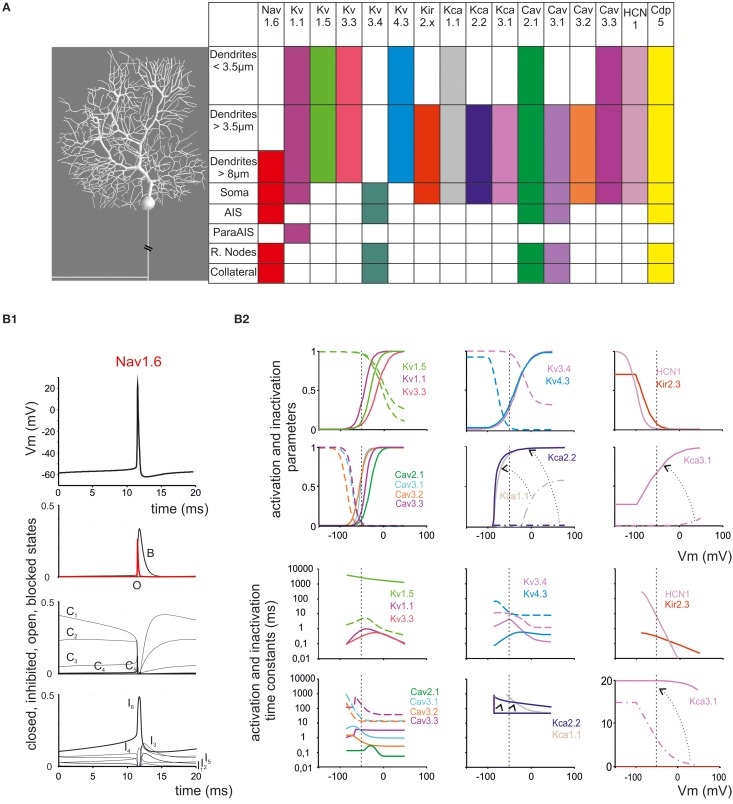
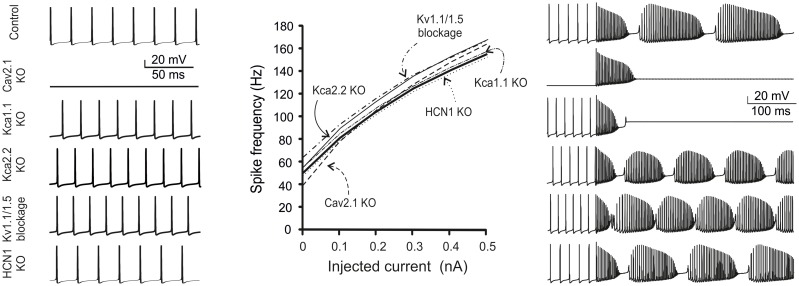
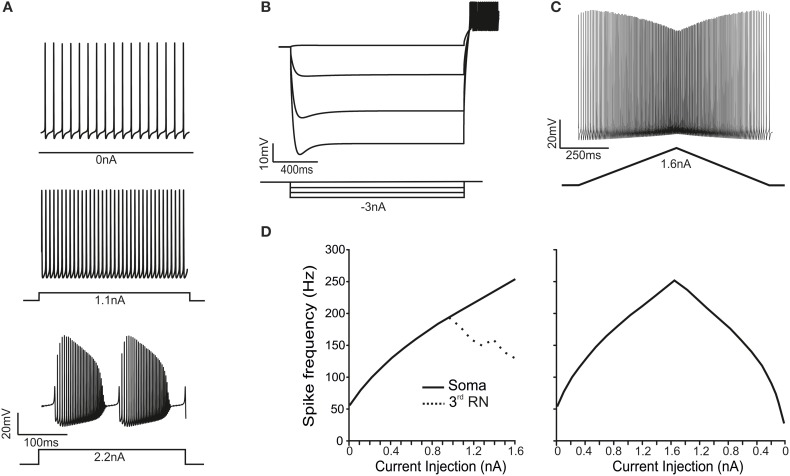
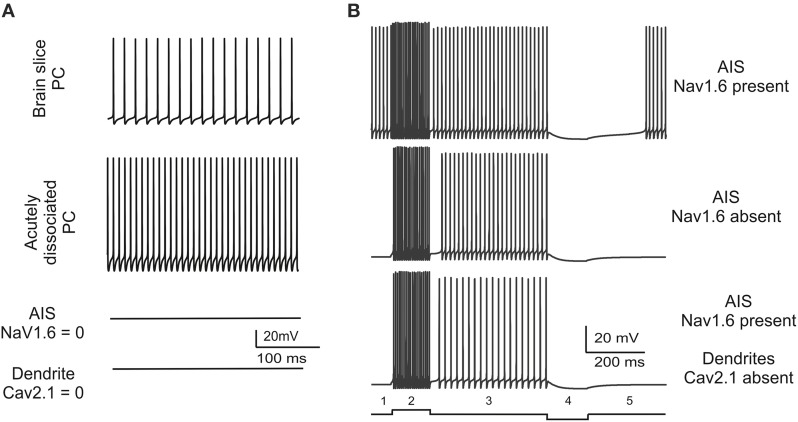
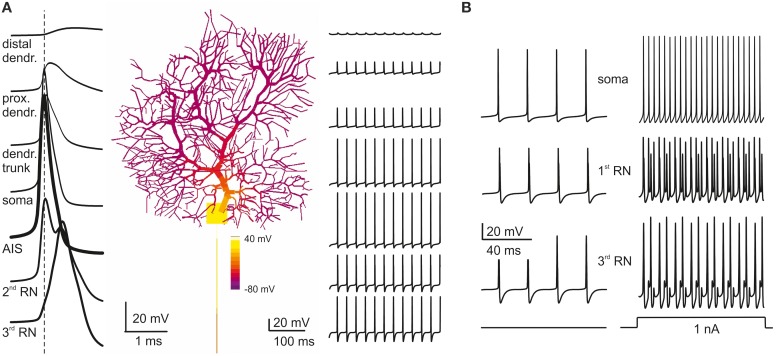
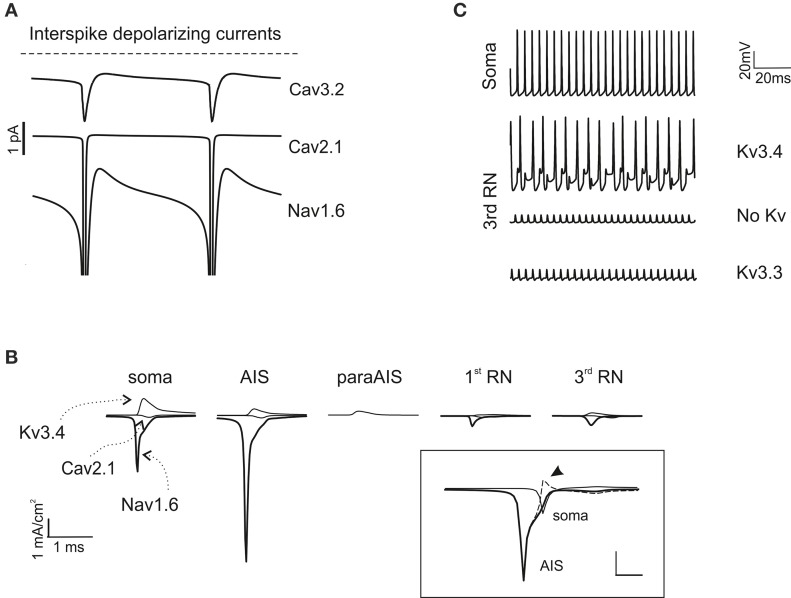
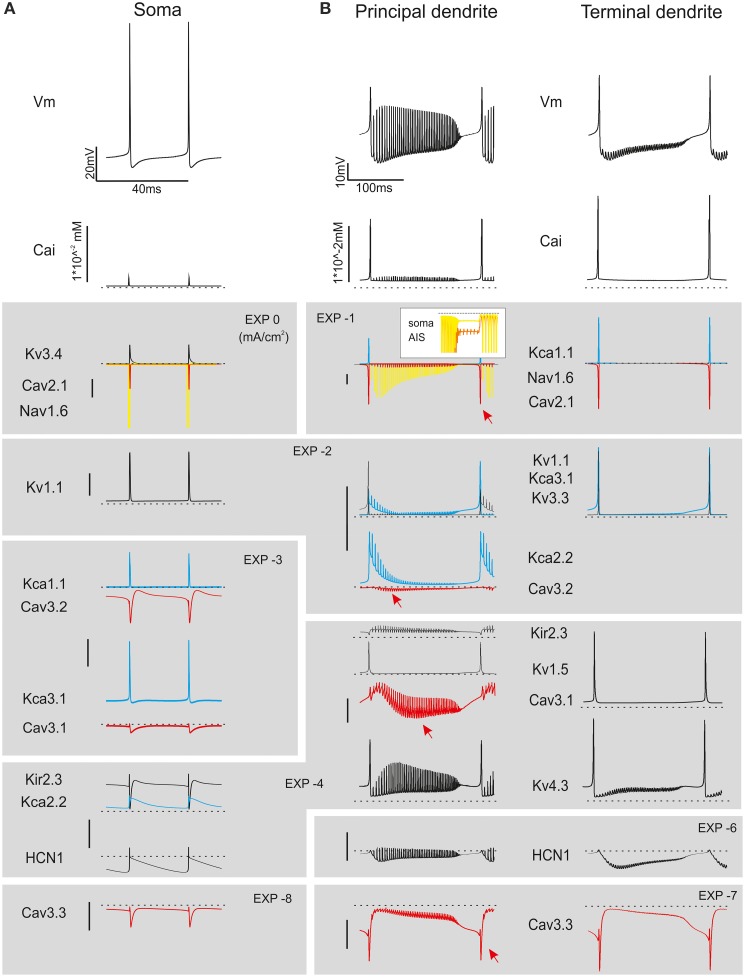
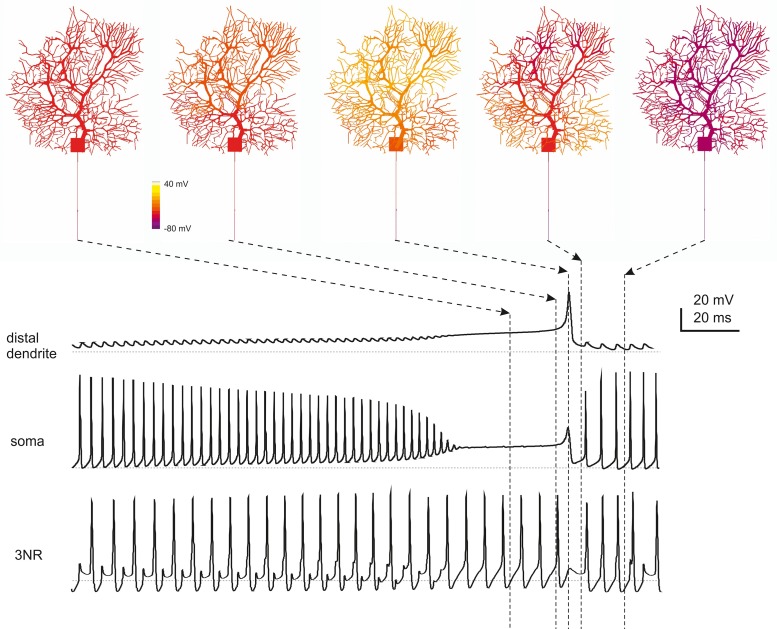
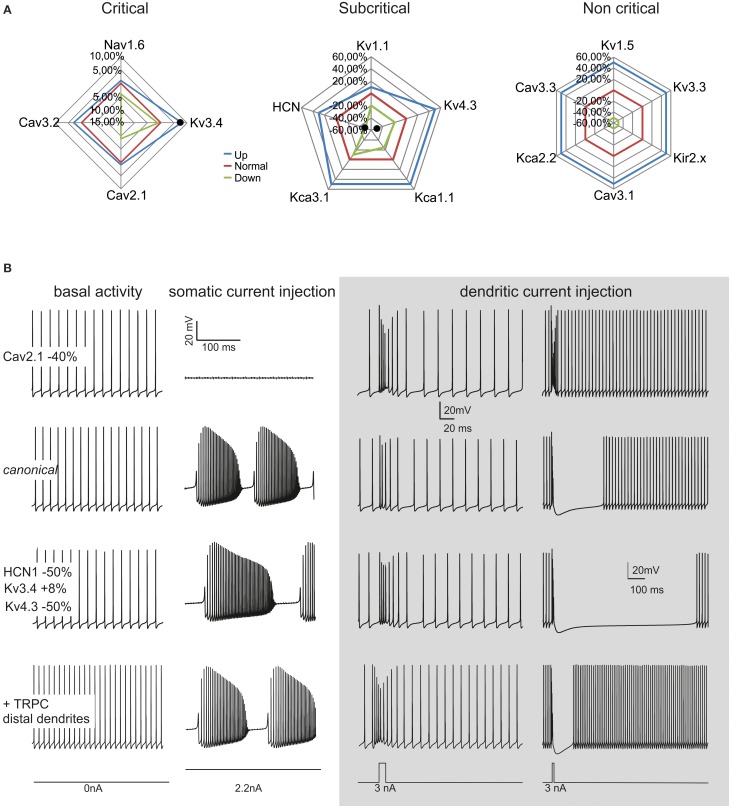
The Purkinje cell (PC) is among the most complex neurons in the brain and plays a critical role for cerebellar functioning. PCs operate as fast pacemakers modulated by synaptic inputs but can switch from simple spikes to complex bursts and, in some conditions, show bistability. In contrast to original works emphasizing dendritic Ca-dependent mechanisms, recent experiments have supported a primary role for axonal Na-dependent processing, which could effectively regulate spike generation and transmission to deep cerebellar nuclei (DCN). In order to account for the numerous ionic mechanisms involved (at present including Nav1.6, Cav2.1, Cav3.1, Cav3.2, Cav3.3, Kv1.1, Kv1.5, Kv3.3, Kv3.4, Kv4.3, KCa1.1, KCa2.2, KCa3.1, Kir2.x, HCN1), we have elaborated a multicompartmental model incorporating available knowledge on localization and gating of PC ionic channels. The axon, including initial segment (AIS) and Ranvier nodes (RNs), proved critical to obtain appropriate pacemaking and firing frequency modulation. Simple spikes initiated in the AIS and protracted discharges were stabilized in the soma through Na-dependent mechanisms, while somato-dendritic Ca channels contributed to sustain pacemaking and to generate complex bursting at high discharge regimes. Bistability occurred only following Na and Ca channel down-regulation. In addition, specific properties in RNs K currents were required to limit spike transmission frequency along the axon. The model showed how organized electroresponsive functions could emerge from the molecular complexity of PCs and showed that the axon is fundamental to complement ionic channel compartmentalization enabling action potential processing and transmission of specific spike patterns to DCN.
浦肯野细胞(PC)是大脑中最复杂的神经元之一,对小脑功能起着至关重要的作用。PC 作为受突触输入调节的快速起搏器运行,但可以从简单的尖峰转变为复杂的爆发,并且在某些条件下表现出双稳态。与强调树突 Ca 依赖性机制的原始作品相反,最近的实验支持了轴突 Na 依赖性处理的主要作用,这可以有效地调节尖峰生成和向小脑深部核团(DCN)的传递。为了说明涉及的众多离子机制(目前包括 Nav1.6、Cav2.1、Cav3.1、Cav3.2、Cav3.3、Kv1.1、Kv1.5、Kv3.3、Kv3.4、Kv4.3、KCa1.1、KCa2.2、KCa3.1、Kir2.x、HCN1),我们详细阐述了一个包含 PC 离子通道定位和门控的多区室模型。轴突,包括起始段(AIS)和郎飞节(RNs),对于获得适当的起搏和放电频率调制至关重要。在 AIS 中发起的简单尖峰和延长放电通过 Na 依赖性机制在胞体中得到稳定,而体树突 Ca 通道有助于维持起搏并在高放电状态下产生复杂爆发。只有在 Na 和 Ca 通道下调后才会出现双稳态。此外,沿轴突限制尖峰传输频率需要特定的 RNs K 电流特性。该模型展示了组织的电响应功能如何从 PC 的分子复杂性中出现,并表明轴突对于补充离子通道分区,使动作电位处理和特定尖峰模式向 DCN 的传输是必不可少的。