Cheron G, Prigogine C, Cheron J, Márquez-Ruiz J, Traub R D, Dan B
Laboratory of Electrophysiology, Université de Mons, 7000 Mons, Belgium; Laboratory of Neurophysiology and Movement Biomechanics, CP601, ULB Neurosciences Institut, Université Libre de Bruxelles, 1070 Brussels, Belgium.
Laboratory of Electrophysiology, Université de Mons, 7000 Mons, Belgium; Laboratory of Neurophysiology and Movement Biomechanics, CP601, ULB Neurosciences Institut, Université Libre de Bruxelles, 1070 Brussels, Belgium.
Neuroscience. 2014 Mar 28;263:15-26. doi: 10.1016/j.neuroscience.2014.01.007. Epub 2014 Jan 15.
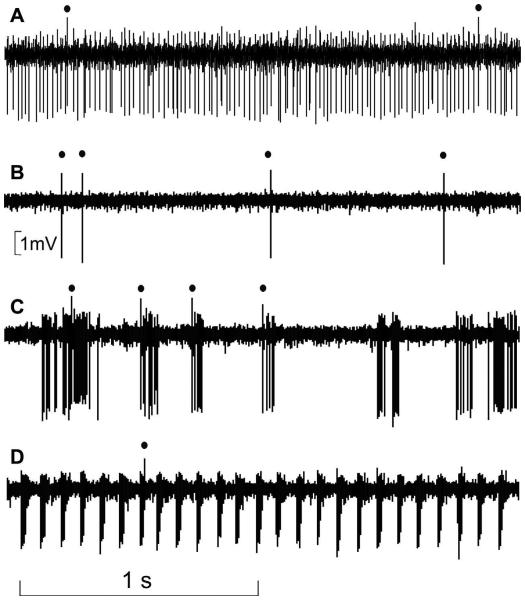
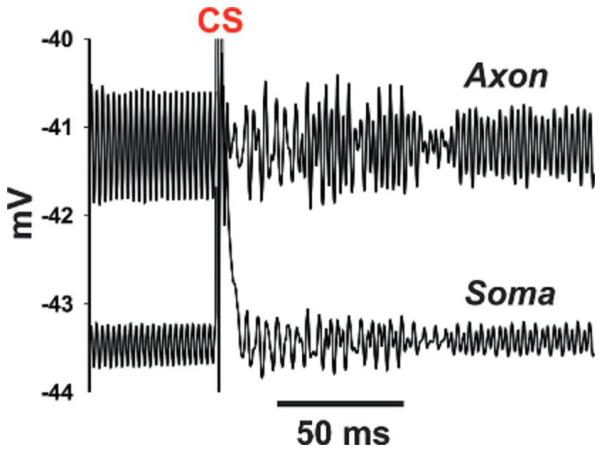
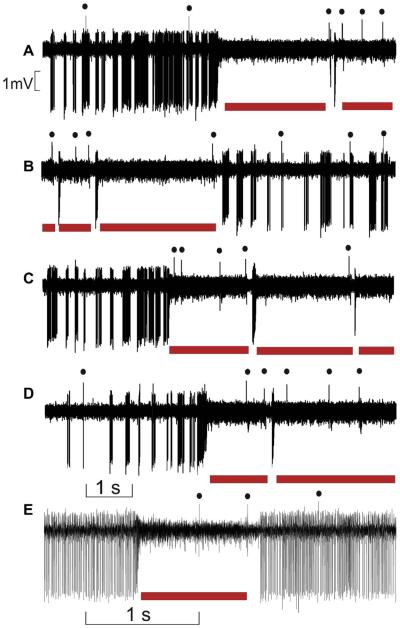
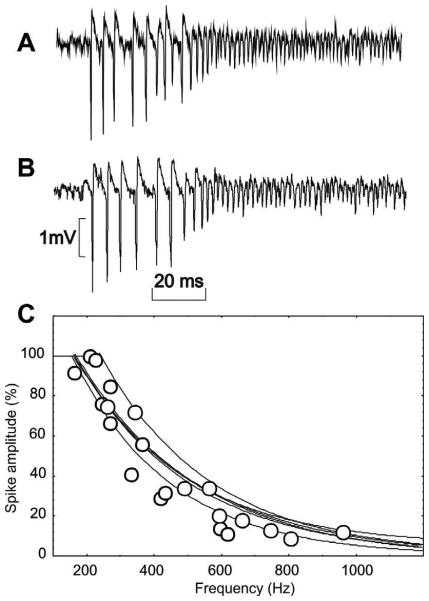
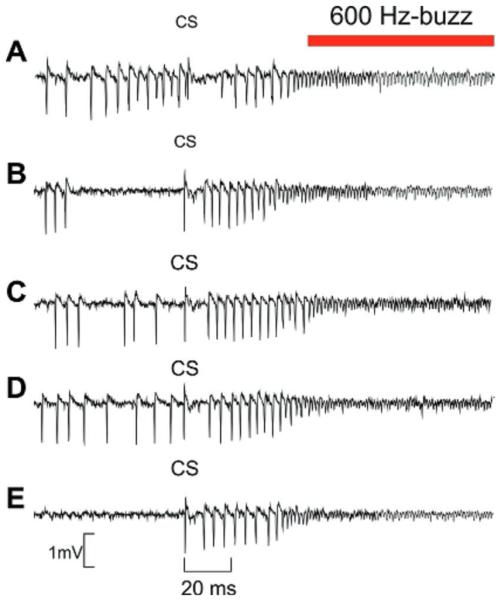
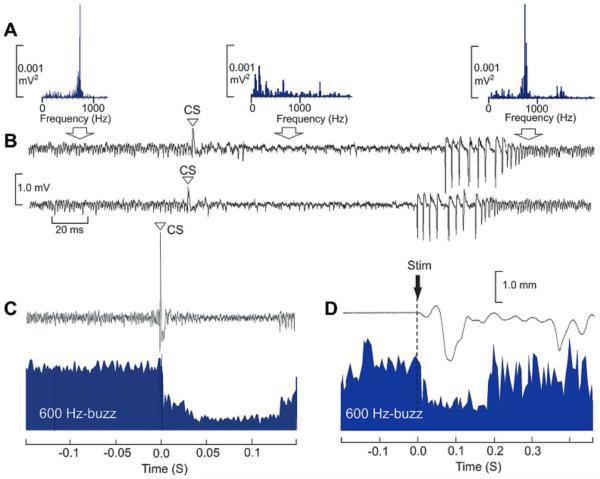
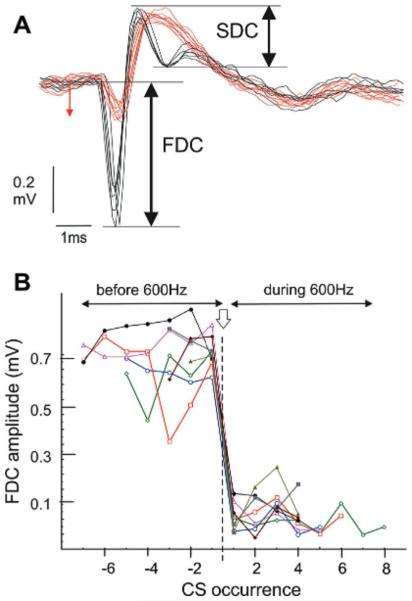
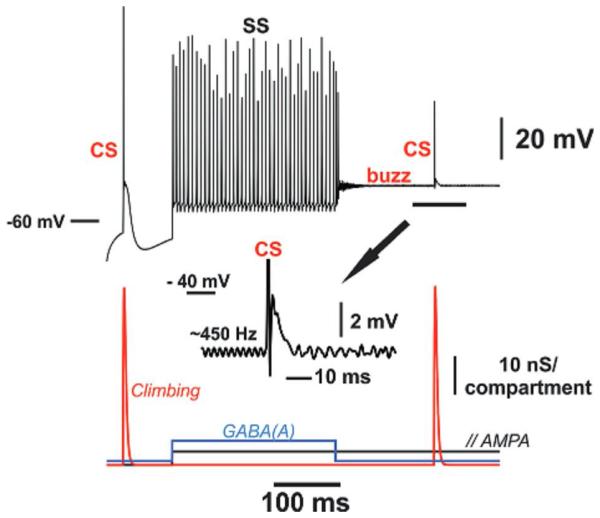
Purkinje cell (PC) firing represents the sole output from the cerebellar cortex onto the deep cerebellar and vestibular nuclei. Here, we explored the different modes of PC firing in alert mice by extracellular recording. We confirm the existence of a tonic and/or bursting and quiescent modes corresponding to UP and DOWN state, respectively. We demonstrate the existence of a novel 600-Hz buzz UP state of firing characterized by simple spikes (SS) of very small amplitude. Climbing fiber (CF) input is able to switch the 600-Hz buzz to the DOWN state, as for the classical UP-to-DOWN state transition. Conversely, the CF input can initiate a typical SS pattern terminating into 600-Hz buzz. The 600-Hz buzz was transiently suppressed by whisker pad stimulation demonstrating that it remained responsive to peripheral input. It must not be mistaken for a DOWN state or the sign of PC inhibition. Complex spike (CS) frequency was increased during the 600-Hz buzz, indicating that this PC output actively contributes to the cerebello-olivary loop by triggering a disinhibition of the inferior olive. During the 600-Hz buzz, the first depolarizing component of the CS was reduced and the second depolarizing component was suppressed. Consistent with our experimental observations, using a 559-compartment single-PC model - in which PC UP state (of about -43mV) was obtained by the combined action of large tonic AMPA conductances and counterbalancing GABAergic inhibition - removal of this inhibition produced the 600-Hz buzz; the simulated buzz frequency decreased following an artificial CS.
浦肯野细胞(PC)放电是小脑皮质向小脑深部核团和前庭核团的唯一输出。在此,我们通过细胞外记录探索了清醒小鼠中PC放电的不同模式。我们证实了分别对应于UP和DOWN状态的紧张性放电和/或爆发性放电以及静息模式的存在。我们证明了一种新型的600赫兹嗡嗡声UP放电状态的存在,其特征是幅度非常小的简单锋电位(SS)。如同经典的UP到DOWN状态转换一样,攀缘纤维(CF)输入能够将600赫兹嗡嗡声转换为DOWN状态。相反,CF输入可以启动一种典型的SS模式并终止于600赫兹嗡嗡声。触须垫刺激可短暂抑制600赫兹嗡嗡声,表明它对外周输入仍有反应。它绝不能被误认为是DOWN状态或PC抑制的标志。在600赫兹嗡嗡声期间,复合锋电位(CS)频率增加,表明这种PC输出通过触发下橄榄核的去抑制而积极参与小脑 - 橄榄环路。在600赫兹嗡嗡声期间,CS的第一个去极化成分减小,第二个去极化成分受到抑制。与我们的实验观察结果一致,使用一个559个隔室的单PC模型——其中PC的UP状态(约为 -43mV)是由大的紧张性AMPA电导和平衡的GABA能抑制的联合作用获得的——去除这种抑制会产生600赫兹嗡嗡声;模拟的嗡嗡声频率在人工CS后降低。