Wang Xiu-Xia, Sun Bao-Fa, Jiao Jiao, Chong Ze-Chen, Chen Yu-Shen, Wang Xiao-Li, Zhao Yue, Zhou Yi-Ming, Li Da
Department of Obstetrics and Gynecology, Shengjing Hospital of China Medical University, Shenyang 110004, China.
Key Laboratory of Genomic and Precision Medicine, Beijing Institute of Genomics, Chinese Academy of Sciences, Beijing 101300, China.
Oncotarget. 2015 Mar 30;6(9):6535-43. doi: 10.18632/oncotarget.3163.
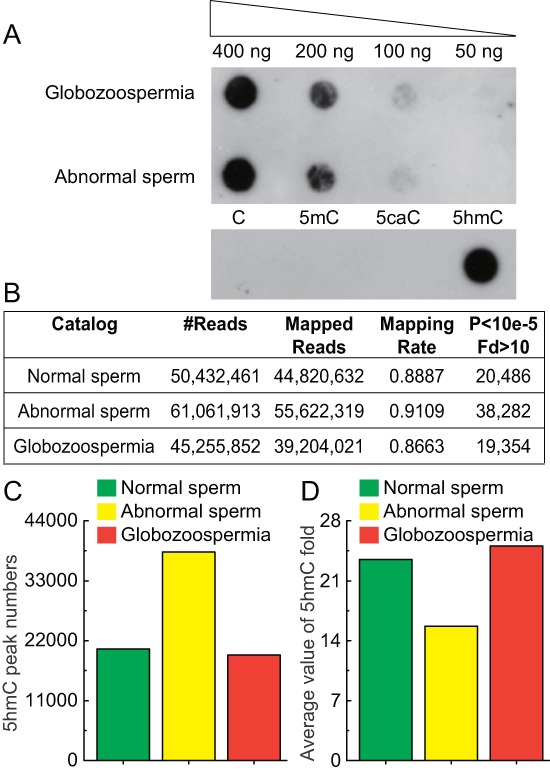
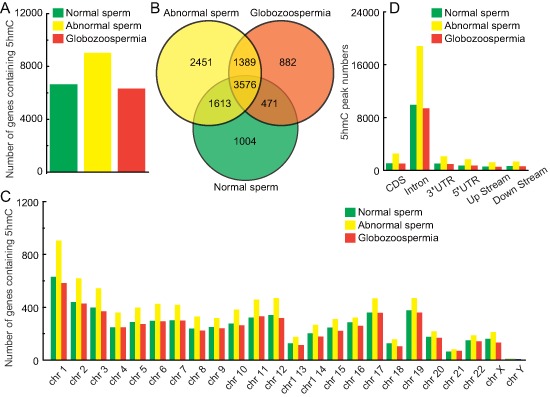
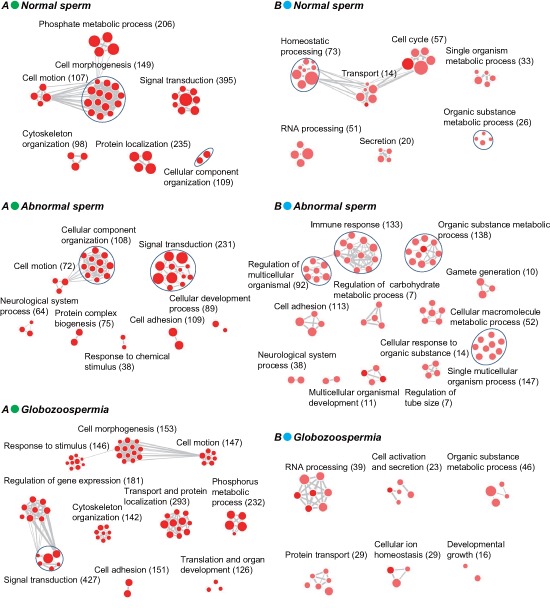
Discovery of 5-hydroxymethylcytosine (5hmC) in mammalian genomes has excited the field of epigenetics, but information on the genome-wide distribution of 5hmC is limited. Globozoospermia is a rare but severe cause of male infertility. To date, the epigenetic mechanism, especially 5hmC profiles involved in globozoospermia progression, remains largely unknown. Here, utilizing the chemical labeling and biotin-enrichment approach followed by Illumina HiSeq sequencing, we showed that (i) 6664, 9029 and 6318 genes contain 5hmC in normal, abnormal, and globozoospermia sperm, respectively; (ii) some 5hmC-containing genes significantly involves in spermatogenesis, sperm motility and morphology, and gamete generation; (iii) 5hmC is exclusively localized in sperm intron; (iv) approximately 40% imprinted genes have 5hmC modification in sperm genomes, but globozoospermia sperm exhibiting a large portion of imprinted genes lose the 5hmC modification; (v) six imprinted genes showed different 5hmC patterns in abnormal sperm (GDAP1L1, GNAS, KCNK9, LIN28B, RB1, RTL1), and five imprinted genes showed different 5hmC patterns in globozoospermia sperm (KCNK9, LIN28B, RB1, SLC22A18, ZDBF2). These results suggested that differences in genome-wide 5hmC patterns may in part be responsible for the sperm phenotype. All of this may improve our understanding of the basic molecular mechanism underlying sperm biology and the etiology of male infertility.
哺乳动物基因组中5-羟甲基胞嘧啶(5hmC)的发现激发了表观遗传学领域的研究热情,但关于5hmC全基因组分布的信息有限。圆头精子症是男性不育的一种罕见但严重的病因。迄今为止,表观遗传机制,尤其是与圆头精子症进展相关的5hmC图谱,仍 largely未知。在此,我们采用化学标记和生物素富集方法,随后进行Illumina HiSeq测序,结果表明:(i)正常、异常和圆头精子症精子中分别有6664、9029和6318个基因含有5hmC;(ii)一些含5hmC的基因显著参与精子发生、精子活力和形态以及配子生成;(iii)5hmC仅定位在精子内含子中;(iv)约40%的印记基因在精子基因组中有5hmC修饰,但圆头精子症精子中很大一部分印记基因失去了5hmC修饰;(v)六个印记基因在异常精子(GDAP1L1、GNAS、KCNK9、LIN28B、RB1、RTL1)中呈现不同的5hmC模式,五个印记基因在圆头精子症精子(KCNK9、LIN28B、RB1、SLC22A18、ZDBF2)中呈现不同的5hmC模式。这些结果表明,全基因组5hmC模式的差异可能部分导致了精子表型的差异。所有这些可能会增进我们对精子生物学基本分子机制以及男性不育病因的理解。