Department of Comparative Biomedical Sciences, The Royal Veterinary College , London , UK.
Front Endocrinol (Lausanne). 2015 Feb 16;6:15. doi: 10.3389/fendo.2015.00015. eCollection 2015.
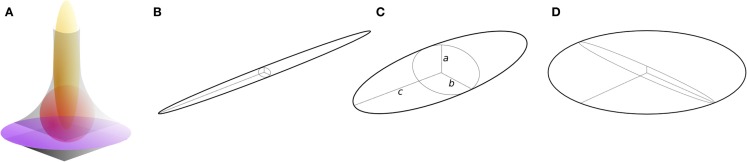
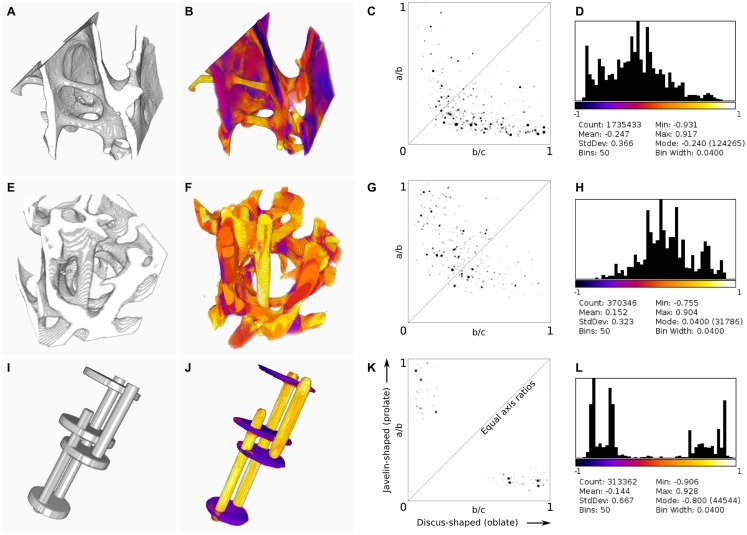
The ellipsoid factor (EF) is a method for the local determination of the rod- or plate-like nature of porous or spongy continua. EF at a point within a 3D structure is defined as the difference in axis ratios of the greatest ellipsoid that fits inside the structure and that contains the point of interest, and ranges from -1 for strongly oblate (discus-shaped) ellipsoids, to +1 for strongly prolate (javelin-shaped) ellipsoids. For an ellipsoid with axes a ≤ b ≤ c, EF = a/b - b/c. Here, EF is demonstrated in a Java plugin, "Ellipsoid Factor" for ImageJ, distributed in the BoneJ plugin collection. Ellipsoid Factor utilizes an ellipsoid optimization algorithm, which assumes that maximal ellipsoids are centered on the medial axis, then dilates, rotates, and translates slightly each ellipsoid until it cannot increase in volume any further. EF successfully identifies rods, plates, and intermediate structures within trabecular bone, and summarizes the distribution of geometries with an overall EF mean and SD, EF histogram, and Flinn diagram displaying a/b versus b/c. EF is released to the community for testing, use, and improvement.
椭圆体因子 (EF) 是一种用于局部确定多孔或海绵状连续体的杆状或板状性质的方法。在 3D 结构内的某一点处的 EF 定义为最适合包含该点的结构内的最大椭球体的轴比与包含该点的椭球体的轴比之间的差异,范围从 -1(极度扁球体)到 +1(极度长球体)。对于具有轴 a≤b≤c 的椭球体,EF=a/b-b/c。这里,EF 在一个名为“ImageJ 的椭球因子”的 Java 插件中得到了演示,该插件分布在 BoneJ 插件集中。椭球因子利用了一种椭球优化算法,该算法假设最大椭球体的中心位于中轴上,然后稍微扩张、旋转和移动每个椭球体,直到它不能再进一步增加体积为止。EF 成功地识别了小梁骨内的杆、板和中间结构,并通过整体 EF 平均值和标准差、EF 直方图和 Flinn 图(显示 a/b 与 b/c)来总结几何形状的分布。EF 被发布给社区进行测试、使用和改进。