Lau Brian, Welter Marie-Laure, Belaid Hayat, Fernandez Vidal Sara, Bardinet Eric, Grabli David, Karachi Carine
1 Sorbonne Universités, UPMC Univ Paris 06, UMR S 1127, CNRS UMR 7225, ICM, F-75013, Paris, France
1 Sorbonne Universités, UPMC Univ Paris 06, UMR S 1127, CNRS UMR 7225, ICM, F-75013, Paris, France 2 Assistance Publique-Hôpitaux de Paris, Groupe Hospitalier Pitié-Salpêtrière, 47 boulevard de l'Hôpital, 75013 Paris, France.
Brain. 2015 May;138(Pt 5):1284-96. doi: 10.1093/brain/awv047. Epub 2015 Mar 12.
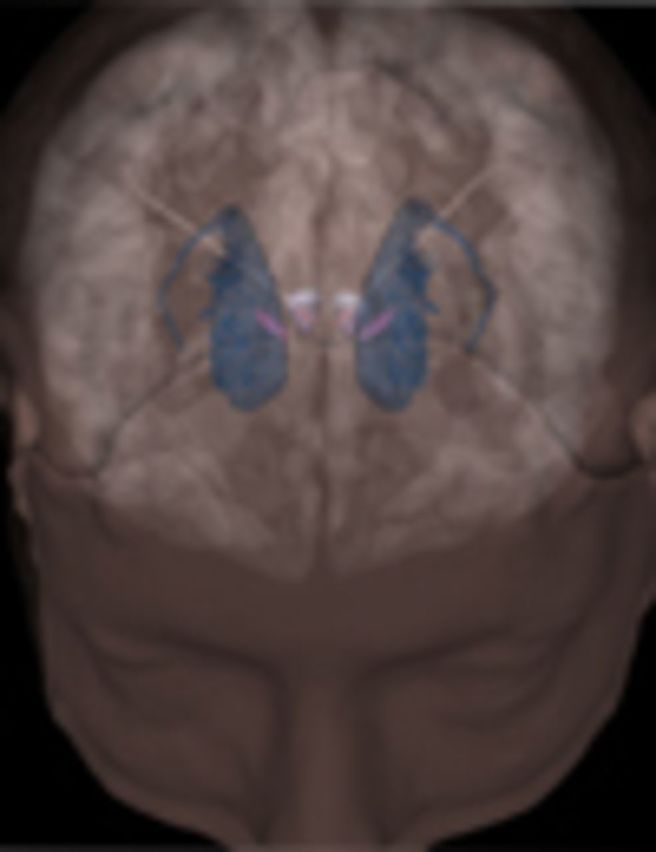
The brainstem pedunculopontine nucleus has a likely, although unclear, role in gait control, and is a potential deep brain stimulation target for treating resistant gait disorders. These disorders are a major therapeutic challenge for the ageing population, especially in Parkinson's disease where gait and balance disorders can become resistant to both dopaminergic medication and subthalamic nucleus stimulation. Here, we present electrophysiological evidence that the pedunculopontine and subthalamic nuclei are involved in distinct aspects of gait using a locomotor imagery task in 14 patients with Parkinson's disease undergoing surgery for the implantation of pedunculopontine or subthalamic nuclei deep brain stimulation electrodes. We performed electrophysiological recordings in two phases, once during surgery, and again several days after surgery in a subset of patients. The majority of pedunculopontine nucleus neurons (57%) recorded intrasurgically exhibited changes in activity related to different task components, with 29% modulated during visual stimulation, 41% modulated during voluntary hand movement, and 49% modulated during imaginary gait. Pedunculopontine nucleus local field potentials recorded post-surgically were modulated in the beta and gamma bands during visual and motor events, and we observed alpha and beta band synchronization that was sustained for the duration of imaginary gait and spatially localized within the pedunculopontine nucleus. In contrast, significantly fewer subthalamic nucleus neurons (27%) recorded intrasurgically were modulated during the locomotor imagery, with most increasing or decreasing activity phasically during the hand movement that initiated or terminated imaginary gait. Our data support the hypothesis that the pedunculopontine nucleus influences gait control in manners extending beyond simply driving pattern generation. In contrast, the subthalamic nucleus seems to control movement execution that is not likely to be gait-specific. These data highlight the crucial role of these two nuclei in motor control and shed light on the complex functions of the lateral mesencephalus in humans.
脑干脚桥核在步态控制中可能发挥作用,尽管尚不清楚,并且是治疗难治性步态障碍的潜在深部脑刺激靶点。这些障碍对老年人群来说是一项重大的治疗挑战,尤其是在帕金森病中,步态和平衡障碍可能对多巴胺能药物和丘脑底核刺激均产生耐药性。在此,我们提供电生理学证据,表明在14例接受脚桥核或丘脑底核深部脑刺激电极植入手术的帕金森病患者中,使用运动想象任务时,脚桥核和丘脑底核参与了步态的不同方面。我们分两个阶段进行电生理记录,一次在手术期间,另一次在手术后几天对部分患者进行记录。术中记录的大多数脚桥核神经元(57%)表现出与不同任务成分相关的活动变化,其中29%在视觉刺激期间受到调制,41%在自主手部运动期间受到调制,49%在想象步态期间受到调制。术后记录的脚桥核局部场电位在视觉和运动事件期间在β和γ频段受到调制,并且我们观察到α和β频段同步在想象步态持续期间持续存在且在脚桥核内呈空间定位。相比之下,术中记录的丘脑底核神经元在运动想象期间受到调制的明显较少(27%),大多数在启动或终止想象步态的手部运动期间相位性地增加或减少活动。我们的数据支持这样的假设,即脚桥核影响步态控制的方式不仅仅是简单地驱动模式生成。相比之下,丘脑底核似乎控制的是不太可能特定于步态的运动执行。这些数据突出了这两个核在运动控制中的关键作用,并揭示了人类中脑外侧的复杂功能。