Department of Biochemistry, Microbiology and Bio-informatics, Université Laval; Axis of Cellular and Molecular Neuroscience, IUSMQ Québec, PQ, Canada.
Front Synaptic Neurosci. 2015 Feb 26;7:5. doi: 10.3389/fnsyn.2015.00005. eCollection 2015.
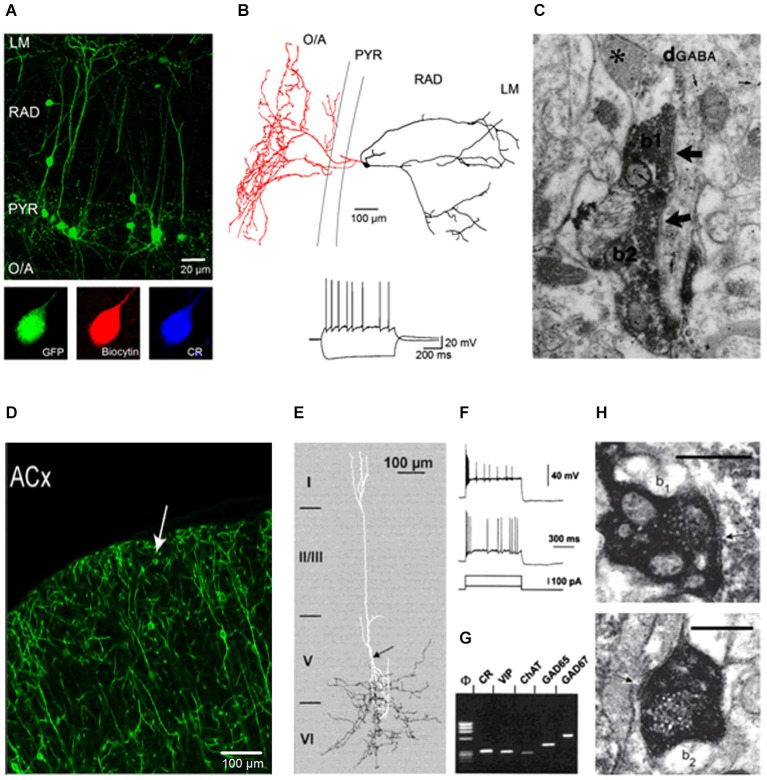
It has been recognized for some time that different subtypes of cortical inhibitory interneurons innervate specific dendritic domains of principal cells and release GABA at particular times during behaviorally relevant network oscillations. However, the lack of basic information on how the activity of interneurons can be controlled by GABA released in particular behavioral states has hindered our understanding of the rules that govern the spatio-temporal organization and function of dendritic inhibition. Similar to principal cells, any given interneuron may receive several functionally distinct inhibitory inputs that target its specific subcellular domains. We recently found that local circuitry of the so-called interneuron-specific (IS) interneurons is responsible for dendritic inhibition of different subtypes of hippocampal interneurons with a great impact on cell output. Here, we will review the properties and the specificity of connections of IS interneurons in the CA1 hippocampus and neocortex, and discuss their possible role in the activity-dependent regulation of dendritic inhibition received by pyramidal neurons.
一段时间以来,人们已经认识到不同亚型的皮质抑制性中间神经元支配主细胞的特定树突域,并在行为相关的网络振荡过程中的特定时间释放 GABA。然而,由于缺乏关于中间神经元的活动如何可以通过特定行为状态下释放的 GABA 进行控制的基本信息,因此我们对支配树突抑制的时空组织和功能的规则的理解受到了阻碍。与主细胞类似,任何给定的中间神经元都可能接收几个功能上不同的抑制性输入,这些输入针对其特定的亚细胞域。我们最近发现,所谓的中间神经元特异性(IS)中间神经元的局部回路负责不同亚型的海马中间神经元的树突抑制,对细胞输出有很大的影响。在这里,我们将回顾 CA1 海马体和新皮层中 IS 中间神经元的连接特性和特异性,并讨论它们在依赖于活动的调节中对接受树突抑制的锥体神经元可能发挥的作用。