Kimerling Rachel, Pavao Joanne, Greene Liberty, Karpenko Julie, Rodriguez Allison, Saweikis Meghan, Washington Donna L
*National Center for PTSD †Center for Innovation to Implementation, VA Palo Alto Health Care System, Menlo Park ‡VA Greater Los Angeles Health Services Research and Development Center for the Study of Healthcare Innovation, Implementation & Policy, Sepulveda §Department of Medicine, Geffen School of Medicine at University of California, Los Angeles, Los Angeles, CA.
Med Care. 2015 Apr;53(4 Suppl 1):S97-S104. doi: 10.1097/MLR.0000000000000272.
Patient-centered access to mental health describes the fit between patient needs and resources of the system. To date, little data are available to guide implementation of services to women veterans, an underrepresented minority within Department of Veteran Affairs (VA) health care. The current study examines access to mental health care among women veterans, and identifies gender-related indicators of perceived access to mental health care.
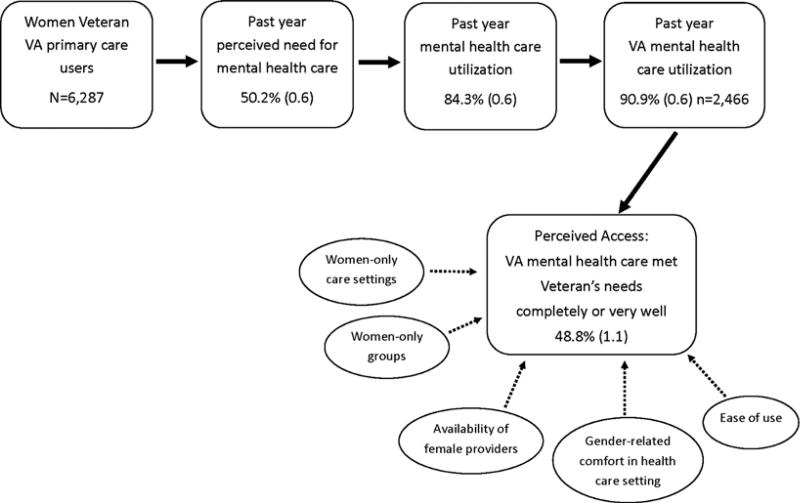
A population-based sample of 6287 women veterans using VA primary care services participated in a survey of past year perceived need for mental health care, mental health utilization, and gender-related mental health care experiences. Subjective rating of how well mental health care met their needs was used as an indicator of perceived access.
Half of all women reported perceived mental health need; 84.3% of those women received care. Nearly all mental health users (90.9%) used VA services, although only about half (48.8%) reported that their mental health care met their needs completely or very well. Gender related experiences (availability of female providers, women-only treatment settings, women-only treatment groups, and gender-related comfort) were each associated with 2-fold increased odds of perceived access, and associations remained after adjusting for ease of getting care.
Women VA users demonstrate very good objective access to mental health services. Desire for, and access to specialized mental health services for women varies across the population and are important aspects of shared decision making in referral and treatment planning for women using VA primary care.
以患者为中心的心理健康服务可及性描述了患者需求与系统资源之间的匹配度。迄今为止,几乎没有数据可用于指导为女性退伍军人提供服务,她们在退伍军人事务部(VA)医疗保健体系中是代表性不足的少数群体。本研究调查了女性退伍军人获得心理健康服务的情况,并确定了与性别相关的心理健康服务可及性认知指标。
对6287名使用VA初级保健服务的女性退伍军人进行基于人群的抽样调查,内容包括过去一年对心理健康服务的感知需求、心理健康服务利用情况以及与性别相关的心理健康服务体验。将心理健康服务满足其需求程度的主观评分作为可及性认知的指标。
一半的女性报告有心理健康需求;其中84.3%的女性接受了治疗。几乎所有心理健康服务使用者(90.9%)都使用了VA服务,尽管只有约一半(48.8%)的人报告其心理健康服务完全或非常好地满足了她们的需求。与性别相关的体验(女性提供者的可及性、仅限女性的治疗环境、仅限女性的治疗小组以及与性别相关的舒适度)每一项都与可及性认知的几率增加2倍相关,在调整了获得护理的难易程度后,这种关联仍然存在。
使用VA服务的女性在客观上有很好的机会获得心理健康服务。女性对专门心理健康服务的需求和可及性因人群而异,并且是为使用VA初级保健服务的女性进行转诊和治疗规划时共同决策的重要方面。