Pauken Kristen E, Nelson Christine E, Martinov Tijana, Spanier Justin A, Heffernan James R, Sahli Nathanael L, Quarnstrom Clare F, Osum Kevin C, Schenkel Jason M, Jenkins Marc K, Blazar Bruce R, Vezys Vaiva, Fife Brian T
Department of Medicine, Center for Immunology, University of Minnesota, Minneapolis, MN 55455.
University of Pennsylvania, Philadelphia, PA 19104.
J Immunol. 2015 Apr 15;194(8):3551-3555. doi: 10.4049/jimmunol.1402262. Epub 2015 Mar 13.
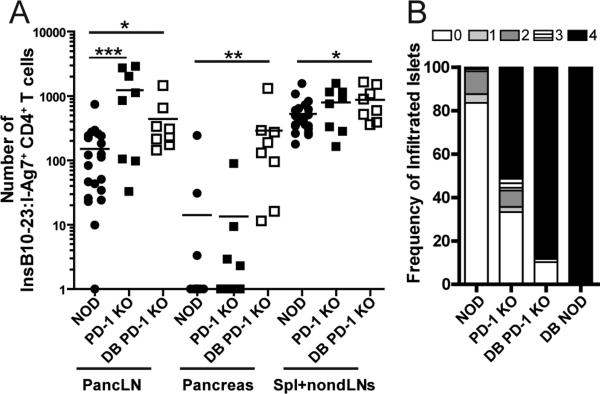
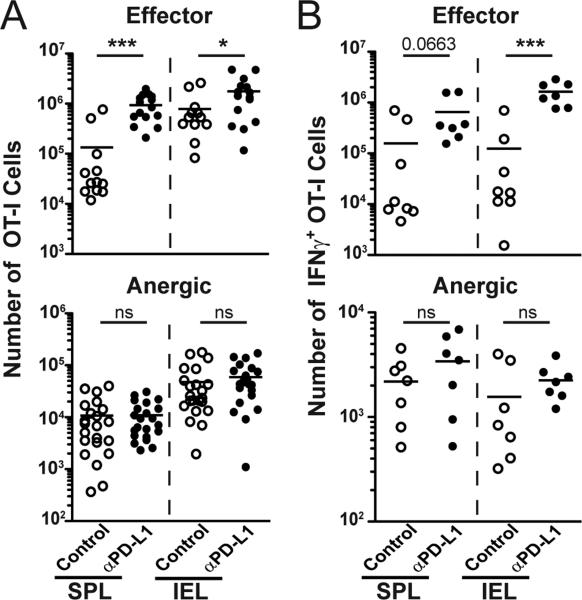
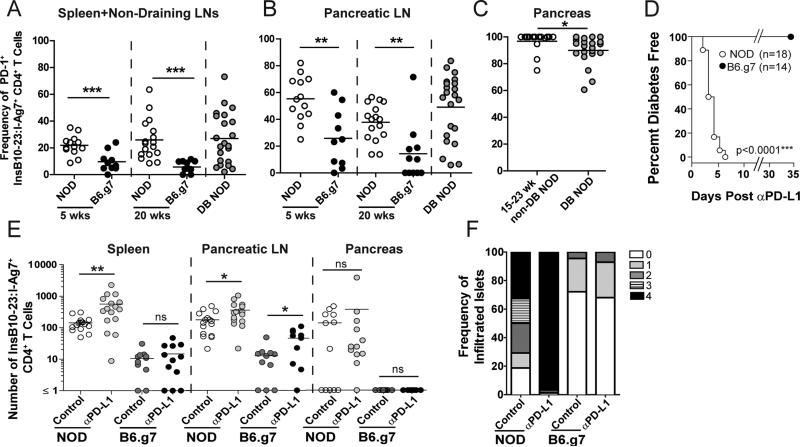
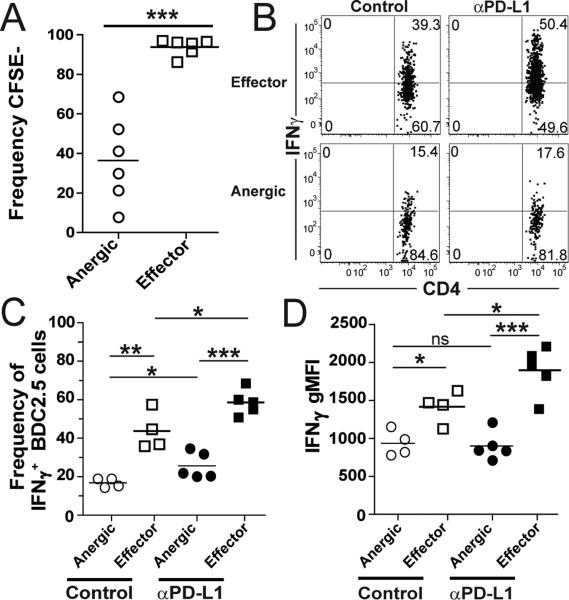
Programmed death-1 (PD-1) promotes T cell tolerance. Despite therapeutically targeting this pathway for chronic infections and tumors, little is known about how different T cell subsets are affected during blockade. We examined PD-1/PD ligand 1 (PD-L1) regulation of self-antigen-specific CD4 and CD8 T cells in autoimmune-susceptible models. PD-L1 blockade increased insulin-specific effector CD4 T cells in type 1 diabetes. However, anergic islet-specific CD4 T cells were resistant to PD-L1 blockade. Additionally, PD-L1 was critical for induction, but not maintenance, of CD8 T cell intestinal tolerance. PD-L1 blockade enhanced functionality of effector T cells, whereas established tolerant or anergic T cells were not dependent on PD-1/PD-L1 signaling to remain unresponsive. This highlights the existence of Ag-experienced T cell subsets that do not rely on PD-1/PD-L1 regulation. These findings illustrate how positive treatment outcomes and autoimmunity development during PD-1/PD-L1 inhibition are linked to the differentiation state of a T cell.
程序性死亡-1(PD-1)促进T细胞耐受。尽管针对慢性感染和肿瘤对该途径进行了治疗性靶向,但对于在阻断过程中不同T细胞亚群如何受到影响却知之甚少。我们在自身免疫易感模型中研究了PD-1/PD配体1(PD-L1)对自身抗原特异性CD4和CD8 T细胞的调节作用。在1型糖尿病中,阻断PD-L1可增加胰岛素特异性效应CD4 T细胞。然而,无反应性的胰岛特异性CD4 T细胞对PD-L1阻断具有抗性。此外,PD-L1对CD8 T细胞肠道耐受的诱导至关重要,但对维持作用并不关键。阻断PD-L1可增强效应T细胞的功能,而已建立耐受或无反应性的T细胞并不依赖PD-1/PD-L1信号来保持无反应状态。这突出表明存在不依赖PD-1/PD-L1调节的抗原经验丰富的T细胞亚群。这些发现阐明了在PD-1/PD-L1抑制期间积极的治疗结果和自身免疫发展如何与T细胞的分化状态相关联。