Lee Jaewon, Zhang Tianxiang, Hwang Ilwoong, Kim Ahrom, Nitschke Larissa, Kim MinJae, Scott Jeannine M, Kamimura Yosuke, Lanier Lewis L, Kim Sungjin
Department of Microbiology and Molecular Genetics, Michigan State University, East Lansing, MI 48824, USA.
Department of Microbiology and Immunology, University of California San Francisco, San Francisco, CA 94143, USA.
Immunity. 2015 Mar 17;42(3):431-42. doi: 10.1016/j.immuni.2015.02.013.
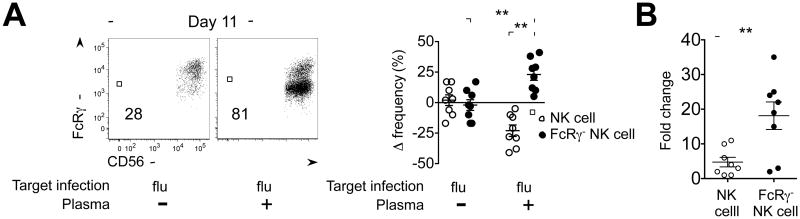
Long-lived "memory-like" NK cells have been identified in individuals infected by human cytomegalovirus (HCMV), but little is known about how the memory-like NK cell pool is formed. Here, we have shown that HCMV-infected individuals have several distinct subsets of memory-like NK cells that are often deficient for multiple transcription factors and signaling proteins, including tyrosine kinase SYK, for which the reduced expression was stable over time and correlated with epigenetic modification of the gene promoter. Deficient expression of these proteins was largely confined to the recently discovered FcRγ-deficient NK cells that display enhanced antibody-dependent functional activity. Importantly, FcRγ-deficient NK cells exhibited robust preferential expansion in response to virus-infected cells (both HCMV and influenza) in an antibody-dependent manner. These findings suggest that the memory-like NK cell pool is shaped and maintained by a mechanism that involves both epigenetic modification of gene expression and antibody-dependent expansion.
在感染人巨细胞病毒(HCMV)的个体中已鉴定出长寿命的“记忆样”自然杀伤细胞(NK细胞),但对于记忆样NK细胞库是如何形成的却知之甚少。在此,我们发现感染HCMV的个体具有几个不同的记忆样NK细胞亚群,这些亚群通常缺乏多种转录因子和信号蛋白,包括酪氨酸激酶SYK,其表达降低随时间稳定,且与基因启动子的表观遗传修饰相关。这些蛋白的表达缺陷主要局限于最近发现的FcRγ缺陷型NK细胞,这些细胞表现出增强的抗体依赖性功能活性。重要的是,FcRγ缺陷型NK细胞以抗体依赖的方式对病毒感染细胞(HCMV和流感病毒)表现出强大的优先扩增。这些发现表明,记忆样NK细胞库是由一种涉及基因表达表观遗传修饰和抗体依赖扩增的机制塑造和维持的。