Ma Xiaofen, Jiang Guihua, Li Shumei, Wang Jinhui, Zhan Wenfeng, Zeng Shaoqing, Tian Junzhang, Xu Yikai
Department of Medical Imaging Center, Nanfang Hospital, Southern Medial University, Guangzhou, PR China.
Department of Medical Imaging, Guangdong No. 2 Provincial People's Hospital, Guangzhou, PR China.
PLoS One. 2015 Mar 18;10(3):e0121085. doi: 10.1371/journal.pone.0121085. eCollection 2015.
This study aimed to investigate the topological organization of intrinsic functional brain networks in patients with end-stage renal disease (ESRD).
Resting-state functional MRI data were collected from 22 patients with ESRD (16 men, 18-61 years) and 29 age- and gender-matched healthy controls (HCs, 19 men, 32-61 years). Whole-brain functional networks were obtained by calculating the interregional correlation of low-frequency fluctuations in spontaneous brain activity among 1,024 parcels that cover the entire cerebrum. Weighted graph-based models were then employed to topologically characterize these networks at different global, modular and nodal levels.
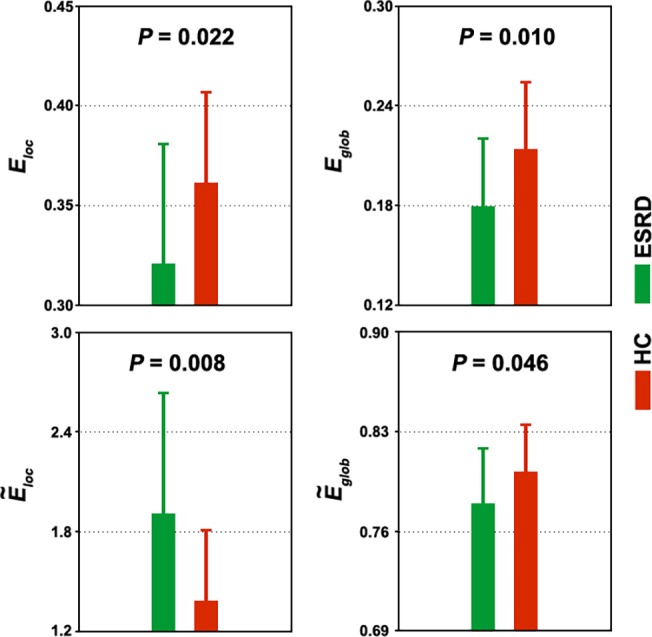
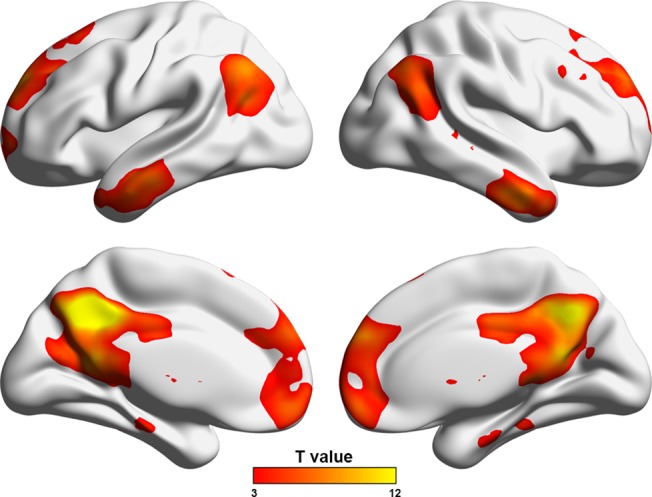
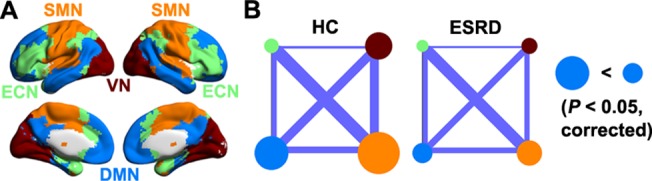
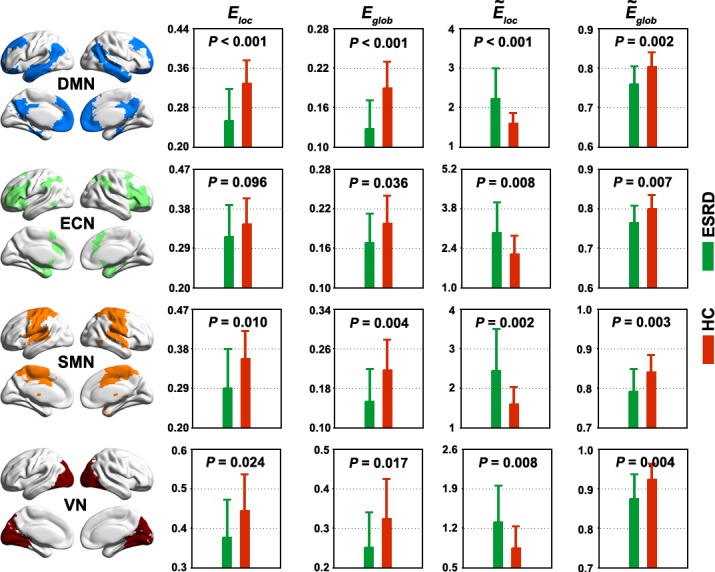
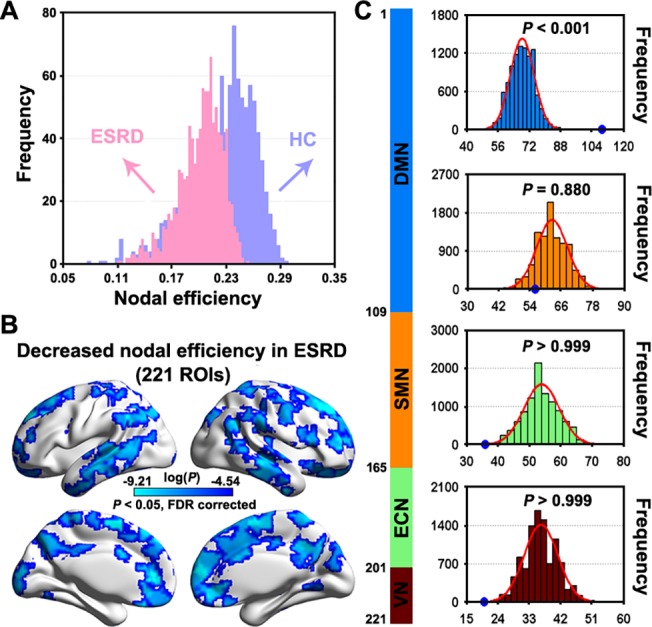
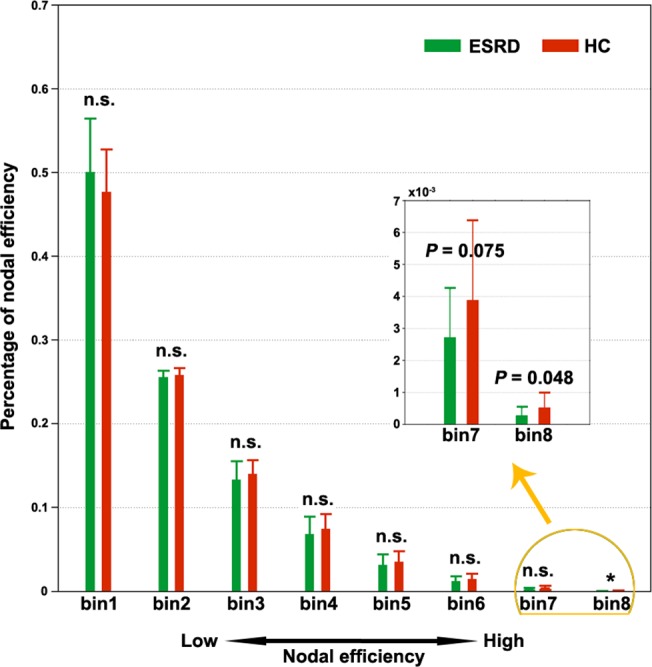
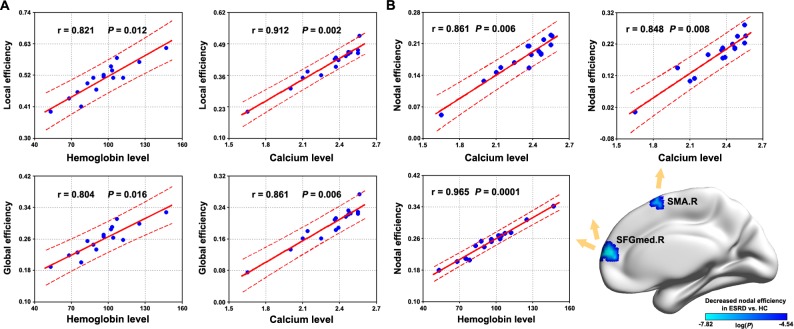
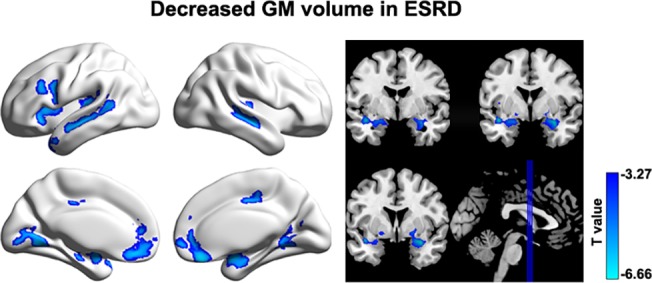
Compared to HCs, the patients exhibited significant disruption in parallel information processing over the whole networks (P < 0.05). The disruption was present in all the functional modules (default mode, executive control, sensorimotor and visual networks) although decreased functional connectivity was observed only within the default mode network. Regional analysis showed that the disease disproportionately weakened nodal efficiency of the default mode components and tended to preferentially affect central or hub-like regions. Intriguingly, the network abnormalities correlated with biochemical hemoglobin and serum calcium levels in the patients. Finally, the functional changes were substantively unchanged after correcting for gray matter atrophy in the patients.
Our findings provide evidence for the disconnection nature of ESRD's brain and therefore have important implications for understanding the neuropathologic substrate of the disease from disrupted network organization perspective.
本研究旨在调查终末期肾病(ESRD)患者大脑内在功能网络的拓扑组织。
收集了22例ESRD患者(16例男性,年龄18 - 61岁)和29例年龄及性别匹配的健康对照者(HCs,19例男性,年龄32 - 61岁)的静息态功能磁共振成像数据。通过计算覆盖整个大脑的1024个脑区自发脑活动低频波动的区域间相关性,获得全脑功能网络。然后采用基于加权图的模型在不同的全局、模块和节点水平对这些网络进行拓扑特征描述。
与HCs相比,患者在整个网络的并行信息处理方面表现出显著破坏(P < 0.05)。尽管仅在默认模式网络内观察到功能连接性降低,但所有功能模块(默认模式、执行控制、感觉运动和视觉网络)均存在破坏。区域分析表明,该疾病对默认模式组件的节点效率削弱程度不成比例,且倾向于优先影响中央或枢纽样区域。有趣的是,患者的网络异常与生化血红蛋白和血清钙水平相关。最后,在对患者的灰质萎缩进行校正后,功能变化基本未改变。
我们的研究结果为ESRD大脑的断开连接性质提供了证据,因此从网络组织破坏的角度对理解该疾病的神经病理基础具有重要意义。