Wong Chee Wai, Liao Jiemin, Cheung Gemmy C, Khor Chiea Chuen, Vithana Eranga N, Wang Jie Jin, Mitchell Paul, Aung Tin, Wong Tien Y, Cheng Ching-Yu
Singapore Eye Research Institute, Singapore National Eye Centre, Singapore, Singapore.
Singapore Eye Research Institute, Singapore National Eye Centre, Singapore, Singapore; Department of Ophthalmology, National University of Singapore and National University Health System, Singapore, Singapore.
PLoS One. 2015 Mar 18;10(3):e0119570. doi: 10.1371/journal.pone.0119570. eCollection 2015.
To determine the differential effects of genetic polymorphism in CFH and ARMS2 on risk of age-related macular degeneration (AMD) between phakic vs. pseudophakic/aphakic eyes.
9,529 eyes of 4,918 participants from the Singapore Malay Eye Study and Singapore Indian Eye Study were analyzed. Participants had detailed eye examinations, including slit-lamp examinations and dilated fundus photography. AMD grading was performed according to the Wisconsin age-related maculopathy grading system. Lens status was defined. Single nucleotide polymorphisms (SNPs) rs10801555 (Y402H) within CFH and rs3750847 in ARMS2 were assessed. The main outcome measure was early AMD or any AMD.
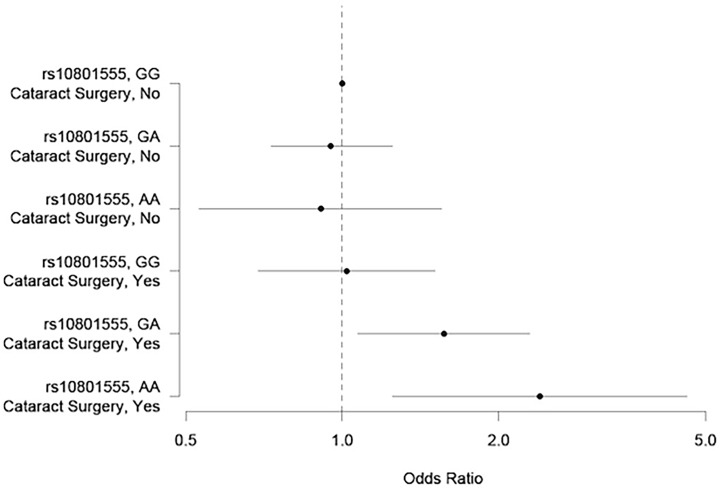
No significant associations between the CFH Y402H genotypes and early AMD were found in phakic individuals. In contrast, among pseudophakic/aphakic individuals, the CFH Y402H risk genotypes were significantly associated with higher odds of early AMD, with an OR of 1.57 (95% CI: 1.07-2.29) for GA genotype and 2.40 (95% CI: 1.25-4.61) for AA genotype, compared to those with GG genotype. There was significant interaction between pseudophakic/aphakic status and CFH Y402H variant on risk of early AMD (p = 0.037), adjusting for age, gender, and the first 5 genetic principal components. No significant interaction was found between lens status and ARMS2 rs3750847.
CFH genetic polymorphism and pseudophakic/aphakic status may have a potential synergistic effect on early AMD, suggesting roles for the complement system and related pathways in the pathogenesis of AMD in eyes after cataract surgery.
确定补体因子H(CFH)和含血管生成素样蛋白2(ARMS2)基因多态性对有晶状体眼与人工晶状体眼/无晶状体眼年龄相关性黄斑变性(AMD)风险的不同影响。
对来自新加坡马来人眼研究和新加坡印度人眼研究的4918名参与者的9529只眼睛进行了分析。参与者接受了详细的眼部检查,包括裂隙灯检查和散瞳眼底照相。根据威斯康星年龄相关性黄斑病变分级系统进行AMD分级。确定晶状体状态。评估CFH基因内的单核苷酸多态性(SNP)rs10801555(Y402H)和ARMS2基因中的rs3750847。主要观察指标为早期AMD或任何AMD。
在有晶状体个体中,未发现CFH Y402H基因型与早期AMD之间存在显著关联。相比之下,在人工晶状体眼/无晶状体个体中,CFH Y402H风险基因型与早期AMD的较高几率显著相关,与GG基因型个体相比,GA基因型的比值比(OR)为1.57(95%可信区间:1.07 - 2.29),AA基因型为2.40(95%可信区间:1.25 - 4.61)。在调整年龄、性别和前5个遗传主成分后,人工晶状体眼/无晶状体状态与CFH Y402H变异对早期AMD风险存在显著交互作用(p = 0.037)。未发现晶状体状态与ARMS2 rs3750847之间存在显著交互作用。
CFH基因多态性与人工晶状体眼/无晶状体状态可能对早期AMD具有潜在的协同作用,提示补体系统及相关途径在白内障手术后眼AMD发病机制中发挥作用。