Mackey Tim K, Strathdee Steffanie A
Department of Anesthesiology, University of California, San Diego School of Medicine, San Diego, CA, USA.
Division of Global Public Health, University of California, San Diego School of Medicine, San Diego, CA, USA.
J Int AIDS Soc. 2015 Mar 17;18(1):19410. doi: 10.7448/IAS.18.1.19410. eCollection 2015.
Peace and stability in Eastern Europe is now at a crossroads with the rapidly deteriorating foreign policy crisis continuing to unfold in the Ukraine. However, largely overlooked in the context of other foreign policy and diplomatic priorities are the serious public health consequences for the region following the annexation of Crimea and the subsequent decision to ban opioid substitution therapy in the disputed territory.
On 1 May 2014, the Republic of Crimea officially announced it would end access to opioid substitution therapy, an essential harm reduction tool recognized by international organizations and virtually all other European countries. The policy development marks a critical reversal in the region's fight against its growing HIV epidemic and also threatens years of public health gains aimed at providing evidence-based and integrated treatment approaches to combat drug dependence and HIV. Beyond these risks, the Ukrainian conflict could also negatively impact control of other infectious diseases that are converging with HIV and injection drug use, such as multidrug-resistant tuberculosis and hepatitis C virus. The continuing conflict is also likely to have a significant negative impact on Ukraine's fragile public health system leading to even worse population health outcomes than currently experienced by the country.
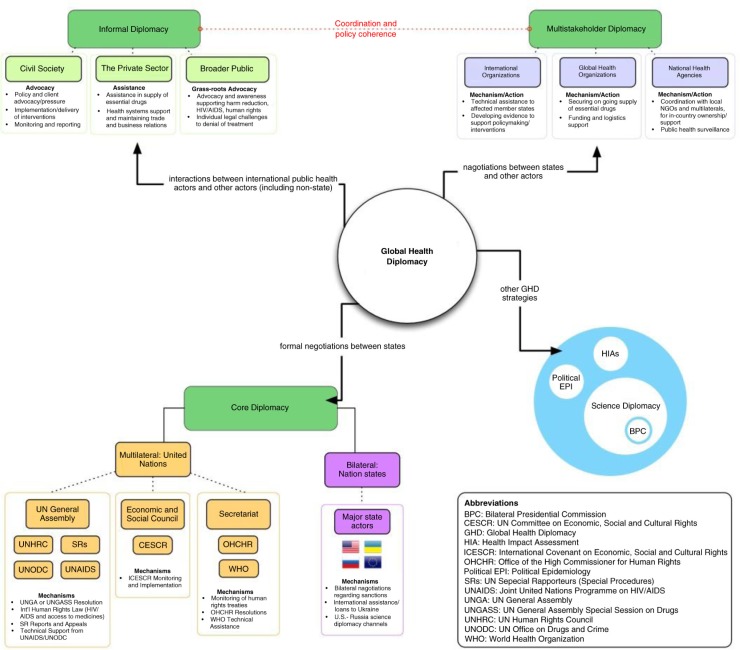
In response to this crisis, the application of global health diplomacy principles represents a possible route of advocacy to ensure that HIV prevention, humane treatment of substance using populations, and improving public health outcomes in the region are pursued among concerned international stakeholders. In order to be effective, global health diplomacy efforts must be coordinated and advocated in all forms of diplomatic engagement, including at the core, multistakeholder and informal levels and through existing channels such as the different human rights bodies of the United Nations as well as amongst other actors. Hence, the Ukraine crisis represents a critical moment for the practice and advancement of global health diplomacy in order to ensure global public health priorities are given their rightful place in foreign policy making to hopefully help in bringing resolution to the current conflict.
随着乌克兰外交政策危机迅速恶化且仍在持续,东欧的和平与稳定正处于十字路口。然而,在其他外交政策和外交重点的背景下,克里米亚被吞并以及随后在争议地区禁止阿片类药物替代疗法给该地区带来的严重公共卫生后果在很大程度上被忽视了。
2014年5月1日,克里米亚共和国正式宣布将停止提供阿片类药物替代疗法,而这是国际组织和几乎所有其他欧洲国家都认可的一项重要的减少伤害工具。这一政策转变标志着该地区在抗击日益严重的艾滋病毒疫情方面的关键逆转,也威胁到多年来旨在提供循证综合治疗方法以对抗药物依赖和艾滋病毒的公共卫生成果。除了这些风险,乌克兰冲突还可能对与艾滋病毒和注射吸毒并存的其他传染病的控制产生负面影响,比如耐多药结核病和丙型肝炎病毒。持续的冲突也可能对乌克兰脆弱的公共卫生系统产生重大负面影响,导致该国人口健康状况比目前更糟。
为应对这一危机,应用全球卫生外交原则是一种可行的倡导途径,以确保相关国际利益攸关方在该地区开展艾滋病毒预防、对吸毒人群的人道治疗以及改善公共卫生成果等工作。为了取得成效,全球卫生外交努力必须在所有形式的外交接触中进行协调和倡导,包括在核心层面、多利益攸关方层面和非正式层面,并通过现有渠道,如联合国不同人权机构以及其他行为体。因此,乌克兰危机是全球卫生外交实践和推进的关键时刻,以确保全球公共卫生重点在外交决策中获得应有的地位,有望帮助解决当前冲突。