Li Xiaohua, Song Dalin, Leng Sean X
Dalian Medical University, Dalian, People's Republic of China.
Department of Geriatrics, Qingdao Municipal Hospital, Qingdao, People's Republic of China.
Clin Interv Aging. 2015 Mar 10;10:549-60. doi: 10.2147/CIA.S74042. eCollection 2015.
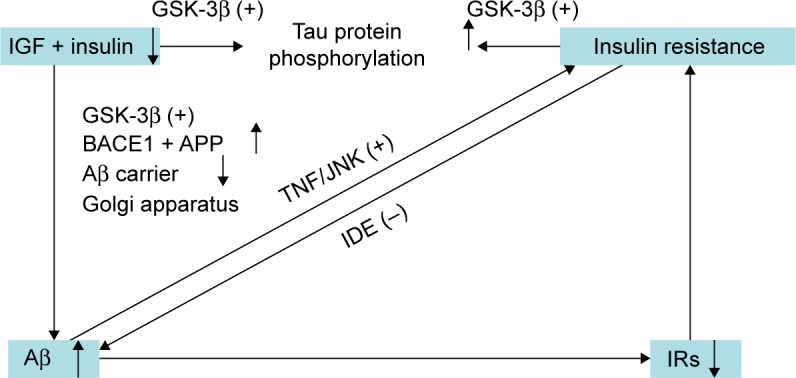
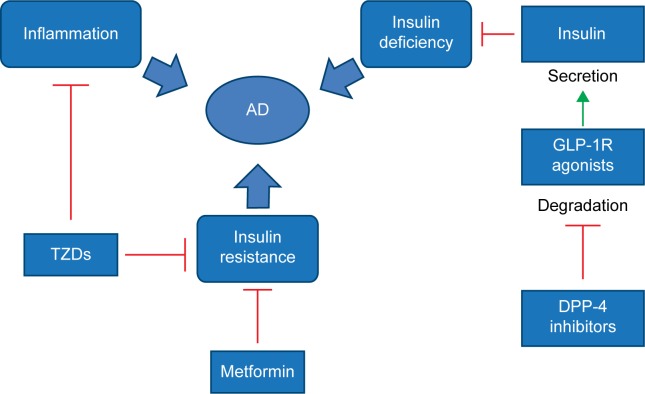
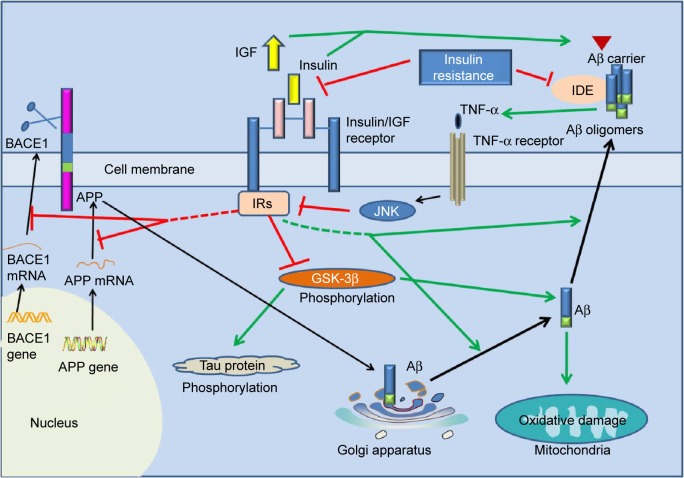
The aim of this paper is to provide a comprehensive review of the epidemiological evidence linking type 2 diabetes mellitus and its related conditions, including obesity, hyperinsulinemia, and metabolic syndrome, to Alzheimer's disease (AD). Several mechanisms could help to explain this proposed link; however, our focus is on insulin resistance and deficiency. Studies have shown that insulin resistance and deficiency can interact with amyloid-β protein and tau protein phosphorylation, each leading to the onset and development of AD. Based on those epidemiological data and basic research, it was recently proposed that AD can be considered as "type 3 diabetes". Special attention has been paid to determining whether antidiabetic agents might be effective in treating AD. There has been much research both experimental and clinical on this topic. We mainly discuss the clinical trials on insulin, metformin, thiazolidinediones, glucagon-like peptide-1 receptor agonists, and dipeptidyl peptidase-4 inhibitors in the treatment of AD. Although the results of these trials seem to be contradictory, this approach is also full of promise. It is worth mentioning that the therapeutic effects of these drugs are influenced by the apolipoprotein E (APOE)-ε4 genotype. Patients without the APOE-ε4 allele showed better treatment effects than those with this allele.
本文旨在全面综述将2型糖尿病及其相关病症(包括肥胖、高胰岛素血症和代谢综合征)与阿尔茨海默病(AD)联系起来的流行病学证据。有几种机制可以解释这种推测的联系;然而,我们关注的是胰岛素抵抗和缺乏。研究表明,胰岛素抵抗和缺乏可与淀粉样β蛋白和tau蛋白磷酸化相互作用,各自导致AD的发生和发展。基于这些流行病学数据和基础研究,最近有人提出AD可被视为“3型糖尿病”。人们特别关注确定抗糖尿病药物是否可能有效治疗AD。关于这个主题已经有很多实验和临床研究。我们主要讨论胰岛素、二甲双胍、噻唑烷二酮类、胰高血糖素样肽-1受体激动剂和二肽基肽酶-4抑制剂治疗AD的临床试验。尽管这些试验的结果似乎相互矛盾,但这种方法也充满希望。值得一提的是,这些药物的治疗效果受载脂蛋白E(APOE)-ε4基因型的影响。没有APOE-ε4等位基因的患者比有该等位基因的患者显示出更好的治疗效果。