Nguyen Huy, Romani Andrea
Department of Physiology and Biophysics, School of Medicine, Case Western Reserve University, Cleveland, OH 44106, USA.
J Cardiovasc Dis Diagn. 2014 Oct 23;2(6):179. doi: 10.4172/2329-9517.1000179.
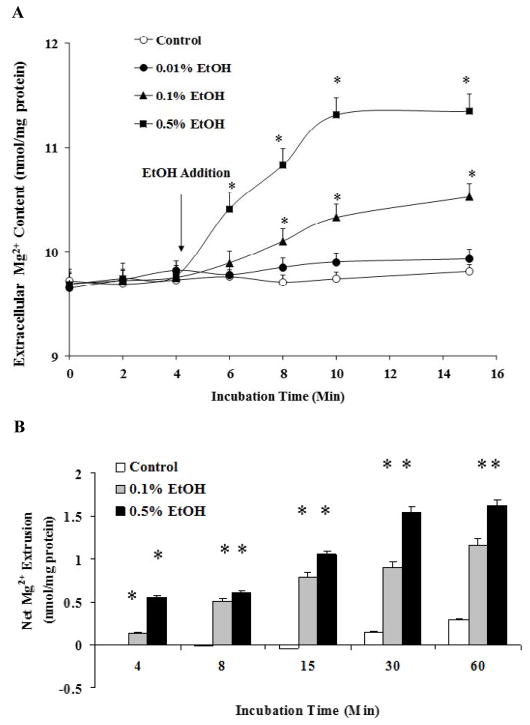
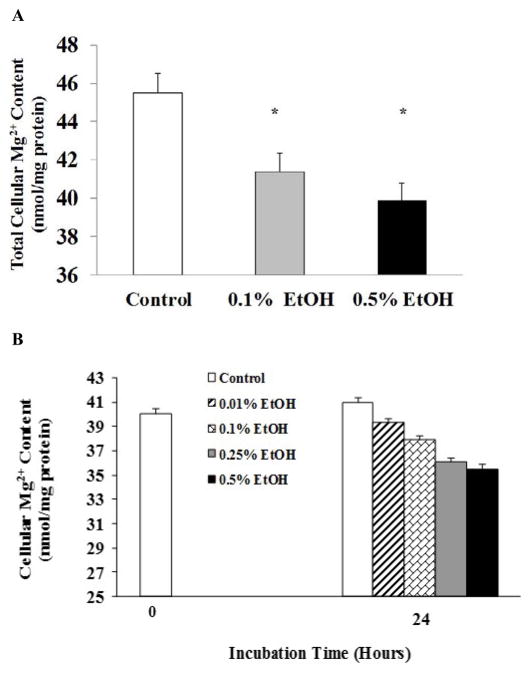
Alcoholic cardiomyopathy represents one of the main clinical complications in chronic alcoholics. This pathology contrasts the seemingly beneficial effect of small doses of alcohol on the cardiovascular system. Studies carried out in liver cells exposed acutely or chronically to varying doses of EtOH indicate that intrahepatic alcohol metabolism results in a major loss of cellular Mg. To investigate whether EtOH administration also induced Mg extrusion in cardiac cells, H9C2 cells were exposed to varying doses of EtOH for short- or ling-term periods of time. The results indicate that H9C2 cells exposed to EtOH doses higher than 0.1% (v/v, or 15 mM) extruded Mg into the extracellular medium on a time- and dose-dependent manner. Consistent with the involvement of cyP4502E1 in metabolizing EtOH, administration of chloro-methiazole (CMZ) as an inhibitor of the cytochrome prevented EtOH-induced Mg loss to a large extent. EtOH-induced Mg extrusion was also prevented by the administration of di-thio-treitol (DTT) and n-acetyl-cysteine (NAC), two agents that prevent the negative effects of ROS formation and free radicals generation associated with EtOH metabolism by cyP4502E1. Taken together, our data indicate that Mg extrusion also occur in cardiac cells exposed to EtOH as a result of alcohol metabolism by cyP4502E1 and associated free radical formation. Interestingly, Mg extrusion only occurs at doses of EtOH higher than 0.1% administered for an extended period of time. The significance of Mg extrusion for the onset of alcoholic cardiomyopathy remains to be elucidated.
酒精性心肌病是慢性酒精中毒患者主要的临床并发症之一。这种病症与小剂量酒精对心血管系统看似有益的作用形成对比。对急性或慢性暴露于不同剂量乙醇的肝细胞进行的研究表明,肝内酒精代谢会导致细胞内镁大量流失。为了研究乙醇给药是否也会诱导心肌细胞中镁的排出,将H9C2细胞在短期或长期内暴露于不同剂量的乙醇中。结果表明,暴露于高于0.1%(体积/体积,即15 mM)乙醇剂量的H9C2细胞以时间和剂量依赖的方式将镁排出到细胞外培养基中。与细胞色素P4502E1参与乙醇代谢一致,给予氯美噻唑(CMZ)作为细胞色素抑制剂可在很大程度上防止乙醇诱导的镁流失。给予二硫苏糖醇(DTT)和N-乙酰半胱氨酸(NAC)也可防止乙醇诱导的镁排出,这两种药物可防止与细胞色素P4502E1介导的乙醇代谢相关的活性氧形成和自由基产生的负面影响。综上所述,我们的数据表明,由于细胞色素P4502E1介导的酒精代谢和相关的自由基形成,暴露于乙醇的心肌细胞中也会发生镁排出。有趣的是,镁排出仅在长时间给予高于0.1%的乙醇剂量时才会发生。镁排出对酒精性心肌病发病的意义仍有待阐明。