Danaviah Sivapragashini, de Oliveira Tulio, Bland Ruth, Viljoen Johannes, Pillay Sureshnee, Tuaillon Edouard, Van de Perre Philippe, Newell Marie-Louise
Africa Centre for Health and Population Studies, University of KwaZulu-Natal, Durban, South Africa.
Africa Centre for Health and Population Studies, University of KwaZulu-Natal, Durban, South Africa; Royal Hospital for Sick Children, Glasgow, United Kingdom.
PLoS One. 2015 Mar 20;10(3):e0120389. doi: 10.1371/journal.pone.0120389. eCollection 2015.
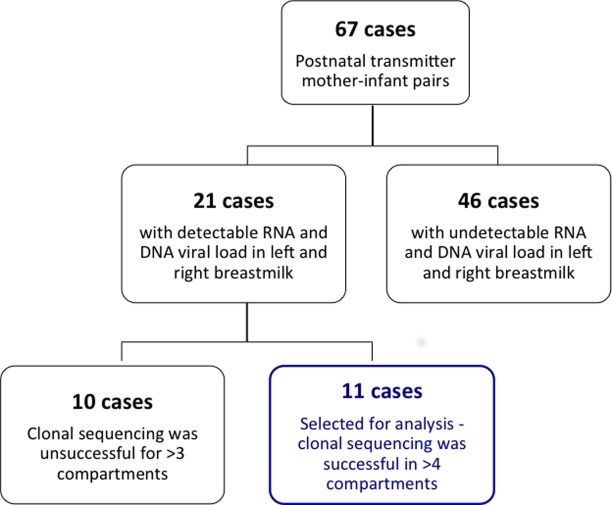
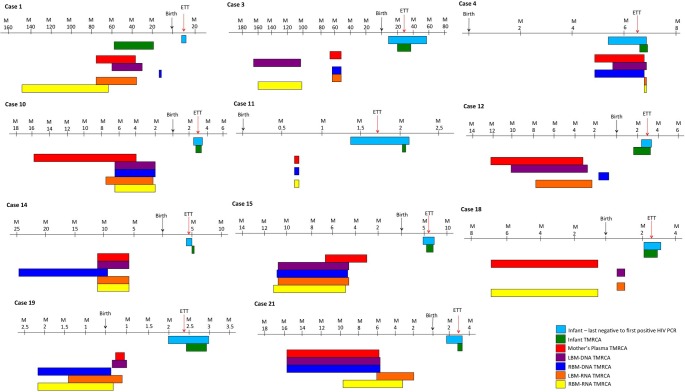
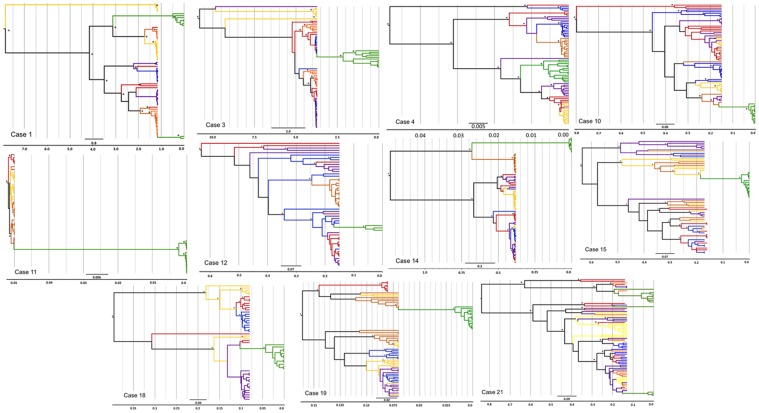
Exposure of the infant's gut to cell-associated and cell-free HIV-1 trafficking in breast milk (BM) remains a primary cause of mother-to-child transmission (MTCT). The mammary gland represents a unique environment for HIV-1 replication and host-virus interplay. We aimed to explore the origin of the virus transmitted during breastfeeding, and the link with quasi-species found in acellular and cellular fractions of breast-milk (BM) and in maternal plasma. The C2-V5 region of the env gene was amplified, cloned and sequenced from the RNA and DNA of BM, the RNA from the mother's plasma (PLA) and the DNA from infant's dried blood spot (DBS) in 11 post-natal mother-infant pairs. Sequences were assembled in Geneious, aligned in ClustalX, manually edited in SeAL and phylogenetic reconstruction was undertaken in PhyML and MrBayes. We estimated the timing of transmission (ETT) and reconstructed the time for the most recent common ancestor (TMRCA) of the infant in BEAST. Transmission of single quasi-species was observed in 9 of 11 cases. Phylogenetic analysis illustrated a BM transmission event by cell-free virus in 4 cases, and by cell-associated virus in 2 cases but could not be identified in the remaining 5 cases. Molecular clock estimates, of the infant ETT and TMRCA, corresponded well with the timing of transmission estimated by sequential infant DNA PCR in 10 of 11 children. The TMRCA of BM variants were estimated to emerge during gestation in 8 cases. We hypothesize that in the remaining cases, the breast was seeded with a long-lived lineage latently infecting resting T-cells. Our analysis illustrated the role of DNA and RNA virus in MTCT. We postulate that DNA archived viruses stem from latently infected quiescent T-cells within breast tissue and MTCT can be expected to continue, albeit at low levels, should interventions not effectively target these cells.
婴儿肠道暴露于母乳(BM)中与细胞相关及无细胞的HIV-1传播,仍然是母婴传播(MTCT)的主要原因。乳腺是HIV-1复制和宿主-病毒相互作用的独特环境。我们旨在探究母乳喂养期间传播病毒的来源,以及与母乳无细胞和细胞成分及母体血浆中发现的准种的联系。在11对产后母婴中,从母乳的RNA和DNA、母亲血浆(PLA)的RNA以及婴儿干血斑(DBS)的DNA中扩增、克隆并测序env基因的C2-V5区域。序列在Geneious中组装,在ClustalX中比对,在SeAL中手动编辑,并在PhyML和MrBayes中进行系统发育重建。我们在BEAST中估计传播时间(ETT)并重建婴儿最近共同祖先的时间(TMRCA)。在11例中的9例观察到单一准种的传播。系统发育分析表明,4例为无细胞病毒导致的母乳传播事件,2例为细胞相关病毒导致的母乳传播事件,但其余5例无法确定。在11名儿童中的10名中,婴儿ETT和TMRCA的分子钟估计与通过连续婴儿DNA PCR估计的传播时间非常吻合。估计8例母乳变异体的TMRCA在妊娠期出现。我们假设在其余病例中,乳腺中植入了一种长期存在的谱系,潜伏感染静止T细胞。我们的分析说明了DNA和RNA病毒在MTCT中的作用。我们推测,存档的DNA病毒源于乳腺组织中潜伏感染的静止T细胞,并且如果干预措施不能有效针对这些细胞,预计MTCT仍将继续,尽管水平较低。