Université François-Rabelais, Institut National de la Santé et de la Recherche Médicale - Unité 966 et Laboratoire de Virologie, Centre Hopsitalier Universitaire Bretonneau, Tours, France; University of California San Diego, Department of Pathology, San Diego, California, United States of America.
Université François-Rabelais, Institut National de la Santé et de la Recherche Médicale - Unité 966 et Laboratoire de Virologie, Centre Hopsitalier Universitaire Bretonneau, Tours, France; Faculty of Associated Medical Sciences, Chiang Mai University, Chiang Mai, Thailand.
PLoS One. 2014 Apr 9;9(4):e90421. doi: 10.1371/journal.pone.0090421. eCollection 2014.
Mother-to-child transmission (MTCT) is responsible for most pediatric HIV-1 infections worldwide. It can occur during pregnancy, labor, or breastfeeding. Numerous studies have used coalescent and molecular clock methods to understand the epidemic history of HIV-1, but the timing of vertical transmission has not been studied using these methods. Taking advantage of the constant accumulation of HIV genetic variation over time and using longitudinally sampled viral sequences, we used a coalescent approach to investigate the timing of MTCT.
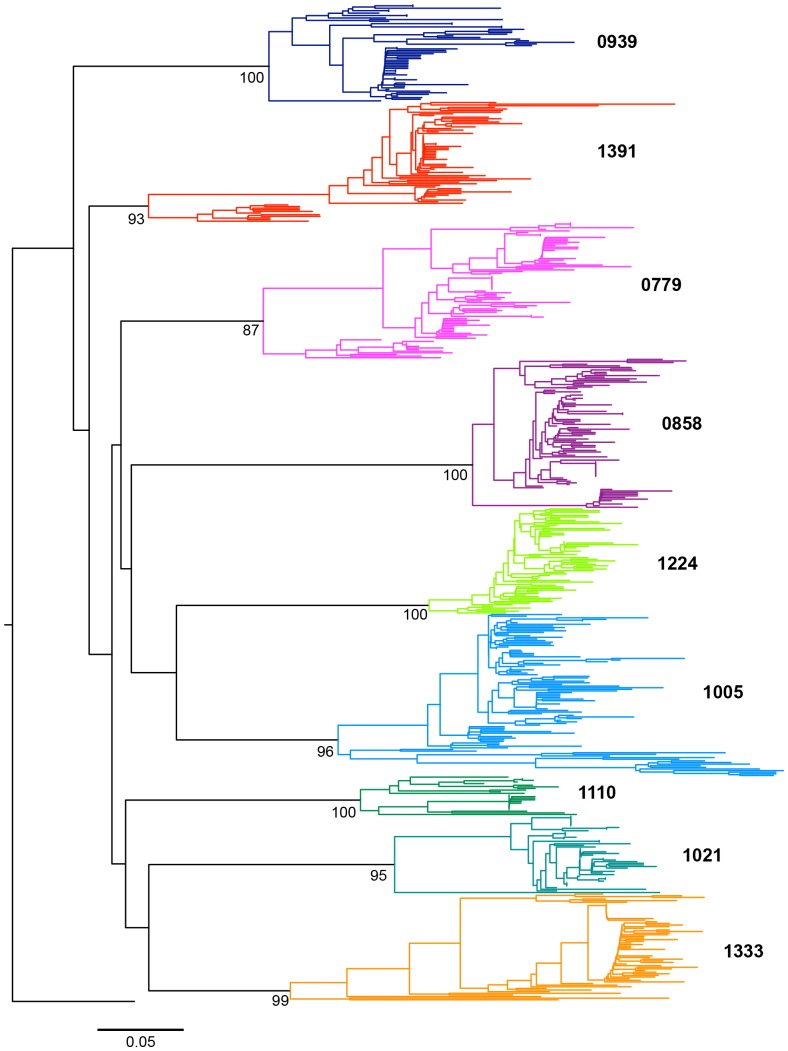
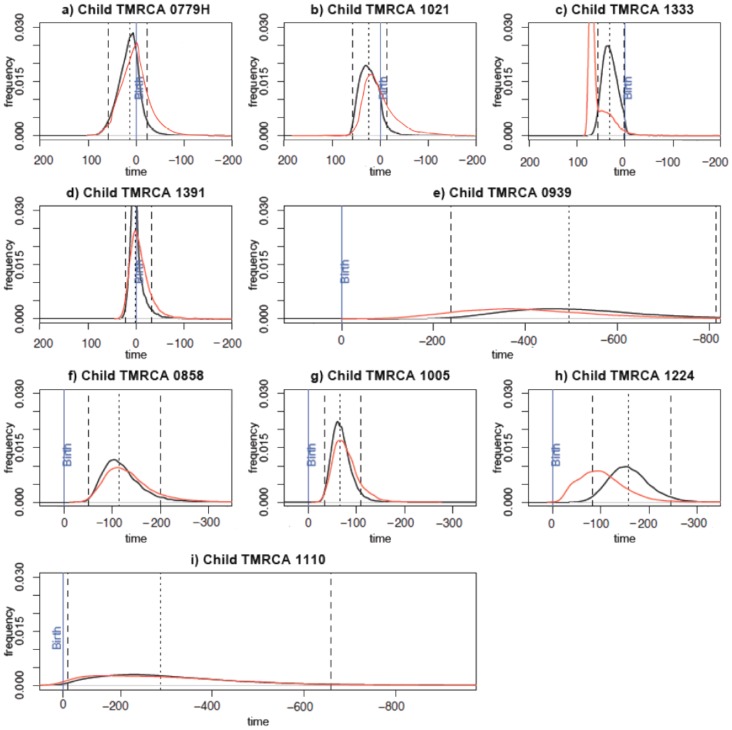
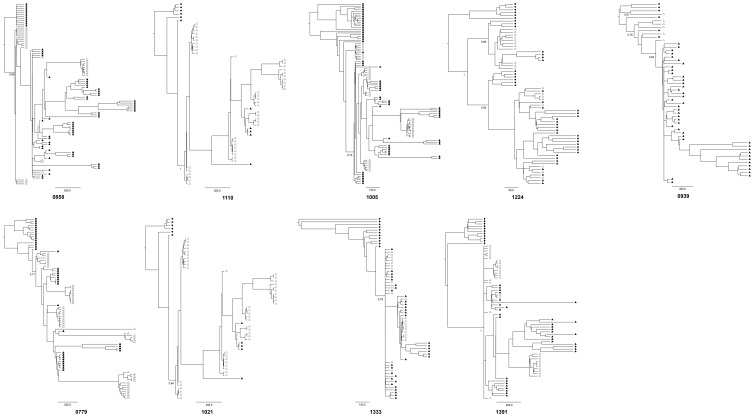
Six-hundred and twenty-two clonal env sequences from the RNA and DNA viral population were longitudinally sampled from nine HIV-1 infected mother-and-child pairs [range: 277-1034 days]. For each transmission pair, timing of MTCT was determined using a coalescent-based model within a Bayesian statistical framework. Results were compared with available estimates of MTCT timing obtained with the classic biomedical approach based on serial HIV DNA detection by PCR assays.
Four children were infected during pregnancy, whereas the remaining five children were infected at time of delivery. For eight out of nine pairs, results were consistent with the transmission periods assessed by standard PCR-based assay. The discordance in the remaining case was likely confused by co-infection, with simultaneous introduction of multiple maternal viral variants at the time of delivery.
The study provided the opportunity to validate the Bayesian coalescent approach that determines the timing of MTCT of HIV-1. It illustrates the power of population genetics approaches to reliably estimate the timing of transmission events and deepens our knowledge about the dynamics of viral evolution in HIV-infected children, accounting for the complexity of multiple transmission events.
母婴传播(MTCT)是全球大多数儿童 HIV-1 感染的原因。它可能发生在妊娠、分娩或母乳喂养期间。许多研究利用合并和分子钟方法来了解 HIV-1 的流行历史,但垂直传播的时间尚未使用这些方法进行研究。利用 HIV 遗传变异随时间不断积累的优势,并使用纵向采样的病毒序列,我们利用合并方法研究 MTCT 的时间。
从九对 HIV-1 感染的母婴对中纵向采样了 622 个克隆 env 序列[范围:277-1034 天]。对于每一对传播者,使用基于合并的模型在贝叶斯统计框架内确定 MTCT 的时间。结果与基于 PCR 检测的经典生物医学方法获得的 MTCT 时间的可用估计进行了比较。
四个孩子在妊娠期间感染,而其余五个孩子在分娩时感染。对于九对中的八对,结果与基于标准 PCR 的检测评估的传播期一致。在剩下的一对中,不一致的情况可能是由于合并感染引起的,即在分娩时同时引入了多种母体病毒变体。
该研究提供了验证确定 HIV-1 母婴传播时间的贝叶斯合并方法的机会。它说明了群体遗传学方法可靠估计传播事件时间的强大功能,并加深了我们对 HIV 感染儿童中病毒进化动态的了解,考虑到了多个传播事件的复杂性。