Chen Yen-Fu, Bramley George, Unwin Gemma, Hanu-Cernat Dalvina, Dretzke Janine, Moore David, Bayliss Sue, Cummins Carole, Lilford Richard
School of Health and Population Sciences, University of Birmingham, Birmingham, United Kingdom; Division of Health Sciences, University of Warwick, Coventry, United Kingdom.
School of Health and Population Sciences, University of Birmingham, Birmingham, United Kingdom.
PLoS One. 2015 Mar 20;10(3):e0116786. doi: 10.1371/journal.pone.0116786. eCollection 2015.
Chronic migraine is a debilitating headache disorder that has significant impact on quality of life. Stimulation of peripheral nerves is increasingly being used to treat chronic refractory pain including headache disorders. This systematic review examines the effectiveness and adverse effects of occipital nerve stimulation (ONS) for chronic migraine.
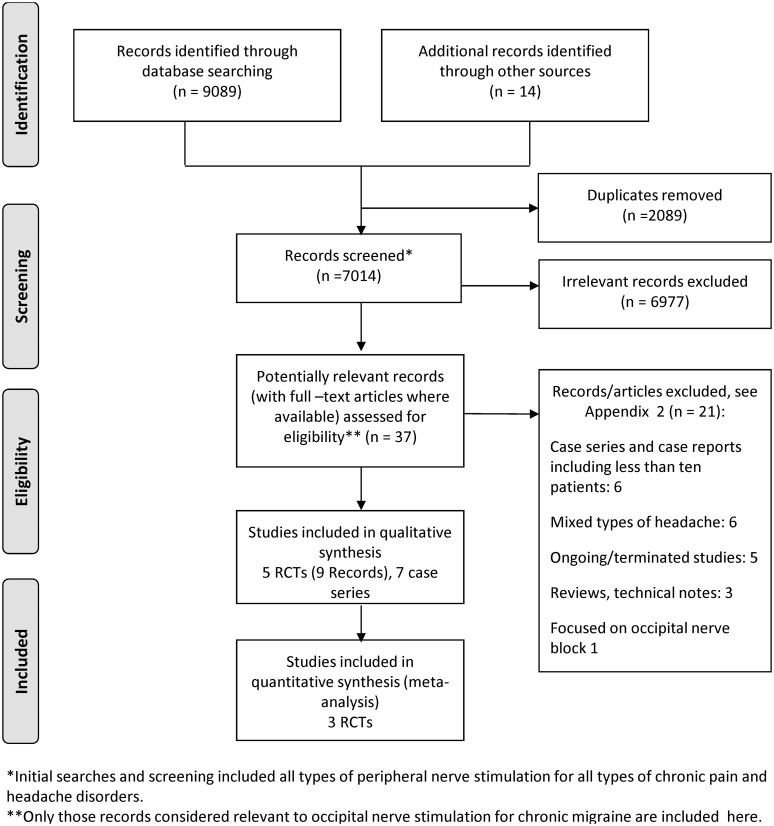
Databases, including the Cochrane Library, MEDLINE, EMBASE, CINAHL and clinical trial registers were searched to September 2014. Randomized controlled trials (RCTs), other controlled and uncontrolled observational studies and case series (n≥ 10) were eligible. RCTs were assessed using the Cochrane risk of bias tool. Meta-analysis was carried out using a random-effects model. Findings are presented in summary tables and forest plots.
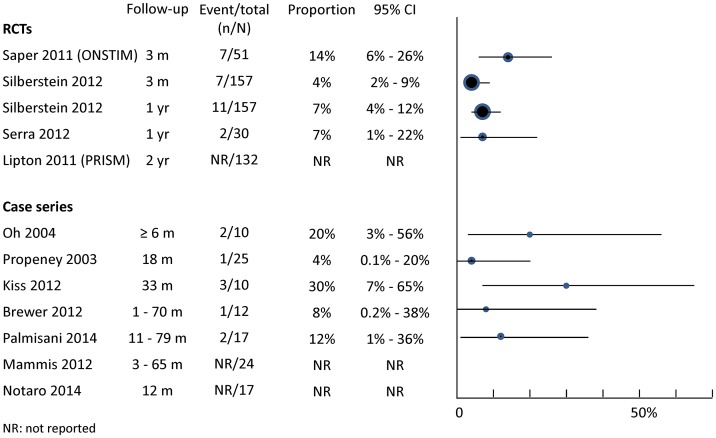
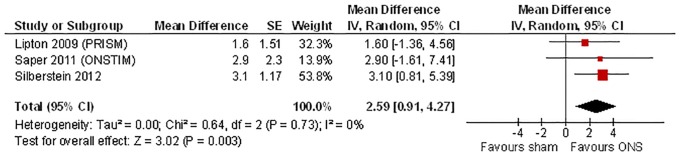
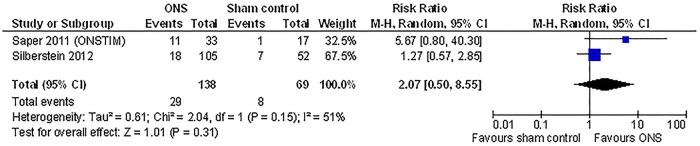
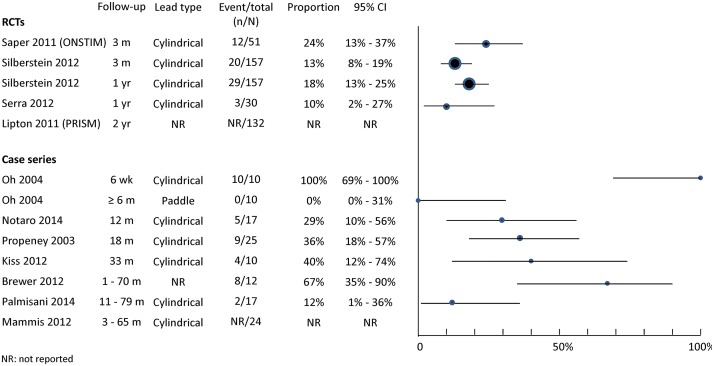
Five RCTs (total n=402) and seven case series (total n=115) met the inclusion criteria. Pooled results from three multicenter RCTs show that ONS was associated with a mean reduction of 2.59 days (95% CI 0.91 to 4.27, I2=0%) of prolonged, moderate to severe headache per month at 3 months compared with a sham control. Results for other outcomes generally favour ONS over sham controls but quantitative analysis was hampered by incomplete publication and reporting of trial data. Lead migration and infections are common and often require revision surgery. Open-label follow-up of RCTs and case series suggest long-term effectiveness can be maintained in some patients but evidence is limited.
While the effectiveness of ONS compared to sham control has been shown in multiple RCTs, the average effect size is modest and may be exaggerated by bias as achieving effective blinding remains a methodological challenge. Further measures to reduce the risk of adverse events and revision surgery are needed.
this systematic review is an update and expanded work of part of a broader review registered with PROSPERO. Registration No. CRD42012002633.
慢性偏头痛是一种使人衰弱的头痛疾病,对生活质量有重大影响。外周神经刺激越来越多地被用于治疗包括头痛疾病在内的慢性难治性疼痛。本系统评价旨在研究枕神经刺激(ONS)治疗慢性偏头痛的有效性和不良反应。
检索截至2014年9月的数据库,包括考克兰图书馆、医学期刊数据库、荷兰医学文摘数据库、护理学与健康领域数据库及临床试验注册库。纳入随机对照试验(RCT)、其他对照及非对照观察性研究和病例系列(n≥10)。使用考克兰偏倚风险工具对RCT进行评估。采用随机效应模型进行荟萃分析。研究结果以汇总表和森林图呈现。
5项RCT(共402例)和7个病例系列(共115例)符合纳入标准。三项多中心RCT的汇总结果显示,与假手术对照组相比,3个月时ONS可使每月中度至重度头痛延长天数平均减少2.59天(95%可信区间0.91至4.27,I2=0%)。其他结局的结果总体上ONS优于假手术对照组,但试验数据的不完全发表和报告妨碍了定量分析。电极移位和感染很常见,且常需翻修手术。RCT和病例系列的开放标签随访表明,部分患者可维持长期疗效,但证据有限。
虽然多项RCT已显示ONS与假手术对照组相比的有效性,但平均效应量较小,且由于实现有效设盲仍是一个方法学挑战,可能存在偏倚导致效应量被夸大。需要采取进一步措施降低不良事件和翻修手术的风险。
本系统评价是已在国际前瞻性系统评价注册库注册的一项更广泛评价的部分更新和扩展工作。注册号CRD42012002633。