Cancer Biology and Evolution Program, Moffitt Cancer Center, Tampa, FL 33612; Department of Biological Sciences, University of Illinois at Chicago, Chicago, IL 60607; Aerospace and Mechanical Engineering, University of Arizona, Tucson, AZ, 85745, USA.
Cancer Biology and Evolution Program, Moffitt Cancer Center, Tampa, FL 33612; Department of Biological Sciences, University of Illinois at Chicago, Chicago, IL 60607; Aerospace and Mechanical Engineering, University of Arizona, Tucson, AZ, 85745, USA Cancer Biology and Evolution Program, Moffitt Cancer Center, Tampa, FL 33612; Department of Biological Sciences, University of Illinois at Chicago, Chicago, IL 60607; Aerospace and Mechanical Engineering, University of Arizona, Tucson, AZ, 85745, USA
Evol Med Public Health. 2015 Mar 20;2015(1):76-87. doi: 10.1093/emph/eov006.
Systemic therapy for metastatic cancer is currently determined exclusively by the site of tumor origin. Yet, there is increasing evidence that the molecular characteristics of metastases significantly differ from the primary tumor. We define the evolutionary dynamics of metastases that govern this molecular divergence and examine their potential contribution to variations in response to targeted therapies.
Darwinian interactions of transformed cells with the tissue microenvironments at primary and metastatic sites are analyzed using evolutionary game theory. Computational models simulate responses to targeted therapies in different organs within the same patient.
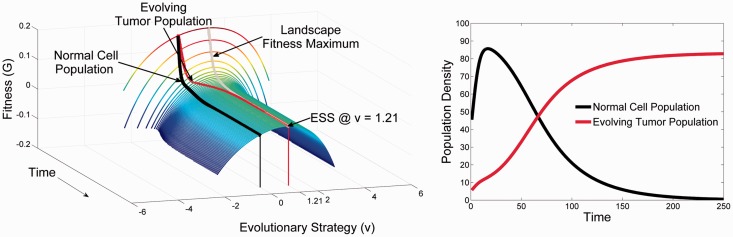
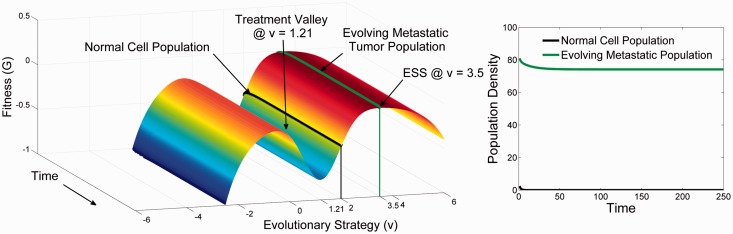
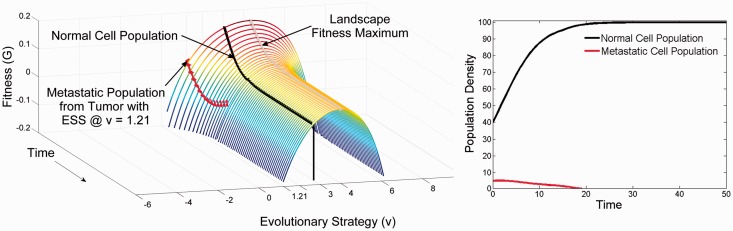
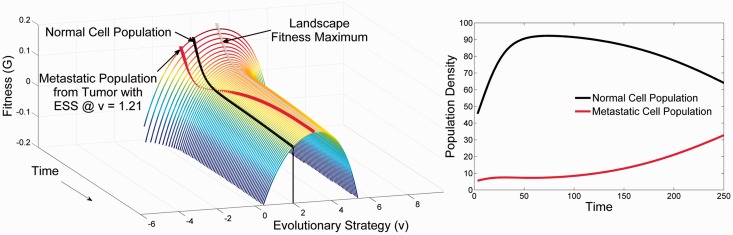
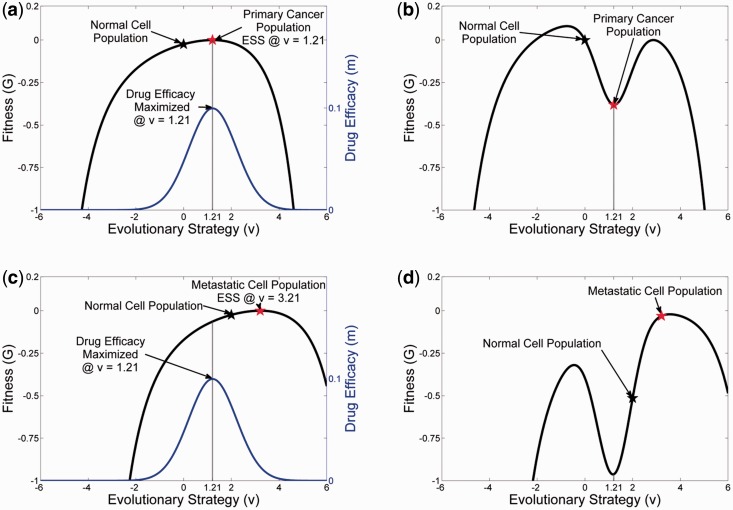
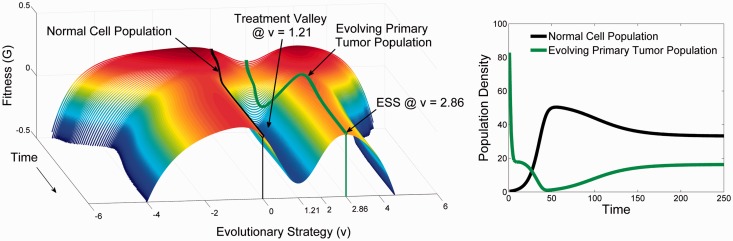
Tumor cells, although maximally fit at their primary site, typically have lower fitness on the adaptive landscapes offered by the metastatic sites due to organ-specific variations in mesenchymal properties and signaling pathways. Clinically evident metastases usually exhibit time-dependent divergence from the phenotypic mean of the primary population as the tumor cells evolve and adapt to their new circumstances. In contrast, tumors from different primary sites evolving on identical metastatic adaptive landscapes exhibit phenotypic convergence. Thus, metastases in the liver from different primary tumors and even in different hosts will evolve toward similar adaptive phenotypes. The combination of evolutionary divergence from the primary cancer phenotype and convergence towards similar adaptive strategies in the same tissue cause significant variations in treatment responses particularly for highly targeted therapies.
The results suggest that optimal therapies for disseminated cancer must take into account the site(s) of metastatic growth as well as the primary organ.
目前,转移性癌症的系统治疗完全取决于肿瘤起源部位。然而,越来越多的证据表明,转移灶的分子特征与原发肿瘤有显著差异。我们定义了控制这种分子分化的转移进化动态,并研究了它们对靶向治疗反应变化的潜在贡献。
采用进化博弈论分析转化细胞与原发和转移部位组织微环境的达尔文相互作用。计算模型模拟了同一患者不同器官中靶向治疗的反应。
肿瘤细胞虽然在原发部位适应性最佳,但由于间质特性和信号通路在不同器官中的特异性变化,其在转移部位的适应性景观上的适应性通常较低。临床上明显的转移灶通常随着肿瘤细胞的进化和适应新环境而表现出与原发群体表型均值的时间依赖性分化。相比之下,在相同转移适应性景观上进化的来自不同原发部位的肿瘤表现出表型趋同。因此,来自不同原发肿瘤的肝脏转移灶,甚至来自不同宿主的转移灶,都将朝着相似的适应性表型进化。原发肿瘤表型的进化分歧以及在同一组织中相似适应性策略的趋同导致了治疗反应的显著变化,特别是对高度靶向治疗。
研究结果表明,针对播散性癌症的最佳治疗方案必须考虑转移生长的部位以及原发器官。