Shah Ami B, Rejniak Katarzyna A, Gevertz Jana L
Department of Biology, The College of New Jersey, Ewing, NJ, United States. email:
Math Biosci Eng. 2016 Dec 1;13(6):1185-1206. doi: 10.3934/mbe.2016038.
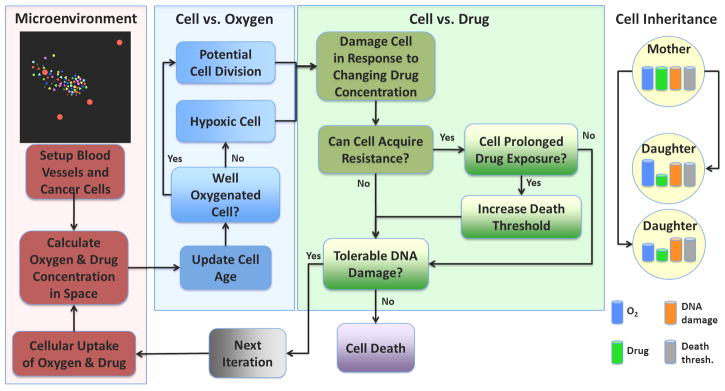
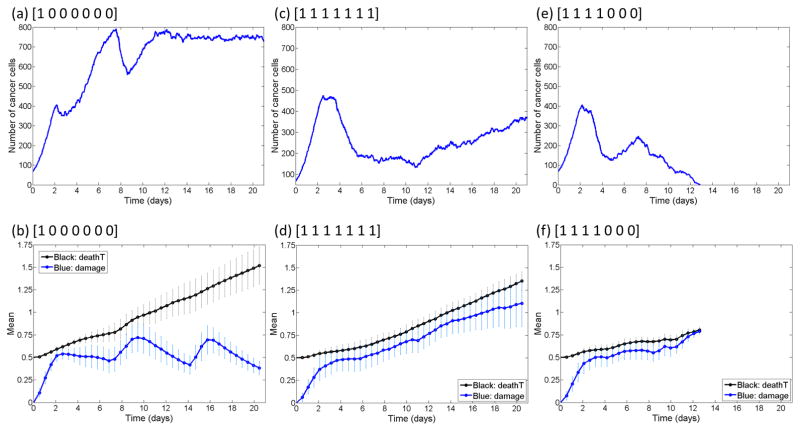
While chemoresistance in primary tumors is well-studied, much less is known about the influence of systemic chemotherapy on the development of drug resistance at metastatic sites. In this work, we use a hybrid spatial model of tumor response to a DNA damaging drug to study how the development of chemoresistance in micrometastases depends on the drug dosing schedule. We separately consider cell populations that harbor pre-existing resistance to the drug, and those that acquire resistance during the course of treatment. For each of these independent scenarios, we consider one hypothetical cell line that is responsive to metronomic chemotherapy, and another that with high probability cannot be eradicated by a metronomic protocol. Motivated by experimental work on ovarian cancer xenografts, we consider all possible combinations of a one week treatment protocol, repeated for three weeks, and constrained by the total weekly drug dose. Simulations reveal a small number of fractionated-dose protocols that are at least as effective as metronomic therapy in eradicating micrometastases with acquired resistance (weak or strong), while also being at least as effective on those that harbor weakly pre-existing resistant cells. Given the responsiveness of very different theoretical cell lines to these few fractionated-dose protocols, these may represent more effective ways to schedule chemotherapy with the goal of limiting metastatic tumor progression.
虽然对原发性肿瘤中的化疗耐药性已有充分研究,但对于全身化疗对转移部位耐药性发展的影响却知之甚少。在这项研究中,我们使用肿瘤对DNA损伤药物反应的混合空间模型,来研究微转移灶中化疗耐药性的发展如何取决于给药方案。我们分别考虑对药物具有预先存在耐药性的细胞群体,以及在治疗过程中获得耐药性的细胞群体。对于这些独立的情况,我们考虑一种对节拍化疗有反应的假设细胞系,以及另一种极有可能无法通过节拍方案根除的细胞系。受卵巢癌异种移植实验工作的启发,我们考虑了一种为期一周、重复三周且受每周总药物剂量限制的治疗方案的所有可能组合。模拟结果显示,有少数分次给药方案在根除获得性耐药(弱或强)的微转移灶方面至少与节拍疗法一样有效,同时对那些含有弱预先存在耐药细胞的微转移灶也至少同样有效。鉴于非常不同的理论细胞系对这少数分次给药方案有反应,这些方案可能代表了更有效的化疗给药方式,以限制转移性肿瘤的进展。