Perez-Rosello Tamara, Anderson Charles T, Ling Cindy, Lippard Stephen J, Tzounopoulos Thanos
Department of Otolaryngology, University of Pittsburgh, 3501 Fifth Avenue, Pittsburgh, PA 15261, USA.
Department of Chemistry, Massachusetts Institute of Technology, 77 Massachusetts Avenue, Cambridge, MA 02139, USA.
Neurobiol Dis. 2015 Sep;81:14-9. doi: 10.1016/j.nbd.2015.03.012. Epub 2015 Mar 18.
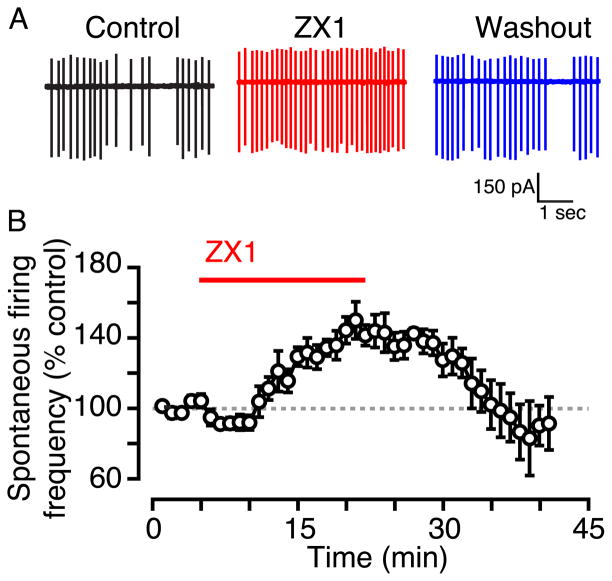
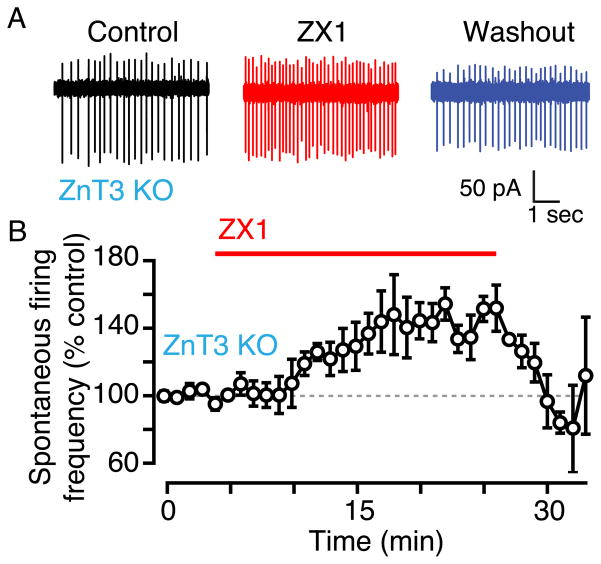
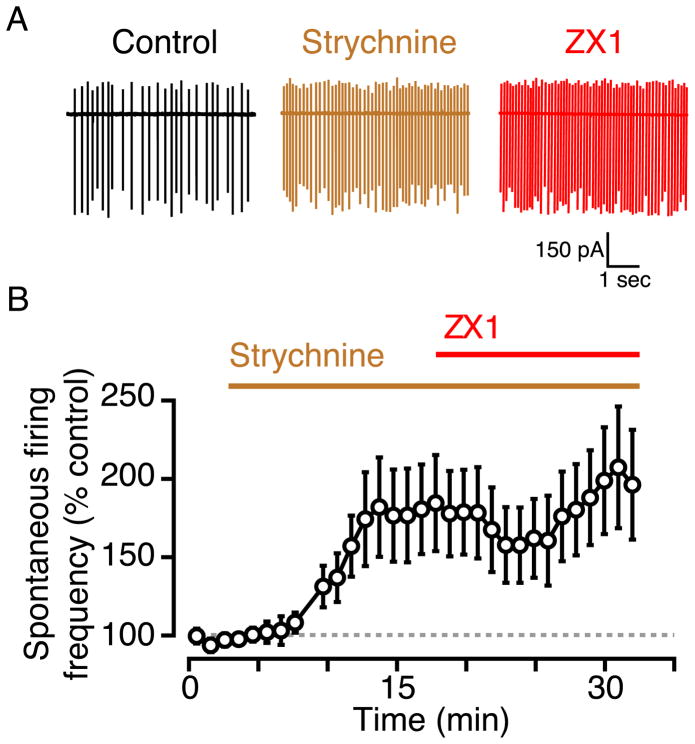
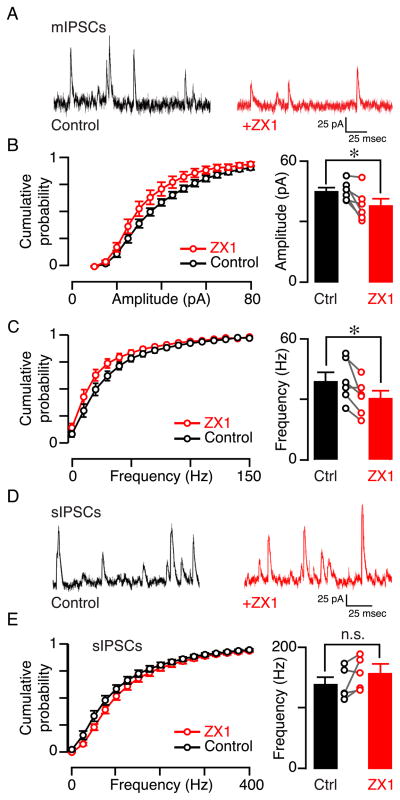
In many synapses of the CNS, mobile zinc is packaged into glutamatergic vesicles and co-released with glutamate during neurotransmission. Following synaptic release, the mobilized zinc modulates ligand- and voltage-gated channels and receptors, functioning as an inhibitory neuromodulator. However, the origin and role of tonic, as opposed to phasically released, zinc are less well understood. We investigated tonic zinc in the dorsal cochlear nucleus (DCN), a zinc-rich, auditory brainstem nucleus. Our results show that application of a high-affinity, extracellular zinc chelator (ZX1) enhances spontaneous firing in DCN principal neurons (fusiform cells), consistent with inhibition of this neuronal property by tonic zinc. The enhancing effect was prevented by prior application of strychnine, a glycine receptor antagonist, suggesting that ZX1 interferes with zinc-mediated modulation of spontaneous glycinergic inhibition. In particular, ZX1 decreased the amplitude and the frequency of glycinergic miniature inhibitory postsynaptic currents in fusiform cells, from which we conclude that tonic zinc enhances glycinergic inhibitory neurotransmission. The observed zinc-mediated inhibition in spontaneous firing is present in mice lacking the vesicular zinc transporter (ZnT3), indicating that non-vesicular zinc inhibits spontaneous firing. Noise-induced increase in the spontaneous firing of fusiform cells is crucial for the induction of tinnitus. In this context, tonic zinc provides a powerful break of spontaneous firing that may protect against pathological run-up of spontaneous activity in the DCN.
在中枢神经系统的许多突触中,可移动锌被包装到谷氨酸能囊泡中,并在神经传递过程中与谷氨酸共同释放。突触释放后,动员起来的锌调节配体门控通道和电压门控通道及受体,起到抑制性神经调质的作用。然而,与相位性释放的锌相反,持续性锌的来源和作用却鲜为人知。我们研究了耳蜗背核(DCN)中的持续性锌,这是一个富含锌的听觉脑干核。我们的结果表明,应用高亲和力的细胞外锌螯合剂(ZX1)可增强DCN主神经元(梭形细胞)的自发放电,这与持续性锌对这种神经元特性的抑制作用一致。事先应用甘氨酸受体拮抗剂士的宁可防止这种增强作用,这表明ZX1干扰了锌介导的对自发性甘氨酸能抑制的调节。特别是,ZX1降低了梭形细胞中甘氨酸能微小抑制性突触后电流的幅度和频率,由此我们得出结论,持续性锌增强了甘氨酸能抑制性神经传递。在缺乏囊泡锌转运体(ZnT3)的小鼠中也存在观察到的锌介导的对自发放电的抑制作用,这表明非囊泡锌抑制自发放电。噪声诱导的梭形细胞自发放电增加对耳鸣的诱发至关重要。在这种情况下,持续性锌对自发放电提供了有力的抑制,这可能防止DCN中自发放电的病理性增强。