Jenkins Molly H, Brinckerhoff Constance E, Mullins David W
Department of Medicine, Geisel School of Medicine at Dartmouth, Lebanon, New Hampshire, United States of America; Department of Microbiology and Immunology, Geisel School of Medicine at Dartmouth, Lebanon, New Hampshire, United States of America; Norris Cotton Cancer Center, Geisel School of Medicine at Dartmouth, Lebanon, New Hampshire, United States of America.
Department of Medicine, Geisel School of Medicine at Dartmouth, Lebanon, New Hampshire, United States of America; Department of Biochemistry, Geisel School of Medicine at Dartmouth, Lebanon, New Hampshire, United States of America; Norris Cotton Cancer Center, Geisel School of Medicine at Dartmouth, Lebanon, New Hampshire, United States of America.
PLoS One. 2015 Mar 23;10(3):e0121140. doi: 10.1371/journal.pone.0121140. eCollection 2015.
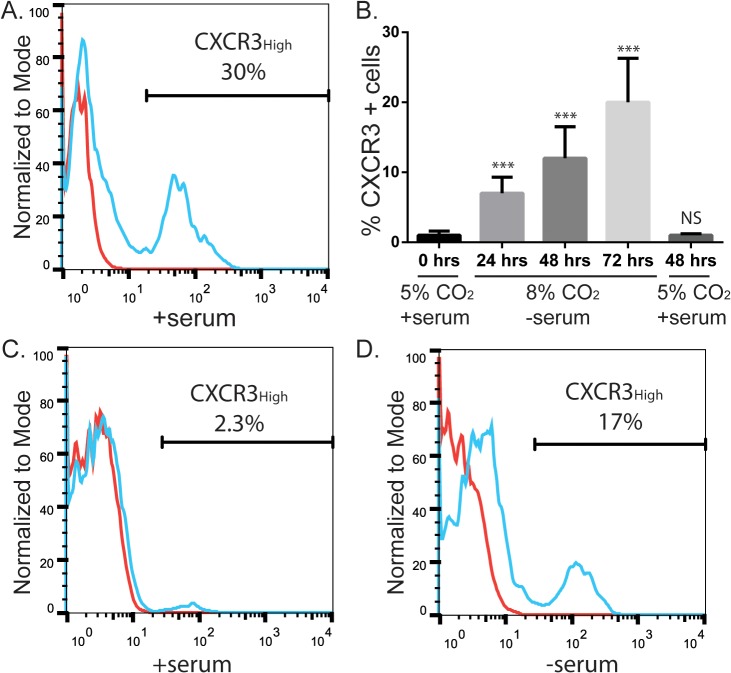
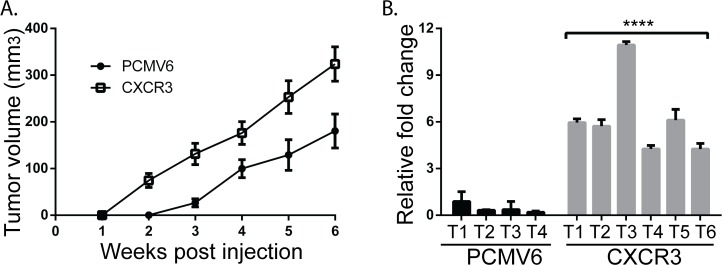
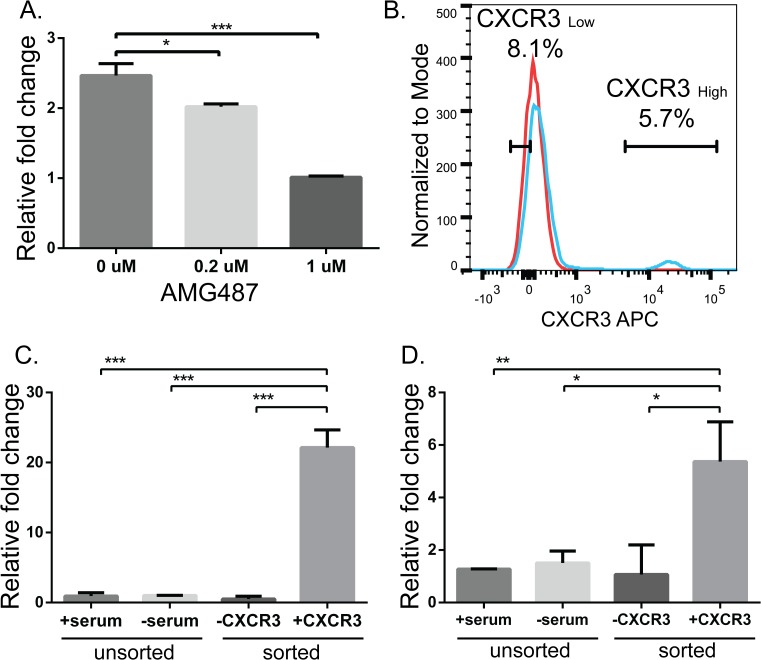
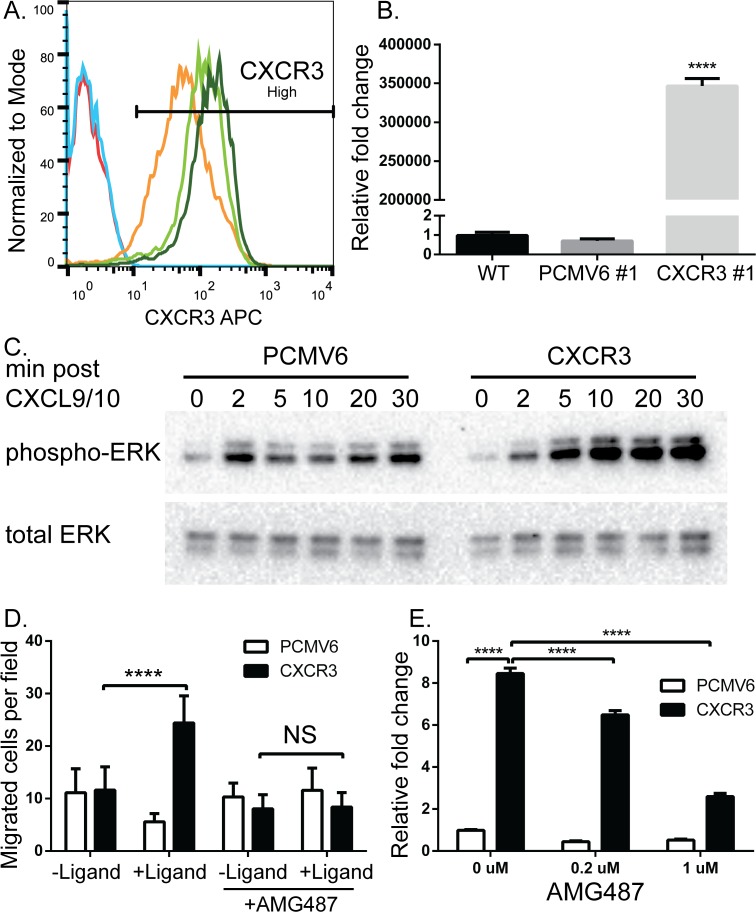
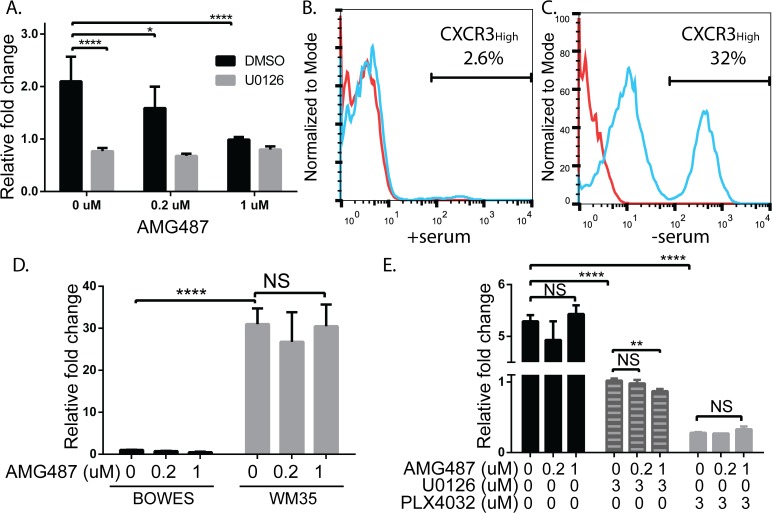
Patients with early stage, radial growth phase (RGP) melanoma have a 97% survival rate; however, when the melanoma progresses to the invasive vertical growth phase (VGP), survival rates decrease to 15%. The targets of many clinical trials are the known genetic and molecular mechanisms involved in melanoma progression, with the most common oncogenic mutation being the BRAFV600E. However, less than half of melanomas harbor this mutation, and consequently, do not respond to the current BRAF targeted treatments. It is therefore critical to elucidate alternative mechanisms regulating melanoma progression. Increased expression of the chemokine receptor, CXCR3, on melanoma cells is correlated with increased metastasis and poor patient outcomes, suggesting a role for CXCR3 in the RGP to VGP transition. We found that endogenous CXCR3 can be induced in two RGP cell lines, BOWES (BRAFWT) and WM35 (BRAFV600E), with in vitro environmental stress and nutrient deprivation. Signaling via induced endogenous CXCR3 is linked with IL-8 expression in BOWES cells. Ectopic overexpression of CXCR3 in BOWES cells leads to increased ligand-mediated phERK, cellular migration, and IL-8 expression in vitro, and to increased tumorigenesis and lymph node metastasis in vivo. Our results demonstrate that, in BRAFWT melanomas, CXCR3 signaling mediates significant increases in IL-8 expression, suggesting that CXCR3 expression and signaling may represent a transformative event that drives the progression of BRAFWT melanomas.
Expression of CXCR3 on BRAFWT melanoma cells may be a mediator of melanoma progression.
早期处于放射状生长阶段(RGP)的黑色素瘤患者生存率为97%;然而,当黑色素瘤进展到侵袭性垂直生长阶段(VGP)时,生存率降至15%。许多临床试验的靶点是黑色素瘤进展中已知的遗传和分子机制,最常见的致癌突变是BRAFV600E。然而,不到一半的黑色素瘤携带这种突变,因此对目前的BRAF靶向治疗无反应。因此,阐明调节黑色素瘤进展的替代机制至关重要。黑色素瘤细胞上趋化因子受体CXCR3表达增加与转移增加和患者预后不良相关,提示CXCR3在RGP向VGP转变中起作用。我们发现,在体外环境应激和营养剥夺条件下,两种RGP细胞系BOWES(BRAF野生型)和WM35(BRAFV600E)中可诱导内源性CXCR3。通过诱导的内源性CXCR3发出的信号与BOWES细胞中IL-8的表达相关。在BOWES细胞中异位过表达CXCR3导致体外配体介导的磷酸化细胞外信号调节激酶(pERK)增加、细胞迁移和IL-8表达增加,以及体内肿瘤发生和淋巴结转移增加。我们的结果表明,在BRAF野生型黑色素瘤中,CXCR3信号介导IL-8表达显著增加,提示CXCR3表达和信号可能代表驱动BRAF野生型黑色素瘤进展的一个转变性事件。
BRAF野生型黑色素瘤细胞上CXCR3的表达可能是黑色素瘤进展的一个介导因素。