van Vliet Dillys, Alonso Ariel, Rijkers Ger, Heynens Jan, Rosias Philippe, Muris Jean, Jöbsis Quirijn, Dompeling Edward
Department of Pediatric Pulmonology, School for Public Health and Primary Care (CAPHRI), Maastricht University Medical Centre (MUMC+),Maastricht, The Netherlands.
Department of Methodology and Statistics, CAPHRI, MUMC+, Maastricht, The Netherlands.
PLoS One. 2015 Mar 23;10(3):e0119434. doi: 10.1371/journal.pone.0119434. eCollection 2015.
In asthma management guidelines the primary goal of treatment is asthma control. To date, asthma control, guided by symptoms and lung function, is not optimal in many children and adults. Direct monitoring of airway inflammation in exhaled breath may improve asthma control and reduce the number of exacerbations.
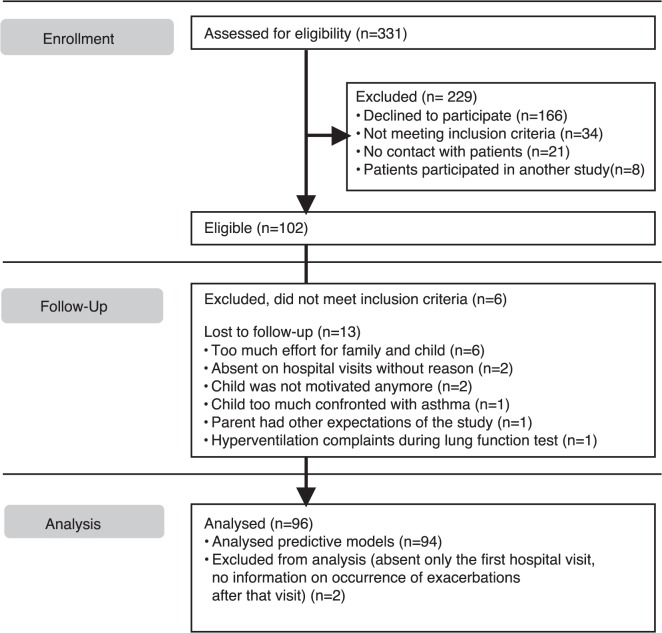
96 asthmatic children were included in this one-year prospective observational study, with clinical visits every 2 months. Between visits, daily symptom scores and lung function were recorded using a home monitor. During clinical visits, asthma control and FeNO were assessed. Furthermore, lung function measurements were performed and EBC was collected. Statistical analysis was performed using a test dataset and validation dataset for 1) conditionally specified models, receiver operating characteristic-curves (ROC-curves); 2) k-nearest neighbors algorithm.
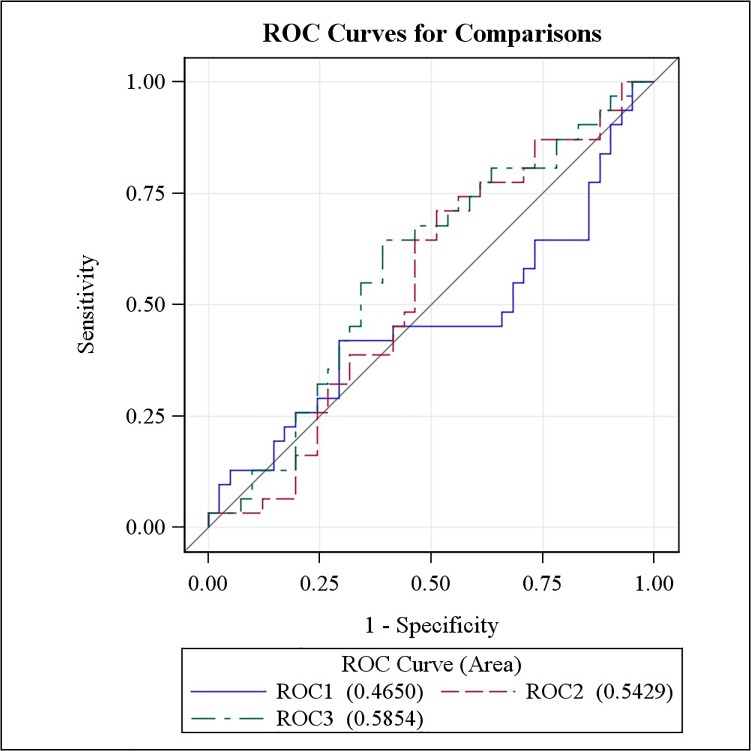
Three conditionally specified predictive models were constructed. Model 1 included inflammatory markers in EBC alone, model 2 included FeNO plus clinical characteristics and the ACQ score, and model 3 included all the predictors used in model 1 and 2. The area under the ROC-curves was estimated as 47%, 54% and 59% for models 1, 2 and 3 respectively. The k-nearest neighbors predictive algorithm, using the information of all the variables in model 3, produced correct predictions for 52% of the exacerbations in the validation dataset.
The predictive power of FeNO and inflammatory markers in EBC for prediction of an asthma exacerbation was low, even when combined with clinical characteristics and symptoms. Qualitative improvement of the chemical analysis of EBC may lead to a better non-invasive prediction of asthma exacerbations.
在哮喘管理指南中,治疗的主要目标是控制哮喘。迄今为止,在许多儿童和成人中,以症状和肺功能为指导的哮喘控制并不理想。直接监测呼出气中的气道炎症可能会改善哮喘控制并减少急性发作的次数。
1)研究呼出气一氧化氮分数(FeNO)和呼出气冷凝液(EBC)中的炎症标志物在预测儿科人群哮喘急性发作中的应用。2)研究这些呼出气炎症标志物与临床参数相结合的预测能力。
96名哮喘儿童纳入了这项为期一年的前瞻性观察研究,每2个月进行一次临床访视。在访视期间,使用家庭监测仪记录每日症状评分和肺功能。在临床访视期间,评估哮喘控制情况和FeNO。此外,进行肺功能测量并收集EBC。使用测试数据集和验证数据集进行统计分析,用于1)条件指定模型、受试者操作特征曲线(ROC曲线);2)k近邻算法。
构建了三个条件指定的预测模型。模型1仅包括EBC中的炎症标志物,模型2包括FeNO加上临床特征和哮喘控制问卷(ACQ)评分,模型3包括模型1和模型2中使用的所有预测因子。模型1、2和3的ROC曲线下面积分别估计为47%、54%和59%。使用模型3中所有变量的信息的k近邻预测算法,对验证数据集中52%的急性发作做出了正确预测。
FeNO和EBC中的炎症标志物对哮喘急性发作的预测能力较低,即使与临床特征和症状相结合也是如此。EBC化学分析的定性改进可能会导致对哮喘急性发作更好的无创预测。