Busardò Francesco Paolo, Frati Paola, Zaami Simona, Fineschi Vittorio
Department of Anatomical, Histological, Forensic and Orthopaedic Sciences, Sapienza University of Rome, Viale Regina Elena 336, 00161 Rome, Italy.
Neuromed, Istituto Mediterraneo Neurologico (IRCCS), Via Atinense 18, Pozzilli, 86077 Isernia, Italy.
Int J Mol Sci. 2015 Mar 23;16(3):6557-70. doi: 10.3390/ijms16036557.
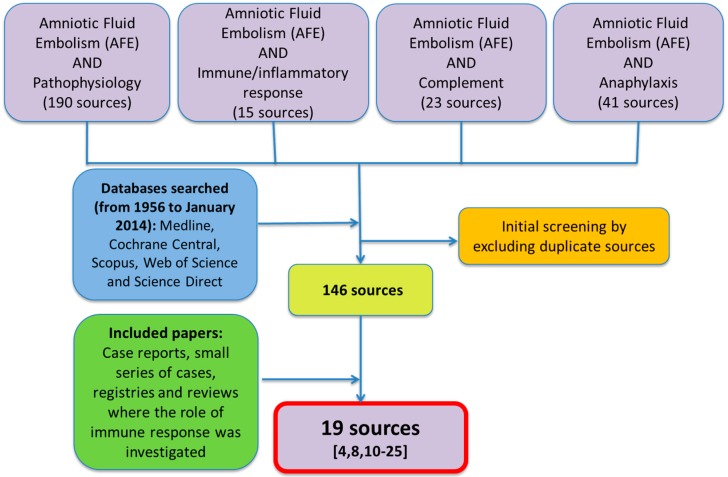
Amniotic fluid embolism (AFE) is an uncommon obstetric condition involving pregnant women during labor or in the initial stages after delivery. Its incidence is estimated to be around 5.5 cases per 100,000 deliveries. Therefore, this paper investigated the pathophysiological mechanism, which underlies AFE, in order to evaluate the role of immune response in the development of this still enigmatic clinical entity. The following databases (from 1956 to September 2014) Medline, Cochrane Central, Scopus, Web of Science and Science Direct were used, searching the following key words: AFE, pathophysiology, immune/inflammatory response, complement and anaphylaxis. The main key word "AFE" was searched singularly and associated individually to each of the other keywords. Of the 146 sources found, only 19 were considered appropriate for the purpose of this paper. The clinical course is characterized by a rapid onset of symptoms, which include: acute hypotension and/or cardiac arrest, acute hypoxia (with dyspnoea, cyanosis and/or respiratory arrest), coagulopathies (disseminated intravascular coagulation and/or severe hemorrhage), coma and seizures. The pathology still determines a significant morbidity and mortality and potential permanent neurological sequelae for surviving patients. At this moment, numerous aspects involving the pathophysiology and clinical development are still not understood and several hypotheses have been formulated, in particular the possible role of anaphylaxis and complement. Moreover, the detection of serum tryptase and complement components and the evaluation of fetal antigens can explain several aspects of immune response.
羊水栓塞(AFE)是一种罕见的产科病症,发生于分娩期间或产后初期的孕妇身上。据估计,其发病率约为每10万例分娩中有5.5例。因此,本文对羊水栓塞潜在的病理生理机制进行了研究,以评估免疫反应在这种仍神秘的临床病症发展过程中的作用。使用了以下数据库(从1956年至2014年9月):医学索引数据库(Medline)、考克兰系统评价数据库(Cochrane Central)、Scopus数据库、科学引文索引数据库(Web of Science)和科学Direct数据库,搜索了以下关键词:羊水栓塞、病理生理学、免疫/炎症反应、补体和过敏反应。主要关键词“羊水栓塞”单独进行搜索,并分别与其他每个关键词相关联。在找到的146篇文献中,仅19篇被认为适用于本文的研究目的。其临床病程的特点是症状迅速出现,包括:急性低血压和/或心脏骤停、急性缺氧(伴有呼吸困难、发绀和/或呼吸骤停)、凝血功能障碍(弥散性血管内凝血和/或严重出血)、昏迷和癫痫发作。这种病症仍然会导致显著的发病率和死亡率,以及存活患者潜在的永久性神经后遗症。目前,涉及病理生理学和临床发展的许多方面仍未明确,已经提出了几种假说,特别是过敏反应和补体的可能作用。此外,血清类胰蛋白酶和补体成分的检测以及胎儿抗原的评估可以解释免疫反应的几个方面。