Havrylenko Svitlana, Mirande Marc
Laboratoire d'Enzymologie et Biochimie Structurales (LEBS), CNRS, Université Paris-Sud, 1 avenue de la Terrasse, 91190 Gif-sur-Yvette, France.
Institute for Integrative Biology of the Cell (I2BC), CEA, CNRS, Université Paris-Sud, 1 avenue de la Terrasse, 91190 Gif-sur-Yvette, France.
Int J Mol Sci. 2015 Mar 23;16(3):6571-94. doi: 10.3390/ijms16036571.
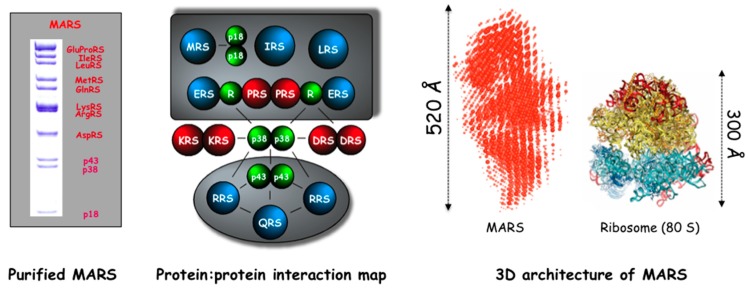
Aminoacyl-tRNA synthetases are essential enzymes for interpreting the genetic code. They are responsible for the proper pairing of codons on mRNA with amino acids. In addition to this canonical, translational function, they are also involved in the control of many cellular pathways essential for the maintenance of cellular homeostasis. Association of several of these enzymes within supramolecular assemblies is a key feature of organization of the translation apparatus in eukaryotes. It could be a means to control their oscillation between translational functions, when associated within a multi-aminoacyl-tRNA synthetase complex (MARS), and nontranslational functions, after dissociation from the MARS and association with other partners. In this review, we summarize the composition of the different MARS described from archaea to mammals, the mode of assembly of these complexes, and their roles in maintenance of cellular homeostasis.
氨酰-tRNA合成酶是解读遗传密码的关键酶。它们负责使mRNA上的密码子与氨基酸正确配对。除了这种典型的翻译功能外,它们还参与调控许多维持细胞稳态所必需的细胞通路。这些酶中的几种在超分子组装体中的缔合是真核生物翻译装置组织的一个关键特征。这可能是一种控制它们在与多氨酰-tRNA合成酶复合体(MARS)缔合时的翻译功能和从MARS解离并与其他伙伴缔合后的非翻译功能之间振荡的手段。在本综述中,我们总结了从古细菌到哺乳动物所描述的不同MARS的组成、这些复合体的组装模式及其在维持细胞稳态中的作用。