National University Health System, Singapore, Singapore, and National University of Singapore, Yong Loo Lin School of Medicine, Singapore.
National University of Singapore, Saw Swee Hock School of Public Health, Singapore, and Huazhong University of Science and Technology, School of Public Health and Tongji Medical College, Wuhan, China.
Arthritis Rheumatol. 2015 Jul;67(7):1933-42. doi: 10.1002/art.39115.
Prospective studies evaluating diet in relation to the risk of gout in Asian populations are lacking. The purpose of this study was to examine the relationship between the consumption of dietary protein from each of its major sources and the risk of gout in a Chinese population.
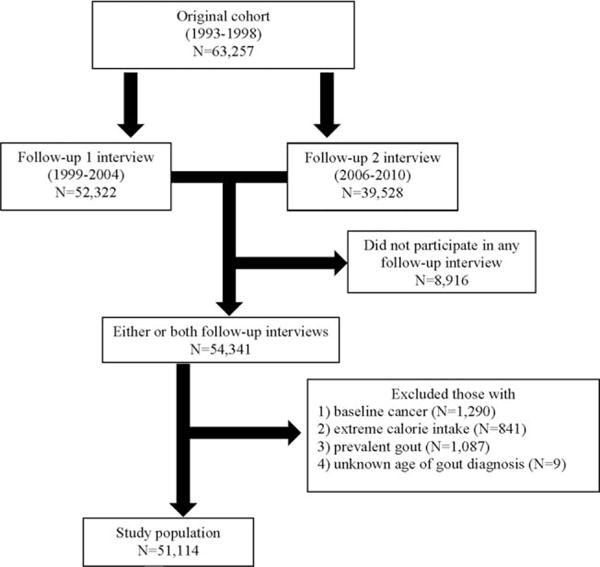
We used data from the Singapore Chinese Health Study, a prospective cohort of 63,257 Chinese adults who were 45-74 years old at recruitment during the years 1993-1998. Habitual diet information was collected via a validated semiquantitative food frequency questionnaire, and physician-diagnosed gout was self-reported during 2 followup interviews up to the year 2010. Cox proportional hazards models were used to calculate the hazard ratios (HRs) and 95% confidence intervals (95% CIs), with adjustment for potential confounders, among 51,114 eligible study participants who were free of gout at baseline and responded to our followup interviews.
A total of 2,167 participants reported physician-diagnosed gout during the followup period. The multivariate-adjusted HRs (with 95% CIs) of gout, comparing the first quartile with the fourth quartile, were as follows: 1.27 (1.12-1.44; P for trend < 0.001) for total protein, 1.27 (1.11-1.45; P for trend < 0.001) for poultry, 1.16 (1.02-1.32; P for trend = 0.006) for fish and shellfish, 0.86 (0.75-0.98; P for trend = 0.018) for soy food, and 0.83 (0.73-0.95; P for trend = 0.012) for nonsoy legumes. No statistically significant associations were found with protein intake from other sources (red meat, eggs, dairy products, grains, or nuts and seeds).
In this Chinese population living in Singapore, higher total dietary protein intake from mainly poultry and fish/shellfish was associated with an increased risk of gout, while dietary intake of soy and nonsoy legumes was associated with a reduced risk of gout.
缺乏评估亚洲人群饮食与痛风风险的前瞻性研究。本研究旨在探讨中国人从每种主要来源摄入的膳食蛋白质与痛风风险之间的关系。
我们使用了新加坡华人健康研究的数据,这是一项前瞻性队列研究,纳入了 1993 年至 1998 年期间招募的 63257 名年龄在 45-74 岁的中国成年人。通过经过验证的半定量食物频率问卷收集习惯性饮食信息,并在 2 次随访访谈中报告医生诊断的痛风,随访至 2010 年。使用 Cox 比例风险模型计算风险比(HR)和 95%置信区间(95%CI),在基线时无痛风且对我们的随访访谈做出回应的 51114 名合格研究参与者中,对潜在混杂因素进行调整。
共有 2167 名参与者在随访期间报告了医生诊断的痛风。多变量调整后的 HR(95%CI)如下:与四分位 1 相比,四分位 4 的痛风风险为:1.27(1.12-1.44;趋势 P<0.001)总蛋白,1.27(1.11-1.45;趋势 P<0.001)禽肉,1.16(1.02-1.32;趋势 P=0.006)鱼贝类,0.86(0.75-0.98;趋势 P=0.018)大豆食品,0.83(0.73-0.95;趋势 P=0.012)非大豆豆类。与其他来源(红肉、鸡蛋、乳制品、谷物或坚果和种子)的蛋白质摄入无统计学显著关联。
在新加坡居住的中国人中,主要来自禽肉和鱼/贝类的总膳食蛋白质摄入量较高与痛风风险增加有关,而大豆和非大豆豆类的饮食摄入与痛风风险降低有关。