Rai Sharan K, Fung Teresa T, Lu Na, Keller Sarah F, Curhan Gary C, Choi Hyon K
Division of Rheumatology, Allergy and Immunology, Massachusetts General Hospital, Harvard Medical School, Boston, MA, 02114, USA.
Channing Division of Network Medicine, Department of Medicine, Brigham and Women's Hospital, Harvard Medical School, Boston, MA, USA.
BMJ. 2017 May 9;357:j1794. doi: 10.1136/bmj.j1794.
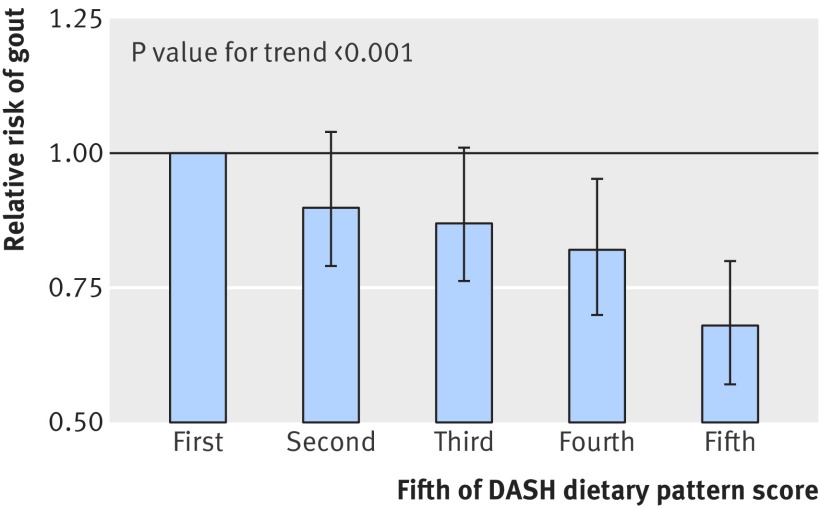
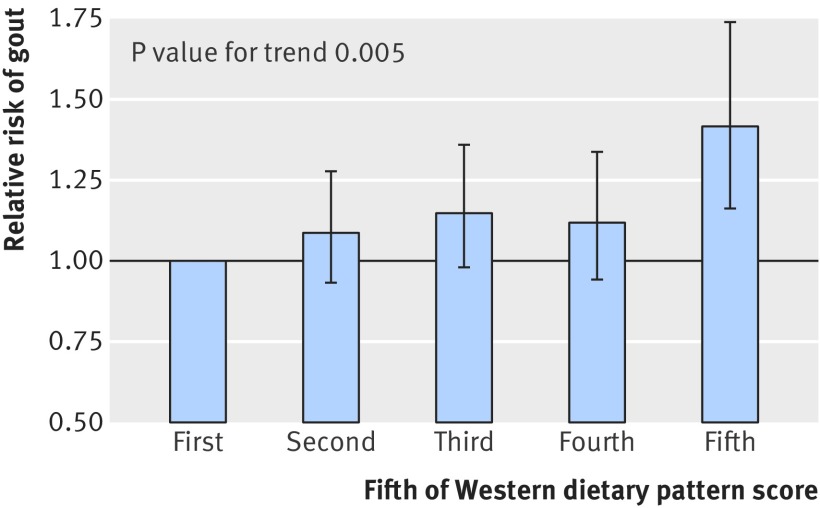
To prospectively examine the relation between the Dietary Approaches to Stop Hypertension (DASH) and Western diets and risk of gout (ie, the clinical endpoint of hyperuricemia) in men. Prospective cohort study. The Health Professionals Follow-up Study. 44 444 men with no history of gout at baseline. Using validated food frequency questionnaires, each participant was assigned a DASH dietary pattern score (based on high intake of fruits, vegetables, nuts and legumes, low fat dairy products, and whole grains, and low intake of sodium, sweetened beverages, and red and processed meats) and a Western dietary pattern score (based on high intake of red and processed meats, French fries, refined grains, sweets, and desserts). Risk of incident gout meeting the preliminary American College of Rheumatology survey criteria for gout, adjusting for potential confounders, including age, body mass index, hypertension, diuretic use, and alcohol intake. During 26 years of follow-up, 1731 confirmed cases of incident gout were documented. A higher DASH dietary pattern score was associated with a lower risk for gout (adjusted relative risk for extreme fifths 0.68, 95% confidence interval 0.57 to 0.80, P value for trend <0.001). In contrast, a higher Western dietary pattern score was associated with an increased risk for gout (1.42, 1.16 to 1.74, P=0.005). The DASH diet is associated with a lower risk of gout, suggesting that its effect of lowering uric acid levels in individuals with hyperuricemia translates to a lower risk of gout. Conversely, the Western diet is associated with a higher risk of gout. The DASH diet may provide an attractive preventive dietary approach for men at risk of gout.
前瞻性研究男性中终止高血压膳食疗法(DASH)与西方饮食和痛风风险(即高尿酸血症的临床终点)之间的关系。前瞻性队列研究。健康专业人员随访研究。44444名基线时无痛风病史的男性。使用经过验证的食物频率问卷,为每位参与者分配一个DASH饮食模式评分(基于水果、蔬菜、坚果和豆类、低脂乳制品及全谷物的高摄入量,以及钠、含糖饮料、红肉和加工肉类的低摄入量)和一个西方饮食模式评分(基于红肉和加工肉类、炸薯条、精制谷物、糖果和甜点的高摄入量)。符合美国风湿病学会痛风初步调查标准的新发痛风风险,对潜在混杂因素进行调整,包括年龄、体重指数、高血压、利尿剂使用情况和酒精摄入量。在26年的随访期间,记录了1731例确诊的新发痛风病例。较高的DASH饮食模式评分与较低的痛风风险相关(极端五分位数的调整相对风险为0.68,95%置信区间为0.57至0.80,趋势P值<0.001)。相比之下,较高的西方饮食模式评分与痛风风险增加相关(1.42,1.16至1.74,P = 0.005)。DASH饮食与较低的痛风风险相关,表明其在高尿酸血症个体中降低尿酸水平的作用转化为较低的痛风风险。相反,西方饮食与较高的痛风风险相关。DASH饮食可能为有痛风风险的男性提供一种有吸引力的预防性饮食方法。