Department of Internal Medicine, Keimyung University Dongsan Hospital, Daegu, Korea.
Korean Circ J. 2015 Mar;45(2):87-95. doi: 10.4070/kcj.2015.45.2.87. Epub 2015 Mar 24.
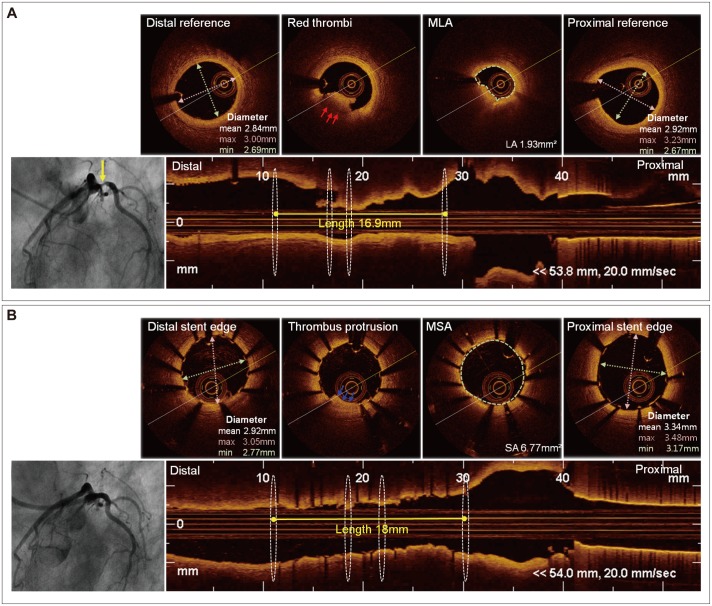
The significant morbidity and mortality associated with coronary artery disease has spurred the development of intravascular imaging devices to optimize the detection and assessment of coronary lesions and percutaneous coronary interventions. Intravascular ultrasound (IVUS) uses reflected ultrasound waves to quantitatively and qualitatively assess lesions; integrated backscatter and virtual histology IVUS more precisely characterizes plaque composition; angioscopy directly visualize thrombus and plaque; optical coherence tomography using near-infrared (NIR) light with very high spatial resolution provides more accurate images; and the recently introduced NIR spectroscopy identifies chemical components in coronary artery plaques based on differential light absorption in the NIR spectrum. This article reviews usefulness of these devices and hybrids thereof.
与冠状动脉疾病相关的显著发病率和死亡率促使了血管内成像设备的发展,以优化冠状动脉病变和经皮冠状动脉介入治疗的检测和评估。血管内超声(IVUS)使用反射超声波对病变进行定量和定性评估;背向散射积分和虚拟组织学 IVUS 更精确地描述斑块成分;血管内镜直接观察血栓和斑块;近红外光(NIR)的光学相干断层扫描具有非常高的空间分辨率,提供更准确的图像;以及最近推出的 NIR 光谱学根据 NIR 光谱中的差分光吸收来识别冠状动脉斑块中的化学成分。本文综述了这些设备及其杂交体的用途。