Pereira Paulo, Buzek David, Franke Jörg, Senker Wolfgang, Kosmala Arkadiusz, Hubbe Ulrich, Manson Neil, Rosenberg Wout, Assietti Roberto, Martens Frederic, Barbanti Brodano Giovanni, Scheufler Kai-Michael
Neurosurgery, Centro Hospitalar S. Joao, Porto, Portugal.
Karvinska hornicka nemocnice, Karvina, Czech Republic.
PLoS One. 2015 Mar 26;10(3):e0122312. doi: 10.1371/journal.pone.0122312. eCollection 2015.
Minimally invasive lumbar interbody fusion (MILIF) offers potential for reduced operative morbidity and earlier recovery compared with open procedures for patients with degenerative lumbar disorders (DLD). Firm conclusions about advantages of MILIF over open procedures cannot be made because of limited number of large studies of MILIF in a real-world setting. Clinical effectiveness of MILIF in a large, unselected real-world patient population was assessed in this Prospective, monitored, international, multicenter, observational study.
To observe and document short-term recovery after minimally invasive interbody fusion for DLD.
In a predefined 4-week analysis from this study, experienced surgeons (≥ 30 MILIF surgeries pre-study) treated patients with DLD by one- or two-level MILIF. The primary study objective was to document patients' short-term post-interventional recovery (primary objective) including back/leg pain (visual analog scale [VAS]), disability (Oswestry Disability Index [ODI]), health status (EQ-5D) and Patient satisfaction.
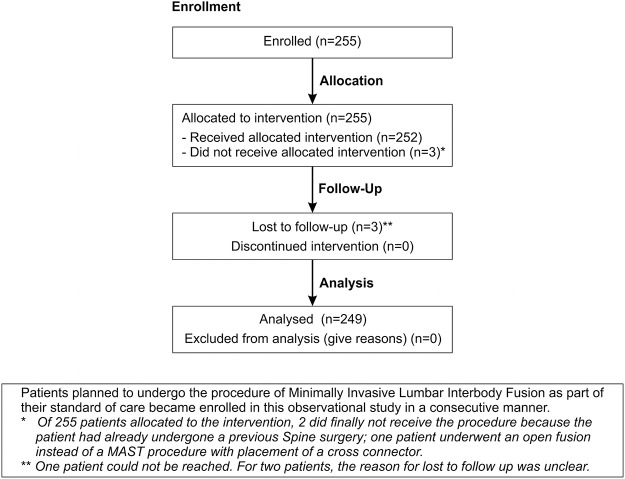
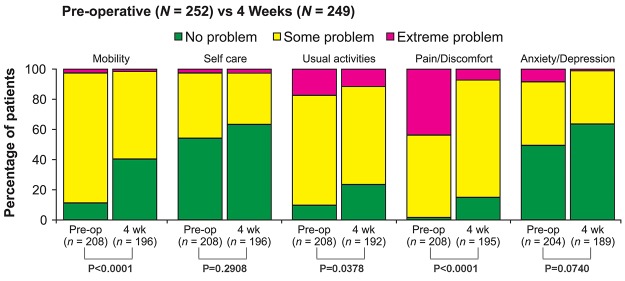
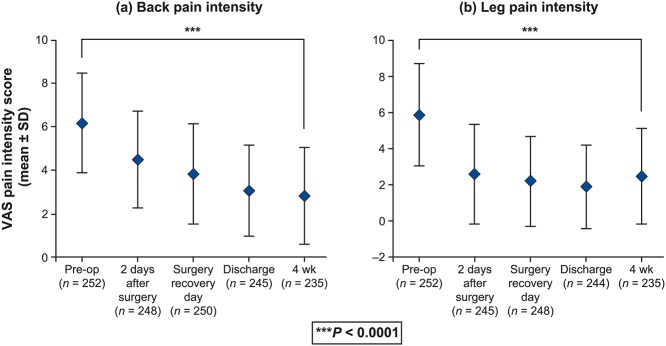
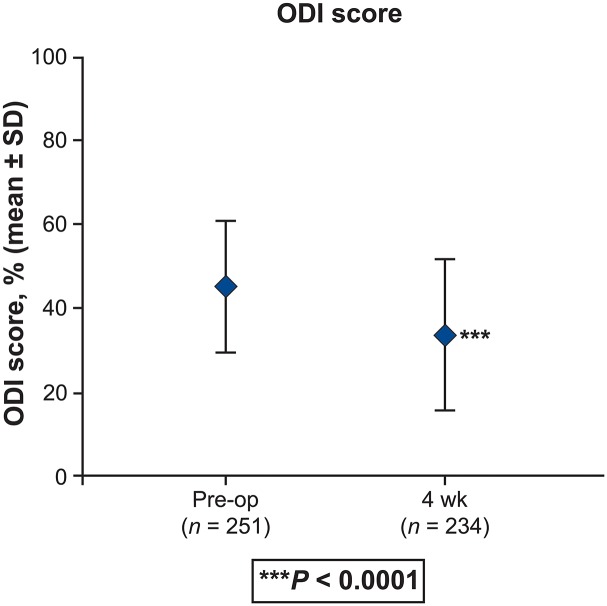
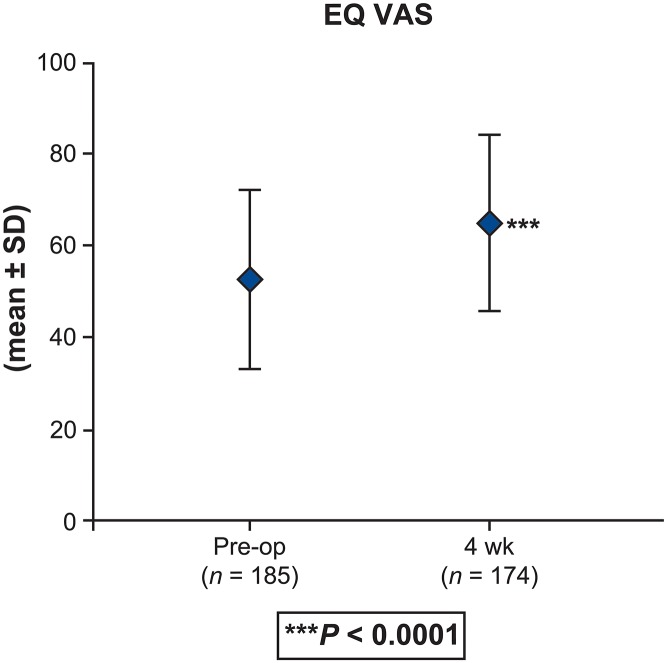
At 4 weeks, 249 of 252 patients were remaining in the study; the majority received one-level MILIF (83%) and TLIF was the preferred approach (94.8%). For one-level (and two-level) procedures, surgery duration was 128 (182) min, fluoroscopy time 115 (154) sec, and blood-loss 164 (233) mL. Time to first ambulation was 1.3 days and time to study-defined surgery recovery was 3.2 days. Patients reported significantly (P < 0.0001) reduced back pain (VAS: 2.9 vs 6.2), leg pain (VAS: 2.5 vs 5.9), and disability (ODI: 34.5% vs 45.5%), and a significantly (P < 0.0001) improved health status (EQ-5D index: 0.61 vs 0.34; EQ VAS: 65.4 vs 52.9) 4 weeks postoperatively. One adverse event was classified as related to the minimally invasive surgical approach. No deep site infections or deaths were reported.
For experienced surgeons, MILIF for DLD demonstrated early benefits (short time to first ambulation, early recovery, high patient satisfaction and improved patient-reported outcomes) and low major perioperative morbidity at 4 weeks postoperatively.
与开放性手术相比,微创腰椎椎间融合术(MILIF)为患有退行性腰椎疾病(DLD)的患者降低手术发病率和实现更早康复提供了可能。由于在现实环境中对MILIF进行的大型研究数量有限,因此无法就MILIF相对于开放性手术的优势得出确凿结论。在这项前瞻性、监测性、国际性、多中心观察性研究中,评估了MILIF在大量未经筛选的现实患者群体中的临床疗效。
观察并记录DLD患者微创椎间融合术后的短期恢复情况。
在本研究预先设定的4周分析中,经验丰富的外科医生(研究前至少进行过30例MILIF手术)采用单节段或双节段MILIF治疗DLD患者。主要研究目标是记录患者干预后的短期恢复情况(主要目标),包括腰/腿痛(视觉模拟量表[VAS])、功能障碍(Oswestry功能障碍指数[ODI])、健康状况(EQ-5D)和患者满意度。
在4周时,252例患者中有249例仍在研究中;大多数患者接受单节段MILIF(83%),经椎间孔腰椎椎体间融合术(TLIF)是首选方法(94.8%)。对于单节段(和双节段)手术,手术时间为128(182)分钟,透视时间为115(154)秒,失血量为164(233)毫升。首次下床活动时间为1.3天,达到研究定义的手术恢复时间为3.2天。患者报告术后4周时背痛(VAS:2.9对6.2)、腿痛(VAS:2.5对5.9)和功能障碍(ODI:34.5%对45.5%)显著减轻(P<0.0001),健康状况显著改善(EQ-5D指数:0.61对0.34;EQ VAS:65.4对52.9)(P<0.0001)。1例不良事件被归类为与微创外科手术方法相关。未报告深部感染或死亡病例。
对于经验丰富的外科医生,DLD患者的MILIF在术后4周时显示出早期益处(首次下床活动时间短、恢复早、患者满意度高且患者报告的结果改善)和较低的围手术期主要发病率。