Kim Young-Eui, Ahn Jin-Hyun
Department of Molecular Cell Biology, Samsung Biomedical Research Institute, Sungkyunkwan University School of Medicine, Suwon, Republic of Korea.
PLoS Pathog. 2015 Mar 26;11(3):e1004785. doi: 10.1371/journal.ppat.1004785. eCollection 2015 Mar.
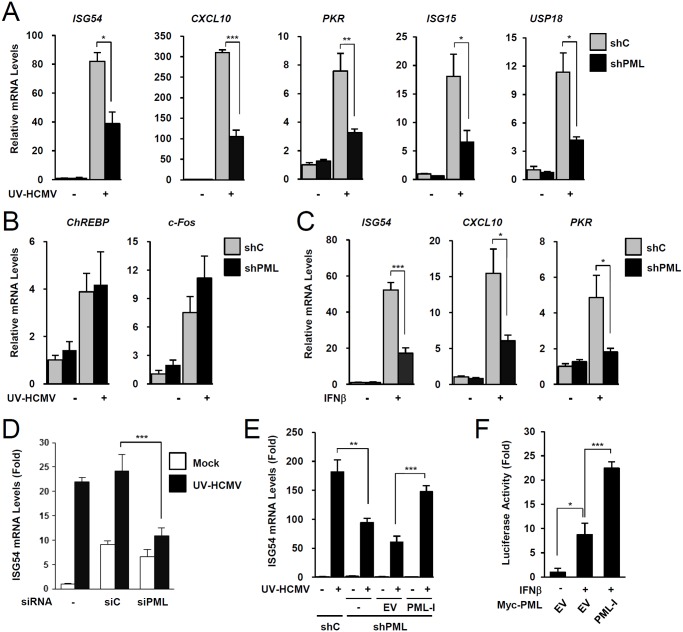
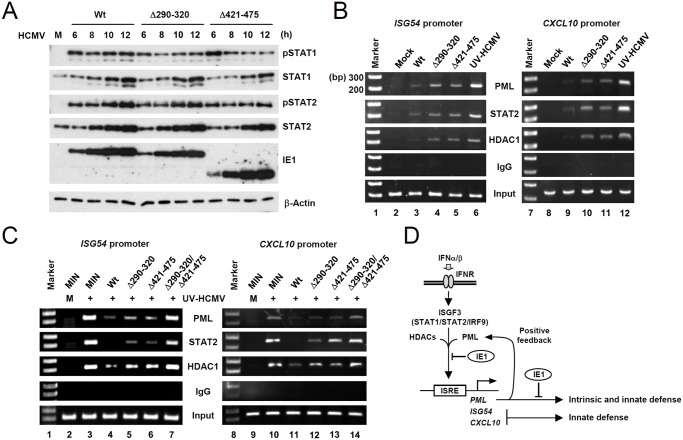
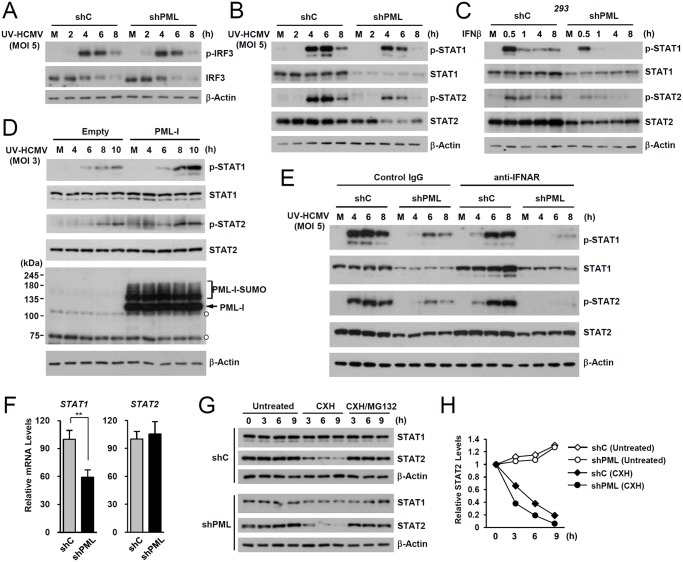
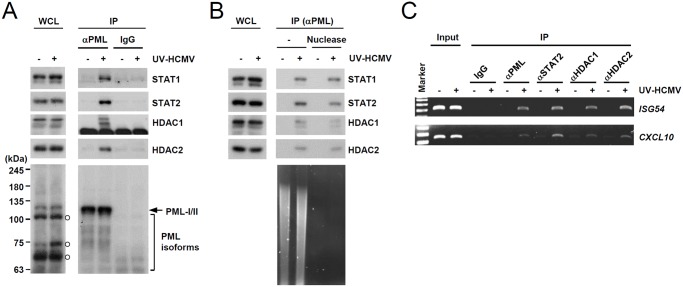
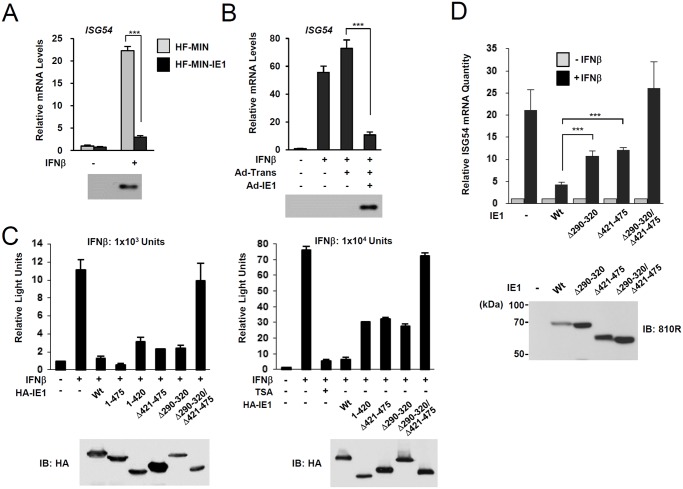
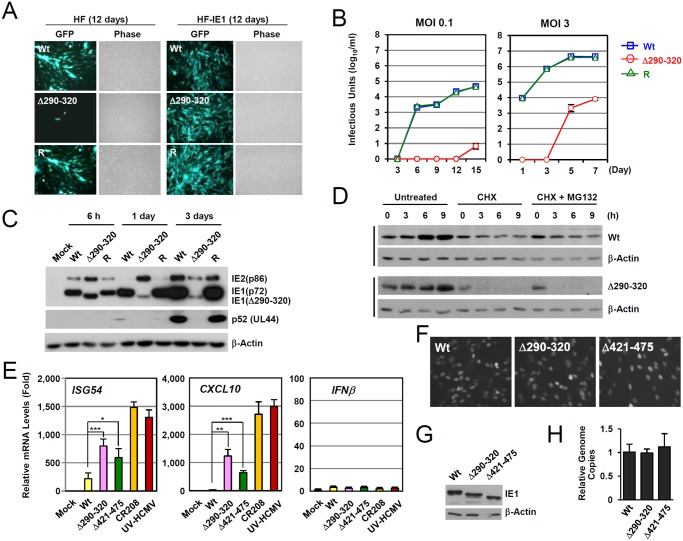
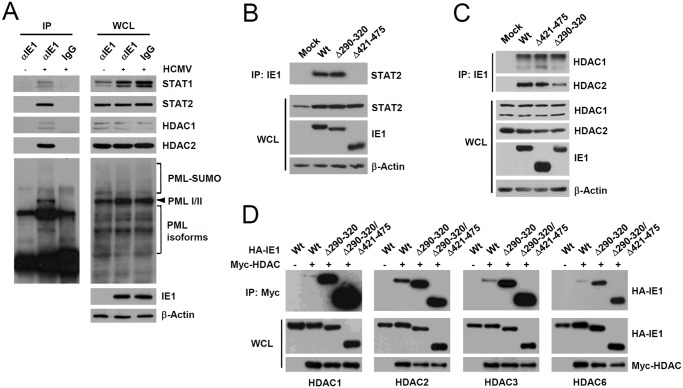
Promyelocytic leukemia protein (PML), a major component of PML nuclear bodies (also known as nuclear domain 10), is involved in diverse cellular processes such as cell proliferation, apoptosis, gene regulation, and DNA damage response. PML also acts as a restriction factor that suppresses incoming viral genomes, therefore playing an important role in intrinsic defense. Here, we show that PML positively regulates type I interferon response by promoting transcription of interferon-stimulated genes (ISGs) and that this regulation by PML is counteracted by human cytomegalovirus (HCMV) IE1 protein. Small hairpin RNA-mediated PML knockdown in human fibroblasts reduced ISG induction by treatment of interferon-β or infection with UV-inactivated HCMV. PML was required for accumulation of activated STAT1 and STAT2, interacted with them and HDAC1 and HDAC2, and was associated with ISG promoters after HCMV infection. During HCMV infection, viral IE1 protein interacted with PML, STAT1, STAT2, and HDACs. Analysis of IE1 mutant viruses revealed that, in addition to the STAT2-binding domain, the PML-binding domain of IE1 was necessary for suppression of interferon-β-mediated ISG transcription, and that IE1 inhibited ISG transcription by sequestering interferon-stimulated gene factor 3 (ISGF3) in a manner requiring its binding of PML and STAT2, but not of HDACs. In conclusion, our results demonstrate that PML participates in type I interferon-induced ISG expression by regulating ISGF3, and that this regulation by PML is counteracted by HCMV IE1, highlighting a widely shared viral strategy targeting PML to evade intrinsic and innate defense mechanisms.
早幼粒细胞白血病蛋白(PML)是PML核体(也称为核结构域10)的主要成分,参与多种细胞过程,如细胞增殖、凋亡、基因调控和DNA损伤反应。PML还作为一种限制因子,抑制进入的病毒基因组,因此在固有防御中发挥重要作用。在这里,我们表明PML通过促进干扰素刺激基因(ISG)的转录来正向调节I型干扰素反应,并且PML的这种调节被人巨细胞病毒(HCMV)IE1蛋白抵消。在人成纤维细胞中,小发夹RNA介导的PML敲低减少了干扰素-β处理或紫外线灭活的HCMV感染诱导的ISG。PML是激活的STAT1和STAT2积累所必需的,与它们以及HDAC1和HDAC2相互作用,并在HCMV感染后与ISG启动子相关联。在HCMV感染期间,病毒IE1蛋白与PML、STAT1、STAT2和HDAC相互作用。对IE1突变病毒的分析表明,除了STAT2结合结构域之外,IE1的PML结合结构域对于抑制干扰素-β介导的ISG转录是必需的,并且IE1通过以需要其与PML和STAT2结合但不需要与HDAC结合的方式隔离干扰素刺激基因因子3(ISGF3)来抑制ISG转录。总之,我们的结果表明PML通过调节ISGF3参与I型干扰素诱导的ISG表达,并且PML的这种调节被HCMV IE1抵消,突出了一种广泛共享的病毒策略,即靶向PML以逃避固有和先天防御机制。