Young Jared W, Dulcis Davide
Department of Psychiatry, University of California San Diego, 9500 Gilman Drive MC 0804, La Jolla, CA 92093-0804, United States; Research Service, VA San Diego Healthcare System, San Diego, CA, United States.
Department of Psychiatry, University of California San Diego, 9500 Gilman Drive MC 0804, La Jolla, CA 92093-0804, United States.
Eur J Pharmacol. 2015 Jul 15;759:151-62. doi: 10.1016/j.ejphar.2015.03.019. Epub 2015 Mar 23.
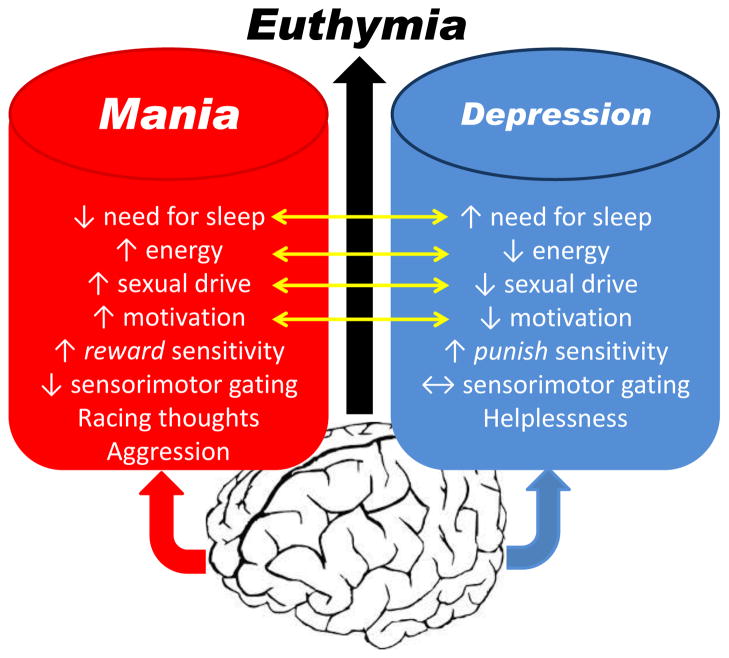
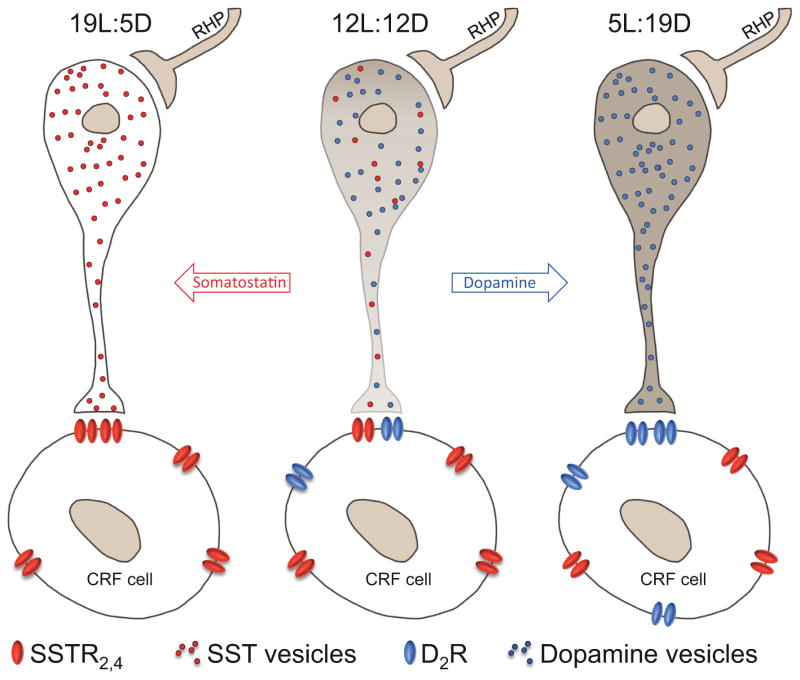
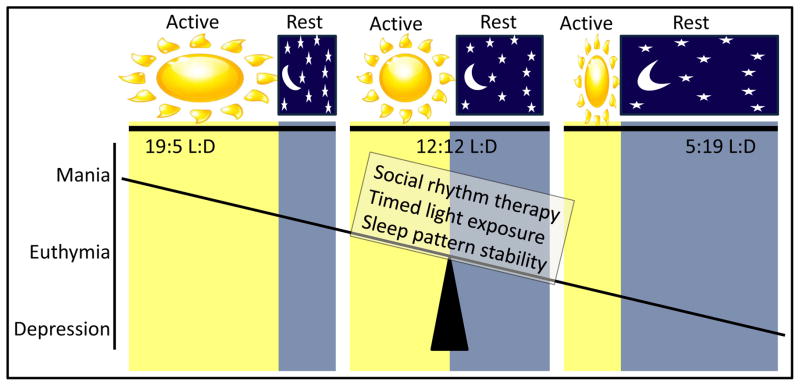
Bipolar disorder (BD) is a unique disorder that transcends domains of function since the same patient can exhibit depression or mania, states with polar opposite mood symptoms. During depression, people feel helplessness, reduced energy, and risk aversion, while with mania behaviors include grandiosity, increased energy, less sleep, and risk preference. The neural mechanism(s) underlying each state are gaining clarity, with catecholaminergic disruption seen during mania, and cholinergic dysfunction during depression. The fact that the same patient cycles/switches between these states is the defining characteristic of BD however. Of greater importance therefore, is the mechanism(s) underlying cycling from one state - and its associated neural changes - to another, considered the 'holy grail' of BD research. Herein, we review studies investigating triggers that induce switching to these states. By identifying such triggers, researchers can study neural mechanisms underlying each state and importantly how such mechanistic changes can occur in the same subject. Current animal models of this switch are also discussed, from submissive- and dominant-behaviors to kindling effects. Focus however, is placed on how seasonal changes can induce manic and depressive states in BD sufferers. Importantly, changing photoperiod lengths can induce local switches in neurotransmitter expression in normal animals, from increased catecholaminergic expression during periods of high activity, to increased somatostatin and corticotrophin releasing factor during periods of low activity. Identifying susceptibilities to this switch would enable the development of targeted animal models. From animal models, targeted treatments could be developed and tested that would minimize the likelihood of switching.
双相情感障碍(BD)是一种独特的疾病,它超越了功能领域,因为同一个患者可能会表现出抑郁或躁狂,这两种状态具有截然相反的情绪症状。在抑郁期间,人们会感到无助、精力下降和风险规避,而在躁狂时,行为包括夸大、精力增加、睡眠减少和风险偏好。每种状态背后的神经机制正在逐渐明晰,躁狂期间可见儿茶酚胺能紊乱,抑郁期间可见胆碱能功能障碍。然而,同一个患者在这些状态之间循环/转换这一事实才是双相情感障碍的决定性特征。因此,更重要的是从一种状态及其相关神经变化转换到另一种状态背后的机制,这被认为是双相情感障碍研究的“圣杯”。在此,我们回顾了研究诱导转换到这些状态的触发因素的研究。通过识别这些触发因素,研究人员可以研究每种状态背后的神经机制,重要的是研究在同一受试者中这种机制变化是如何发生的。本文还讨论了当前这种转换的动物模型,从顺从和主导行为到点燃效应。然而,重点是季节性变化如何在双相情感障碍患者中诱发躁狂和抑郁状态。重要的是,改变光周期长度可以在正常动物中诱导神经递质表达的局部转换,从高活动期儿茶酚胺能表达增加,到低活动期生长抑素和促肾上腺皮质激素释放因子增加。识别这种转换的易感性将有助于开发有针对性的动物模型。从动物模型中,可以开发和测试有针对性的治疗方法,以尽量减少转换的可能性。