Shrestha Dilip, Jenei Attila, Nagy Péter, Vereb György, Szöllősi János
Department of Biophysics and Cell Biology, University of Debrecen, Egyetem tér 1, Nagyerdei Krt. 98, Debrecen 4032, Hungary.
MTA-DE Cell Biology and Signaling Research Group, Faculty of Medicine, University of Debrecen, Egyetem tér 1, Debrecen 4032, Hungary.
Int J Mol Sci. 2015 Mar 25;16(4):6718-56. doi: 10.3390/ijms16046718.
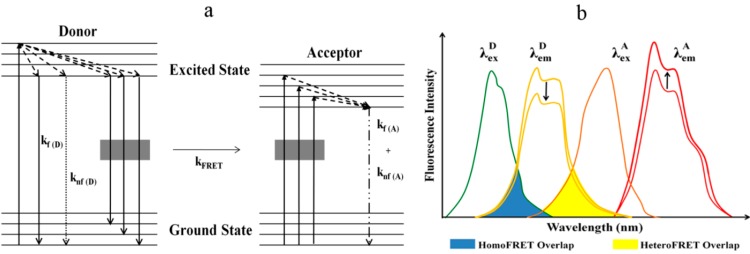
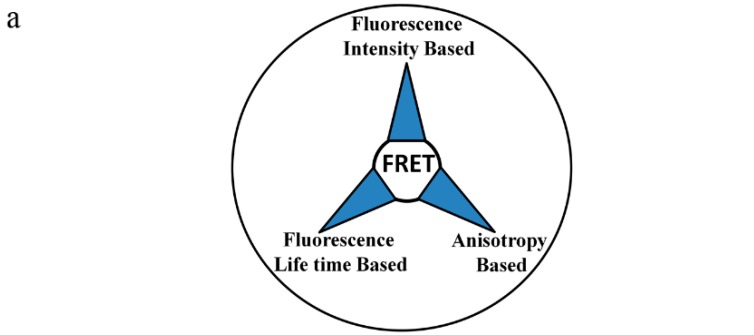
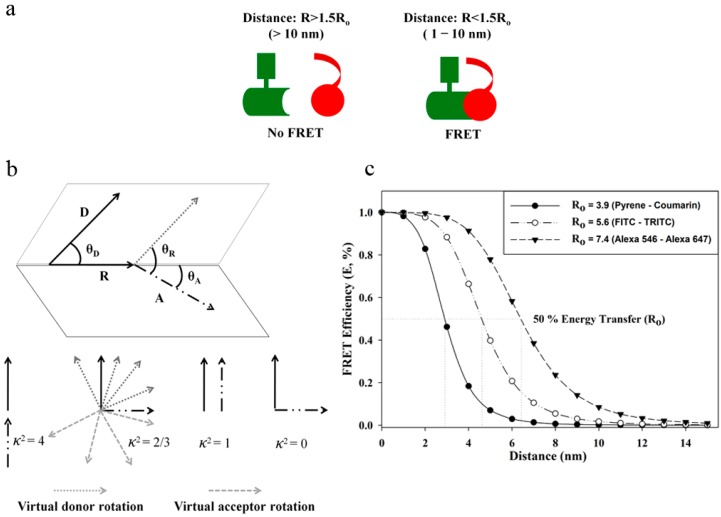
Communication of molecular species through dynamic association and/or dissociation at various cellular sites governs biological functions. Understanding these physiological processes require delineation of molecular events occurring at the level of individual complexes in a living cell. Among the few non-invasive approaches with nanometer resolution are methods based on Förster Resonance Energy Transfer (FRET). FRET is effective at a distance of 1-10 nm which is equivalent to the size of macromolecules, thus providing an unprecedented level of detail on molecular interactions. The emergence of fluorescent proteins and SNAP- and CLIP- tag proteins provided FRET with the capability to monitor changes in a molecular complex in real-time making it possible to establish the functional significance of the studied molecules in a native environment. Now, FRET is widely used in biological sciences, including the field of proteomics, signal transduction, diagnostics and drug development to address questions almost unimaginable with biochemical methods and conventional microscopies. However, the underlying physics of FRET often scares biologists. Therefore, in this review, our goal is to introduce FRET to non-physicists in a lucid manner. We will also discuss our contributions to various FRET methodologies based on microscopy and flow cytometry, while describing its application for determining the molecular heterogeneity of the plasma membrane in various cell types.
分子物种通过在不同细胞位点的动态缔合和/或解离进行的交流调控着生物学功能。要理解这些生理过程,需要描绘活细胞中单个复合物水平上发生的分子事件。基于Förster共振能量转移(FRET)的方法是少数具有纳米分辨率的非侵入性方法之一。FRET在1 - 10纳米的距离内有效,这与大分子的大小相当,从而为分子相互作用提供了前所未有的详细程度。荧光蛋白以及SNAP和CLIP标签蛋白的出现,使FRET能够实时监测分子复合物的变化,从而有可能在天然环境中确定所研究分子的功能意义。现在,FRET广泛应用于生物科学领域,包括蛋白质组学、信号转导、诊断和药物开发等领域,以解决用生化方法和传统显微镜几乎无法想象的问题。然而,FRET的基本物理原理常常让生物学家望而却步。因此,在本综述中,我们的目标是以清晰易懂的方式向非物理学家介绍FRET。我们还将讨论我们在基于显微镜和流式细胞术的各种FRET方法上所做的贡献,同时描述其在确定各种细胞类型中质膜分子异质性方面的应用。