Beydoun May A, Dore Greg A, Canas Jose A, Beydoun Hind A, Zonderman Alan B
National Institute on Aging, NIA/NIH/IRP, Baltimore, Maryland, United States of America.
Pediatric Endocrinology, Diabetes and Metabolism Nemours Children's Clinic, Jacksonville, Florida, United States of America.
PLoS One. 2015 Mar 27;10(3):e0121390. doi: 10.1371/journal.pone.0121390. eCollection 2015.
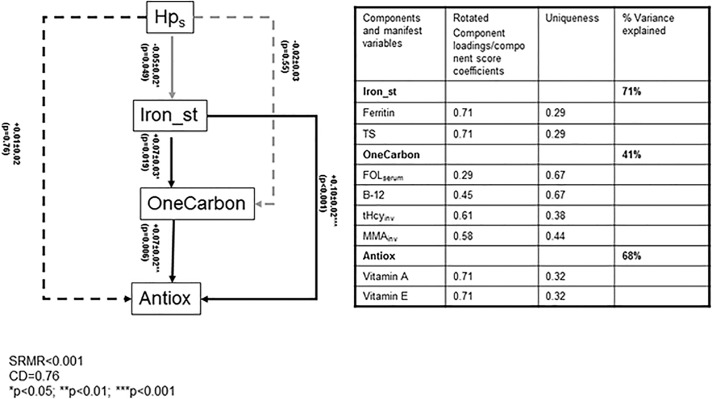
We tested a model in which Helicobacter pylori seropositivity (Hps) predicted iron status, which in turn acted as a predictor for markers of 1-C metabolism that were then allowed to predict antioxidant status.
National Health and Nutrition Examination Surveys (NHANES 1999-2000) cross-sectional data among adults aged 20-85 y were analyzed (n = 3,055). Markers of Hps, iron status (serum ferritin and transferrin saturation (TS)); 1-C metabolism (serum folate (FOLserum), B-12, total homocysteine (tHcy), methylmalonic acid (MMA)) and antioxidant status (vitamins A and E) were entered into a structural equations model (SEM).
Predictors of Hps included older age, lower education and income, racial/ethnic groups (lowest among Non-Hispanic Whites), and lifetime cigarette smoking. SEM modeling indicated that Hps had a direct inverse relationship with iron status (combining serum ferritin and TS) which in turn was positively related to 1-C metabolites (higher serum folate, B-12 or lower tHcy/MMA) that were positively associated with antioxidant status (combining serum vitamins A and E). Another pathway that was found bypassed 1-C metabolites (Hps → Iron_st → Antiox). The sum of all indirect effects from Hps combining both pathways and the other indirect pathways in the model (Hps → Iron_st → OneCarbon; Hps →OneCarbon →Antiox) was estimated at β = -0.006±0.003, p<0.05.
In sum, of the total effect of H. pylori seropositivity on antioxidant status, two significant indirect pathways through Iron status and 1-Carbon metabolites were found. Randomized controlled trials should be conducted to uncover the concomitant causal effect of H. pylori eradication on improving iron status, folate, B-12 and antioxidant status among H. pylori seropositive individuals.
我们测试了一种模型,即幽门螺杆菌血清阳性(Hps)可预测铁状态,而铁状态又可作为一碳代谢标志物的预测指标,进而这些标志物可预测抗氧化状态。
分析了美国国家健康与营养检查调查(1999 - 2000年)中20 - 85岁成年人的横断面数据(n = 3055)。将Hps、铁状态(血清铁蛋白和转铁蛋白饱和度(TS))、一碳代谢(血清叶酸(FOL血清)、维生素B12、总同型半胱氨酸(tHcy)、甲基丙二酸(MMA))和抗氧化状态(维生素A和E)的标志物纳入结构方程模型(SEM)。
Hps的预测因素包括年龄较大、教育程度和收入较低、种族/族裔群体(非西班牙裔白人中最低)以及终生吸烟。结构方程模型表明,Hps与铁状态(结合血清铁蛋白和TS)呈直接负相关,而铁状态又与一碳代谢产物呈正相关(血清叶酸、维生素B12水平较高或tHcy/MMA水平较低),这些代谢产物与抗氧化状态(结合血清维生素A和E)呈正相关。还发现了另一条绕过一碳代谢产物的途径(Hps→铁状态→抗氧化)。模型中Hps通过两条途径以及其他间接途径(Hps→铁状态→一碳;Hps→一碳→抗氧化)产生的所有间接效应之和估计为β = -0.006±0.003,p<0.05。
总之,在幽门螺杆菌血清阳性对抗氧化状态的总体影响中,发现了两条通过铁状态和一碳代谢产物的显著间接途径。应进行随机对照试验,以揭示根除幽门螺杆菌对改善幽门螺杆菌血清阳性个体的铁状态、叶酸、维生素B12和抗氧化状态的伴随因果效应。