
使用包括搜索结果序列的复合蛋白质数据库进行细胞分泌蛋白质组的质谱分析。
Use of composite protein database including search result sequences for mass spectrometric analysis of cell secretome.
作者信息
Shin Jihye, Kim Gamin, Kabir Mohammad Humayun, Park Seong Jun, Lee Seoung Taek, Lee Cheolju
机构信息
Center for Theragnosis, BRI, Korea Institute of Science and Technology, Seoul 136-791, Korea; Department of Biochemistry, College of Life Science and Biotechnology, Yonsei University, Seoul 120-749, Korea.
Center for Theragnosis, BRI, Korea Institute of Science and Technology, Seoul 136-791, Korea; Department of Pathology, Yonsei University College of Medicine, Seoul 120-752, Korea.
出版信息
PLoS One. 2015 Mar 30;10(3):e0121692. doi: 10.1371/journal.pone.0121692. eCollection 2015.
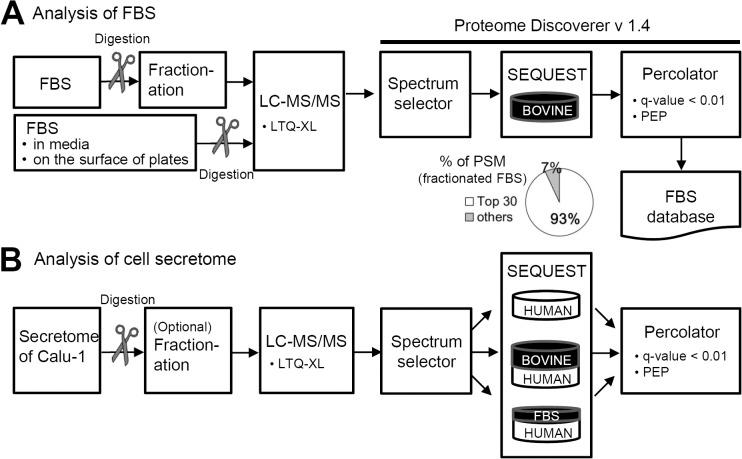
Mass spectrometric (MS) data of human cell secretomes are usually run through the conventional human database for identification. However, the search may result in false identifications due to contamination of the secretome with fetal bovine serum (FBS) proteins. To overcome this challenge, here we provide a composite protein database including human as well as 199 FBS protein sequences for MS data search of human cell secretomes. Searching against the human-FBS database returned more reliable results with fewer false-positive and false-negative identifications compared to using either a human only database or a human-bovine database. Furthermore, the improved results validated our strategy without complex experiments like SILAC. We expect our strategy to improve the accuracy of human secreted protein identification and to also add value for general use.
人类细胞分泌蛋白质组的质谱(MS)数据通常通过传统的人类数据库进行鉴定。然而,由于分泌蛋白质组被胎牛血清(FBS)蛋白污染,搜索可能会导致错误鉴定。为了克服这一挑战,我们在此提供一个复合蛋白质数据库,其中包括人类以及199条FBS蛋白质序列,用于人类细胞分泌蛋白质组的MS数据搜索。与仅使用人类数据库或人类-牛数据库相比,使用人类-FBS数据库进行搜索返回的结果更可靠,假阳性和假阴性鉴定更少。此外,改进后的结果验证了我们的策略,无需像SILAC这样的复杂实验。我们期望我们的策略能够提高人类分泌蛋白鉴定的准确性,并为一般用途增加价值。



 Zotero 插件