Wassermann Marion, Aschenborn Ortwin, Aschenborn Julia, Mackenstedt Ute, Romig Thomas
Parasitology Unit, University of Hohenheim, Emil-Wolff-Str. 34, 70599 Stuttgart, Germany.
Bwabwata Ecological Institute, Susuwe, Zambezi Region, Namibia.
Int J Parasitol Parasites Wildl. 2014 Dec 23;4(1):97-103. doi: 10.1016/j.ijppaw.2014.12.002. eCollection 2015 Apr.
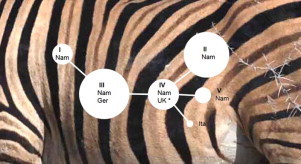
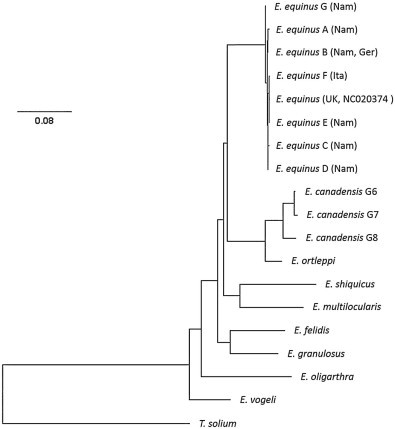
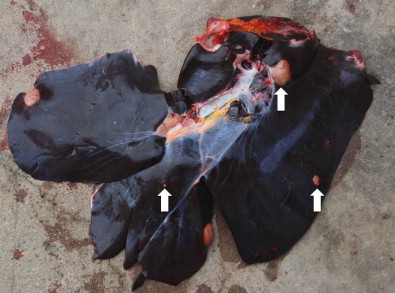
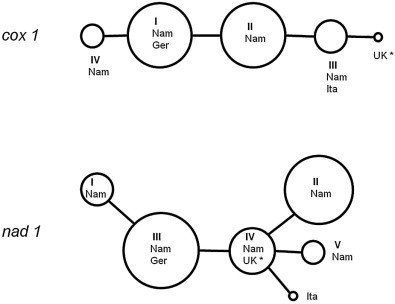
Various species of Echinococcus have been described in the past from wild mammals of sub-Saharan Africa. However, it is only recently, that a few isolates have become available for molecular identification; therefore, the involvement of wildlife in the lifecycles of the various cryptic species within Echinococcus granulosus sensu lato is still only partially known. A preliminary survey was undertaken in Etosha National Park, Namibia, from August to October 2012. Faecal samples were obtained from 34 individual wild carnivores, and metacestodes were collected from carcasses of 18 culled herbivores. Single eggs and metacestode tissue were lysed and identified from sequences of the mitochondrial nad1 gene. In case of metacestodes, the cox1 gene was additionally sequenced and haplotype networks were constructed. Echinococcus equinus was found in lions (4 of 6), black-backed jackals (2 of 7) and Burchell's zebras (11 of 12). The frequency of this parasite in the absence of domestic dogs, horses and donkeys strongly indicates its transmission in a wildlife cycle. Further, a variety of sequences were obtained from eggs and cysticerci from lions, cheetahs, caracals, spotted hyenas and oryx, which most closely clustered with species of Taenia. Only 3 of them, 2 of lion and 1 of hyena origin, could be allocated to Hydatigera (=Taenia) taeniaeformis (lion), Taenia regis (lions and oryx) and Taenia cf. crocutae (spotted hyena and oryx).
过去曾在撒哈拉以南非洲的野生哺乳动物中描述过多种棘球绦虫。然而,直到最近才有少数分离株可用于分子鉴定;因此,野生动物在细粒棘球绦虫复合种内各种隐性物种生命周期中的参与情况仍仅部分为人所知。2012年8月至10月在纳米比亚的埃托沙国家公园进行了一项初步调查。从34只野生食肉动物个体采集粪便样本,并从18只被扑杀的食草动物尸体上收集了囊尾蚴。对单个虫卵和囊尾蚴组织进行裂解,并根据线粒体nad1基因序列进行鉴定。对于囊尾蚴,还对cox1基因进行了测序并构建了单倍型网络。在狮子(6只中的4只)、黑背豺(7只中的2只)和平原斑马(12只中的11只)中发现了马型棘球绦虫。在没有家犬、马和驴的情况下这种寄生虫的出现频率强烈表明其在野生动物循环中的传播。此外,从狮子、猎豹、狞猫、斑鬣狗和大羚羊的虫卵和囊尾蚴中获得了多种序列,这些序列与带绦虫属的物种聚类关系最为密切。其中只有3个,2个来自狮子,1个来自鬣狗,可分别归为泡状带绦虫(狮子)、帝王带绦虫(狮子和大羚羊)和近似猎豹带绦虫(斑鬣狗和大羚羊)。