Baillot Aurélie, Romain Ahmed J, Boisvert-Vigneault Katherine, Audet Mélisa, Baillargeon Jean Patrice, Dionne Isabelle J, Valiquette Louis, Chakra Claire Nour Abou, Avignon Antoine, Langlois Marie-France
Research Center of the Centre hospitalier universitaire de Sherbrooke, Sherbrooke, Quebec, Canada; Department of Medicine, Division of Endocrinology, Université de Sherbrooke, Sherbrooke, Quebec, Canada.
Unit of Nutrition and Diabetes, Department of Endocrinology-Nutrition and Diabetes, University Hospital of Montpellier, Montpellier, France.
PLoS One. 2015 Apr 1;10(4):e0119017. doi: 10.1371/journal.pone.0119017. eCollection 2015.
In class II and III obese individuals, lifestyle intervention is the first step to achieve weight loss and treat obesity-related comorbidities before considering bariatric surgery. A systematic review, meta-analysis, and meta-regression were performed to assess the impact of lifestyle interventions incorporating a physical activity (PA) component on health outcomes of class II and III obese individuals.
An electronic search was conducted in 4 databases (Medline, Scopus, CINAHL and Sportdiscus). Two independent investigators selected original studies assessing the impact of lifestyle interventions with PA components on anthropometric parameters, cardiometabolic risk factors (fat mass, blood pressure, lipid and glucose metabolism), behaviour modification (PA and nutritional changes), and quality of life in adults with body mass index (BMI) ≥ 35 kg/m2. Estimates were pooled using a random-effect model (DerSimonian and Laird method). Heterogeneity between studies was assessed by the Cochran's chi-square test and quantified through an estimation of the I².
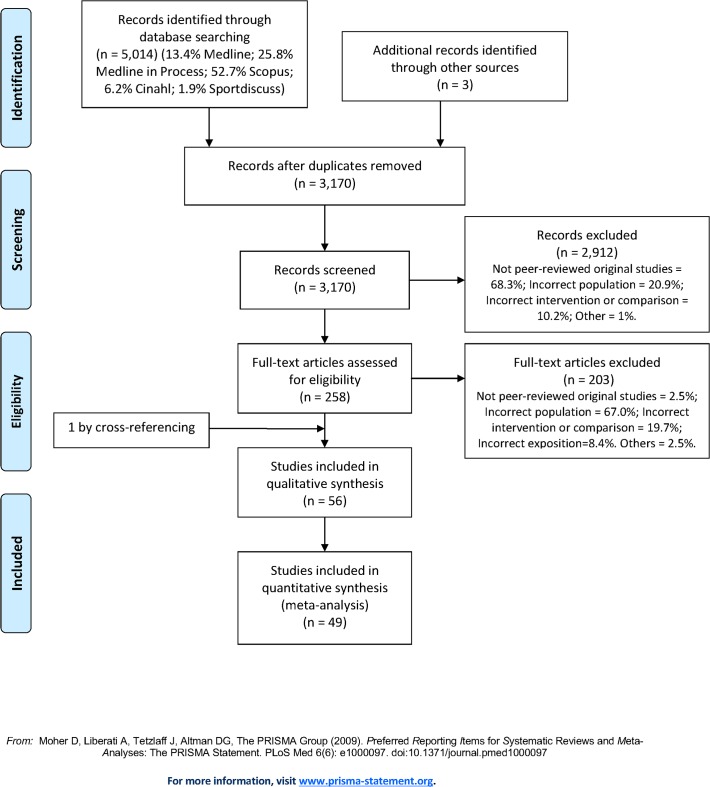
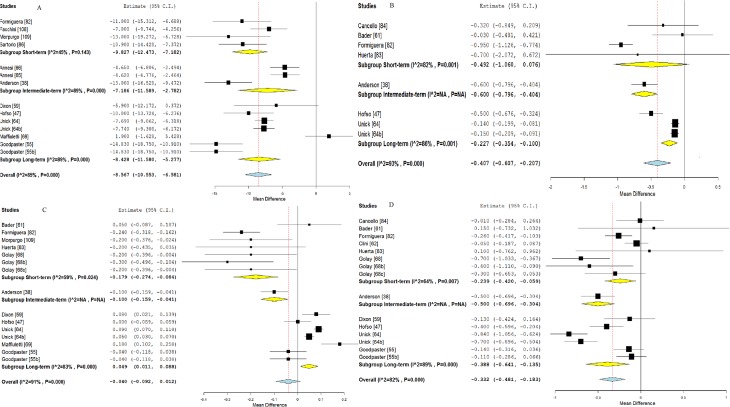
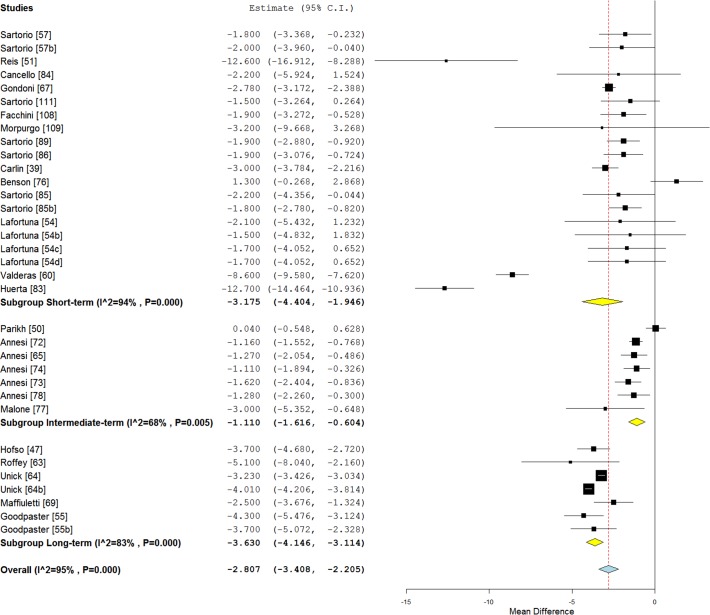
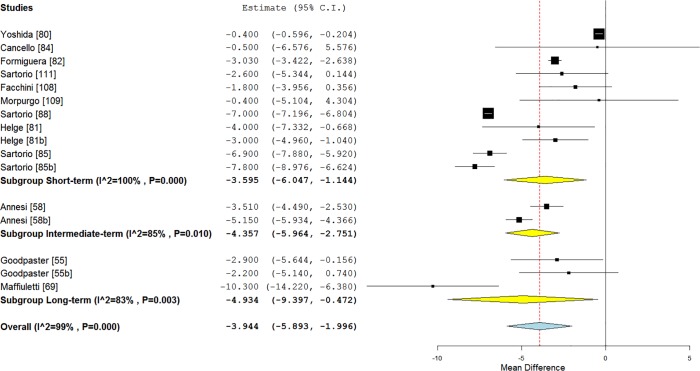
Of the 3,170 identified articles, 56 met our eligibility criteria, with a large majority of uncontrolled studies (80%). The meta-analysis based on uncontrolled studies showed significant heterogeneity among all included studies. The pooled mean difference in weight loss was 8.9 kg (95% CI, 10.2-7.7; p < 0.01) and 2.8 kg/m² in BMI loss (95% CI, 3.4-2.2; p < 0.01). Long-term interventions produced superior weight loss (11.3 kg) compared to short-term (7.2 kg) and intermediate-term (8.0 kg) interventions. A significant global effect of lifestyle intervention on fat mass, waist circumference, blood pressure, total cholesterol, LDL-C, triglycerides and fasting insulin was found (p<0.01), without significant effect on HDL-C and fasting blood glucose.
Lifestyle interventions incorporating a PA component can improve weight and various cardiometabolic risk factors in class II and III obese individuals. However, further high quality trials are needed to confirm this evidence, especially beyond weight loss.
对于II级和III级肥胖个体,在考虑减肥手术之前,生活方式干预是实现体重减轻和治疗肥胖相关合并症的第一步。进行了一项系统评价、荟萃分析和荟萃回归,以评估纳入体育活动(PA)成分的生活方式干预对II级和III级肥胖个体健康结局的影响。
在4个数据库(Medline、Scopus、CINAHL和Sportdiscus)中进行电子检索。两名独立研究人员选择了评估含PA成分的生活方式干预对体重指数(BMI)≥35kg/m²的成年人的人体测量参数、心脏代谢危险因素(脂肪量、血压、脂质和葡萄糖代谢)、行为改变(PA和营养变化)以及生活质量影响的原始研究。采用随机效应模型(DerSimonian和Laird方法)汇总估计值。通过Cochran卡方检验评估研究间的异质性,并通过I²估计进行量化。
在3170篇已识别的文章中,56篇符合我们的纳入标准,其中绝大多数是无对照研究(80%)。基于无对照研究的荟萃分析显示,所有纳入研究之间存在显著异质性。体重减轻的合并平均差异为8.9kg(95%CI,10.2 - 7.7;p<0.01),BMI降低的合并平均差异为2.8kg/m²(95%CI,3.4 - 2.2;p<0.01)。与短期(7.2kg)和中期(8.0kg)干预相比,长期干预产生了更显著的体重减轻(11.3kg)。发现生活方式干预对脂肪量、腰围、血压、总胆固醇、低密度脂蛋白胆固醇、甘油三酯和空腹胰岛素有显著的总体影响(p<0.01),对高密度脂蛋白胆固醇和空腹血糖无显著影响。
纳入PA成分的生活方式干预可改善II级和III级肥胖个体的体重及各种心脏代谢危险因素。然而,需要进一步的高质量试验来证实这一证据,尤其是在体重减轻之外的方面。