Wang Xianfen, Kajiyama Satoshi, Iinuma Hiroki, Hosono Eiji, Oro Shinji, Moriguchi Isamu, Okubo Masashi, Yamada Atsuo
Department of Chemical System Engineering, School of Engineering, The University of Tokyo, Hongo 7-3-1, Bunkyo-ku, Tokyo 113-8656, Japan.
National Institute of Advanced Industrial Science and Technology, Umezono 1-1-1, Tsukuba 305-8568, Japan.
Nat Commun. 2015 Apr 2;6:6544. doi: 10.1038/ncomms7544.
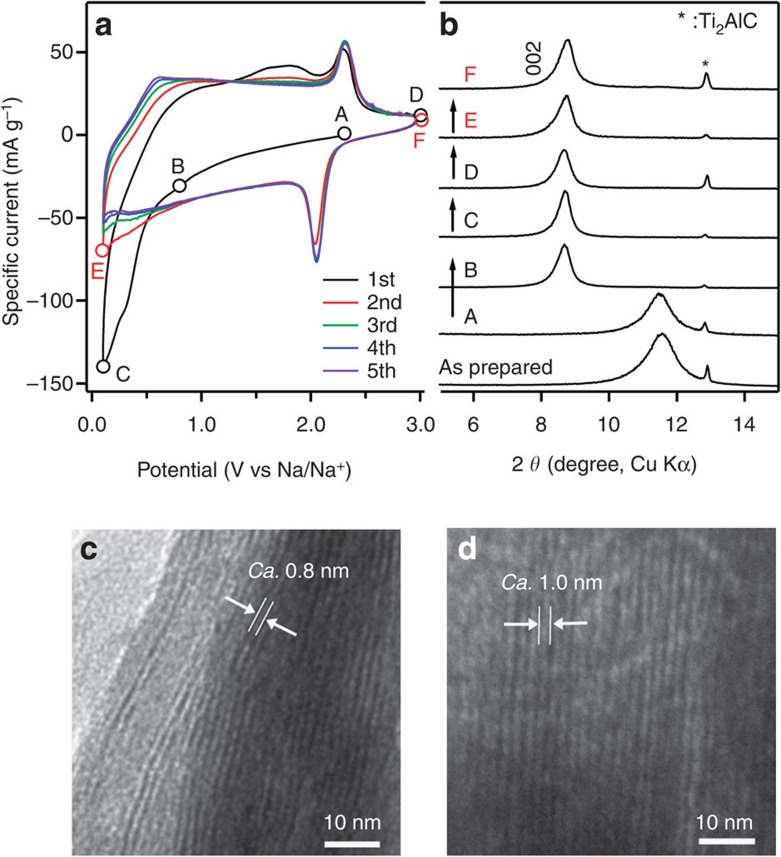
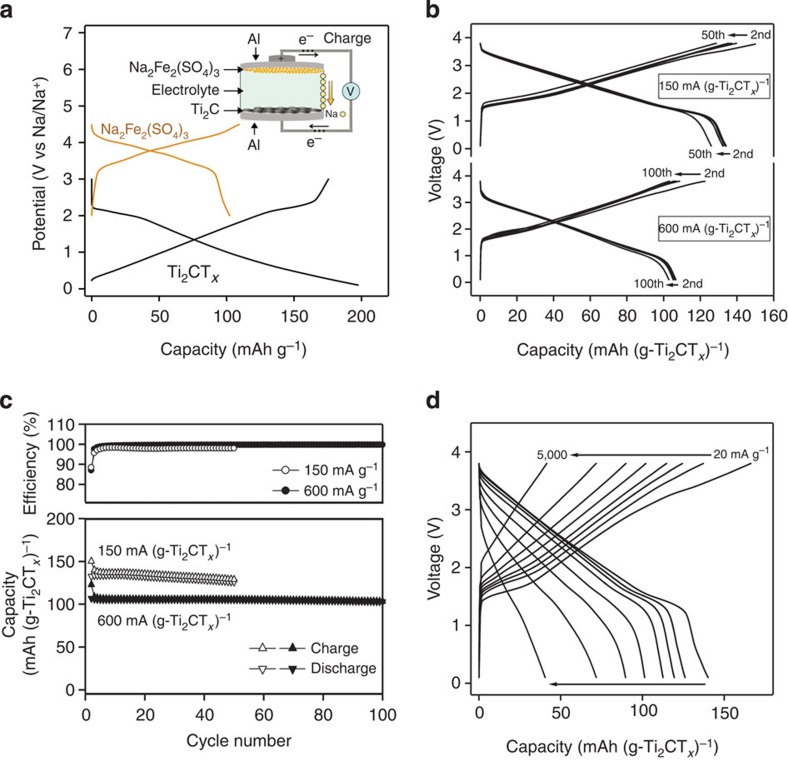
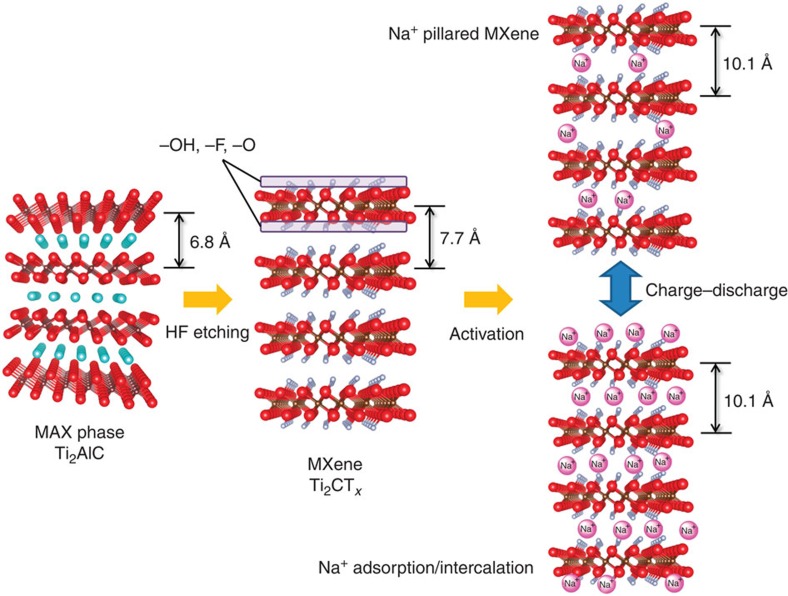
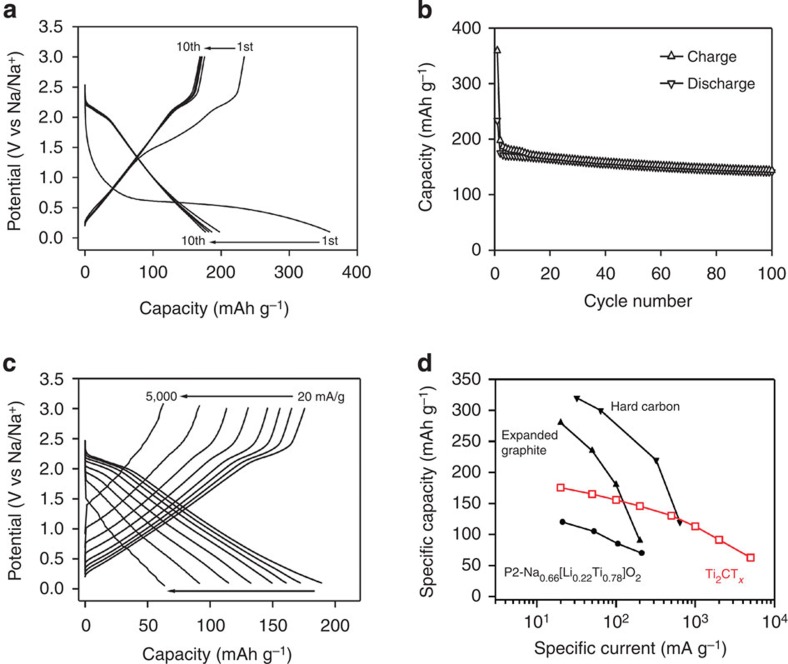
High-power Na-ion batteries have tremendous potential in various large-scale applications. However, conventional charge storage through ion intercalation or double-layer formation cannot satisfy the requirements of such applications owing to the slow kinetics of ion intercalation and the small capacitance of the double layer. The present work demonstrates that the pseudocapacitance of the nanosheet compound MXene Ti2C achieves a higher specific capacity relative to double-layer capacitor electrodes and a higher rate capability relative to ion intercalation electrodes. By utilizing the pseudocapacitance as a negative electrode, the prototype Na-ion full cell consisting of an alluaudite Na2Fe2(SO4)3 positive electrode and an MXene Ti2C negative electrode operates at a relatively high voltage of 2.4 V and delivers 90 and 40 mAh g(-1) at 1.0 and 5.0 A g(-1) (based on the weight of the negative electrode), respectively, which are not attainable by conventional electrochemical energy storage systems.
高能量密度的钠离子电池在各种大规模应用中具有巨大潜力。然而,传统的通过离子嵌入或双电层形成的电荷存储方式,由于离子嵌入动力学缓慢和双电层电容较小,无法满足此类应用的要求。目前的研究表明,纳米片化合物MXene Ti2C的赝电容相对于双电层电容器电极具有更高的比容量,相对于离子嵌入电极具有更高的倍率性能。通过将赝电容用作负极,由钠铁矾Na2Fe2(SO4)3正极和MXene Ti2C负极组成的原型钠离子全电池在相对较高的2.4 V电压下工作,在1.0和5.0 A g(-1)(基于负极重量)时分别提供90和40 mAh g(-1)的容量,这是传统电化学储能系统无法实现的。