Department of Rehabilitation Medicine, Asan Medical Center, University of Ulsan College of Medicine, Seoul, Korea.
J Breast Cancer. 2015 Mar;18(1):87-96. doi: 10.4048/jbc.2015.18.1.87. Epub 2015 Mar 27.
This study examines the effects of a rehabilitation program on quality of life (QoL), cardiopulmonary function, and fatigue in breast cancer patients. The program included aerobic exercises as well as stretching and strengthening exercises.
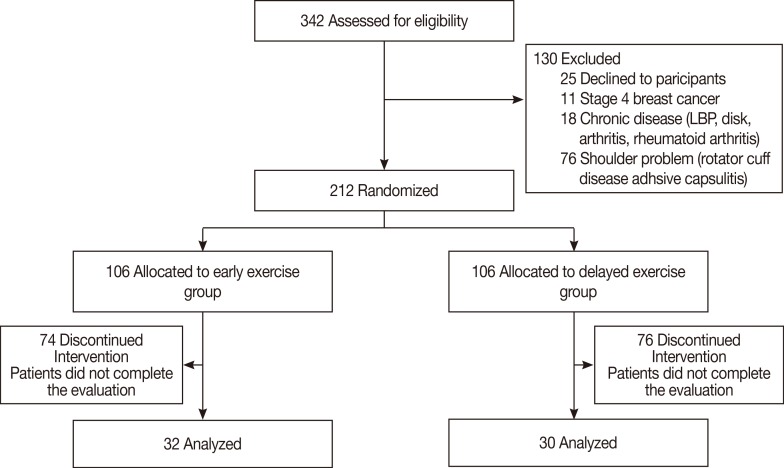
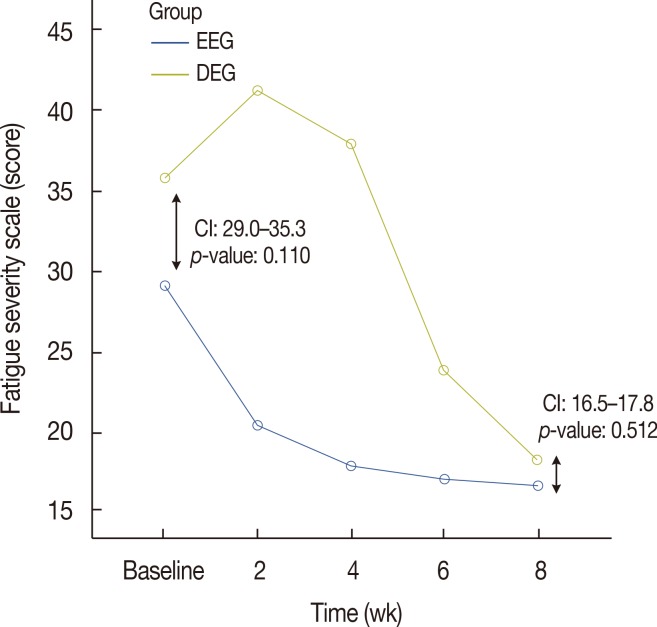
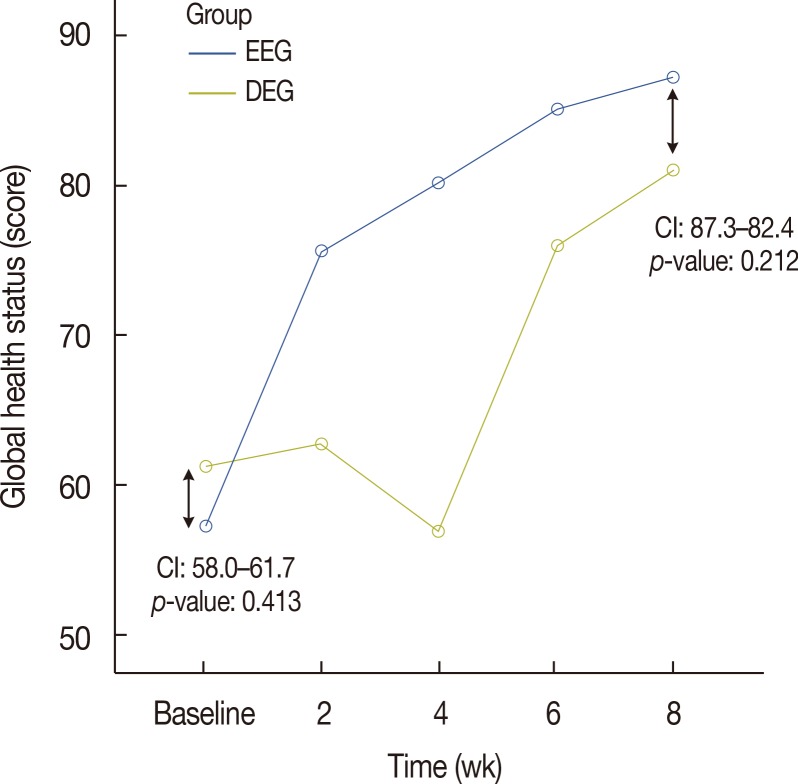
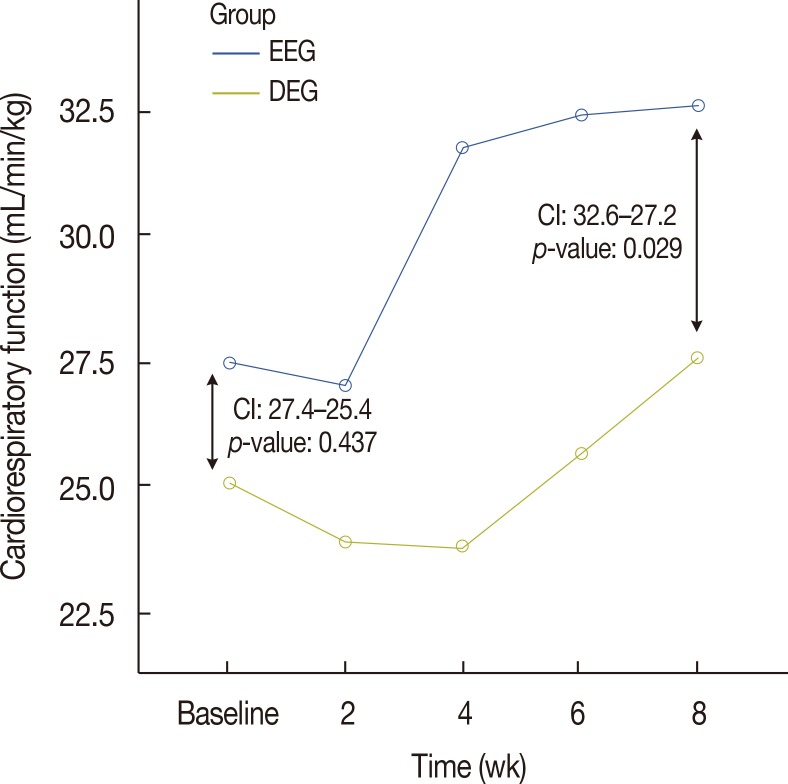
Breast cancer patients (n=62) who had completed chemotherapy were randomly assigned to an early exercise group (EEG; n=32) or a delayed exercise group (DEG; n=30). The EEG underwent 4 weeks of a multimodal rehabilitation program for 80 min/day, 5 times/wk for 4 weeks. The DEG completed the same program during the next 4 weeks. The European Organization for Research and Treatment of Cancer-Core Quality of Life Questionnaire (EORTC QLQ-C30), EORTC Breast Cancer-Specific Quality of Life Questionnaire (EORTC QLQ-BR23), predicted maximal volume of oxygen consumption (VO2max), and fatigue severity scale (FSS) were used for assessment at baseline, and at 2, 4, 6, and 8 weeks.
After 8 weeks, statistically significant differences were apparent in global health, physical, role, and emotional functions, and cancer-related symptoms such as fatigue and pain, nausea, and dyspnea on the EORTC QLQ-C30; cancer-related symptoms involving the arm and breast on the EORTC QLQ-BR23; the predicted VO2max; muscular strength; and FSS (p<0.050), according to time, between the two groups.
The results of our study suggest that a supervised multimodal rehabilitation program may improve the physical symptoms, QoL, and fatigue in patients with breast cancer.
本研究探讨了康复计划对乳腺癌患者生活质量(QoL)、心肺功能和疲劳的影响。该计划包括有氧运动以及伸展和力量训练。
已完成化疗的乳腺癌患者(n=62)被随机分配到早期运动组(EEG;n=32)或延迟运动组(DEG;n=30)。EEG 接受了为期 4 周的多模式康复计划,每天 80 分钟,每周 5 次,持续 4 周。DEG 在接下来的 4 周内完成相同的计划。欧洲癌症研究与治疗组织核心生活质量问卷(EORTC QLQ-C30)、欧洲癌症研究与治疗组织乳腺癌特定生活质量问卷(EORTC QLQ-BR23)、预测最大摄氧量(VO2max)和疲劳严重程度量表(FSS)用于评估基线、第 2、4、6 和 8 周。
8 周后,EORTC QLQ-C30 中全球健康状况、身体、角色和情绪功能以及与癌症相关的症状(如疲劳和疼痛、恶心和呼吸困难)、EORTC QLQ-BR23 中涉及手臂和乳房的癌症相关症状、预测 VO2max、肌肉力量和 FSS 在两组之间均显示出统计学显著差异(p<0.050)。
我们的研究结果表明,监督下的多模式康复计划可能改善乳腺癌患者的身体症状、生活质量和疲劳。